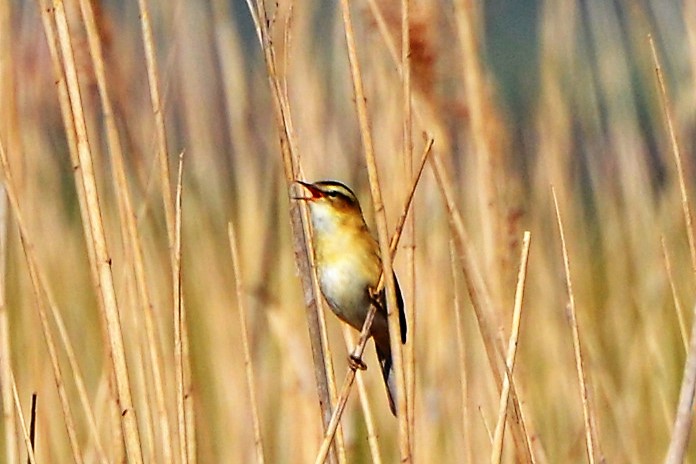
I had never seen a little Hobby bird of prey before. I mean, in the wild of course. I've seen them in books and on TV nature programmes but this was my first up close and real. At first, I thought it was a Merlin, but once home and looked up via the computer, I could see the little fella was indeed, a Hobby.
Scrapbook things on many topics. Retro Brit continues adding blogs. New and growing interest every month.
Thursday, 11 May 2017
Fenland - Bird Hides - Cambridgeshire, England.
![]() |
| Dotty dog Dotty and my wife Carole at Manea bird hides. |
My wife and I decided to take little dotty dog Dotty to the bird hides at Manea today. It was a clear blue day and rather warm. We filled our flask full of coffee and grabbed some nibbles before setting off.
Upon arrival at the River Bedford and the River Delph, which both run parallel to each other, we let Dotty out of the car so she could run her excitement off. Once she had got the pent up energy out of her system we set off across the bridge by the lock gate and walked along the dyke and bridle path that separates the two rivers.
I had my camera and was listening to the various bird song along the way. The rivers reeds were alive with Willow Warblers and Reed Buntings. I was, of course, clicking away with my camera. We walked for a long time surveying all about us.
I saw a Common Buzzard circling over the farmland and tried to get a few shots until RAF Tornados flew over. We passed the first two bird hides and went into the third one and set up our things. We looked out across the Fens once again. The last time we came here with my son Paul, the whole Fen was a giant lake as the River Delph bursts her banks in winter and floods the surrounding pastures.
Now the lake was receded and the fields were back in view. The entire Fen was a lush green where the lake had recently been. The first thing we noticed was a hunting Marsh Harrier gliding low and searching the grassland for the nests of the water birds. The raptor must have found the nest of some Lapwings as these water fowl were constantly try to swoop close and harass the bird of prey. I think it was a desperate effort to protect their nest. The contest went on for some time. The Lapwings would see the Marsh Harrier off, but the big bird would slowly circle the fen and come back low from another direction. I was clicking away with my Nikon D3100 trying to get the best shots possible but it was at some distance.
Carole and I spent an enjoyable couple of hour’s bird watching before deciding to make our way back to the car. That was still another half hour walk for Dotty to stretch her legs a little more.
On the way back we saw a kestrel in the distance and then another come close to it. This other particular bird seemed to be a kestrel too at distance but it did not hover. Instead it was twisting and turning and had a different flight signature altogether. Carol thought it might be a Merlin, but these birds of prey like wooded areas. Then as it got closer we noticed it had a black head. At first, I thought it might be a Peregrine Falcon but it looked too small. Then I realised it might be a Hobby. I managed to get a few great shots of the little raptor as it swooped and twisted in the summer sky. What a smashing little creature it was. Once back home, Carole looked up the Hobby in our British bird’s book and it had all the marks of such. Evidently, the Hobby is a spring and summer visitor each year.
![]() |
| Willow Warbler |
![]() |
| Peacock Butterfly |
![]() |
| Common Buzzard |
![]() |
| Reed Bunting |
![]() |
| Then a couple of RAF Tornados put in an appearance. |
![]() |
| Every time the Marsh Harrier left, it would just circle and come back low. The Lapwings were waiting. |
![]() |
| The air contest lasted for some time. |
![]() |
| The Lapwings would not give up the defence of their nest |
![]() |
| Lapwings |
On the way back, we saw the Hobby swooping, twisting and diving with great ability. At first, I thought it was a Merlin or Peregrine Falcon. However, it was about the size of a kestrel.
![]() |
| Hobby over the Fen |
Wednesday, 10 May 2017
A Pony and Trap in Chatteris
I was doing my usual rounds in the village of Chatteris on Sunday morning. I like the village on Sundays. It is so quite and one can get a lot of work done because almost everyone is still in bed. As I was going about my work a couple of blokes came along the village high streets with their ponies and tarps. I've seen them on many occasions and always meant to get a photo shot. This time I did.
Rummy Things on the Drive out to Bluebell Fishing Lake.
Carole on the grounds of Castle Fotheringhay on a little day out in Northamptonshire. We had a wander around and discovered some rummy things as one does when one least expects too.
It was a place that was very unassuming yet contained many secrets of the past. Richard III was born here and Mary Queen of Scots was beheaded here.
Fotheringhay mound, where once stood Fotheringhay Castle.
Where Richard III was Born and Where Mary Queen of Scots Died - A Little Village Called Fotheringhay
My eldest son, Lloyd and his wife Claire, are planning to come up to Cambridgeshire and do some Carp fishing. They are both keen carp anglers and both regularly appear in national fishing newspapers.
I had to find a place called Bluebell lakes which are just over the county border and into Northamptonshire. Just a few miles west of Peterborough. It was a beautiful sunny day so I decided to find the lake's location before the 26th of May when Lloyd and Claire come up to fish the place. This was a sort of trial run for my son and his wife.
Carole and I set off in the car to find the lake and we did so with comparative ease, stopping at a service station on the way for a coffee and a bite to eat. As we found the lake entrance and were about to leave, Carole noticed a church tower in the distance. It looked rather grand for a church. More like that of an abbey tower. It was just nestled in the distance among the lush green meadows and the trees against the clear blue sky.
We followed the country lane and passed over a small picturesque humpback bridge into a small typical English village called Fotheringhay. It was a tiny little village with a few thatched cottages, but the name meant something to me. There was once a castle here and that flicked a switch. It’s one of those things about England. The place is steeped in history that many of us know and take for granted. Sometimes things of historical significance are right under our noses and we don’t always appreciate the significance of such.
Behind the road where the terraced cottages stood was a rise and upon this was the church that looked like an abbey but for its small size. It looked as though it had been grand in its time but like many places in England, I assumed the Reformation during the time of Henry VIII may have brought about its demise. This is the usual thing about English county abbeys and churches. There are derelict ruins across the country. However, Fotheringhay church was still in use and had a little of the old splendour about it.
Carole and I decided to go inside and look about. I walked through the graveyard to get a good photo shot of the church and noticed that the arched windows to the front were blocked up and had been for some time, while the arched windows along the side were still there.
Once inside the realisation of where I had heard the name blew the cobwebs out of my eyes when I began to read the notices. It was Mary Queen of Scots last prison and the place where she was tried and executed by England’s Elizabeth I for her involvement in the Babington plot. This small unassuming little place with a population of around 100 people had this historical significance. It was also where King Richard III was born too.
As Carole and I wondered about the church an old man with an old dog came in. He had a staff shaped walking stick and he smiled at us knowing we had some interest in the place. He said he was the retired churchwarden of the place and began to tell us the story of how Mary Queen of Scots came to be imprisoned at Fotheringhay Castle which was a little way away from the church grounds. He said the castle was no longer there but the mound and foundation was. It was at this place where Richard III was born and later Mary Queen of Scots would be tried and executed.
He also said the church was only one-third of its original size and pointed to an architectural design of the original church. Where there had been seven arched windows to the side, it now has but three windows on each side. As suspected it was during Henry VIII’s reformation that Fotheringhay church met its demise and was rebuilt and renovated by Queen Elizabeth I in later years.
Two of the queen’s uncles who were buried inside the original chapel were outside in the graveyard after most of the church had been pulled down. The Tudor queen had the bones of both uncles dug up and reburied inside the smaller chapel that remained.
During the last months of Mary Queen of Scots' life, she was made to live in Castle Fotheringhay because Queen Elizabeth I owned the grounds and it was in a very Protestant area of the country. It was also close to Lord Cecil Burghley’s grand house near Stamford. It was two days from London by horse and coach. Close enough should the need for immediate attention be needed from Queen Elizabeth I.
After listening to the churchwarden, we walked out of the church and headed for the old castle mound just outside the village. We found the place and the only incline of Fotheringhay castle was a huge mound with rough grass steps going to the top. I went up there anyway and looked out over the wonderful meadows of English rural countryside. The small area was where Mary Queen of Scots would have been executed back in 1587. I don’t suppose the late queen looked upon the same fields with the same tranquil appreciation I had.
I was looking at a Red Kite circling the meadow below. Forgetting that such a dreadful thing happened here. Also, the baby who would grow to become King Richard III was born here in 1452. This small unassuming village had been host to such significant historical things and no one would even suspect this as my line of vision swept about the panoramic view following the Red Kite and then My gaze stopped at the church tower of Fotheringhay once again. What a remarkable and unassuming little English village this place is.
![]() |
| If you blinked while driving through the village you would miss it altogether. |
![]() |
| The gate entrance to the old church |
![]() |
| The Approach |
![]() |
| Only one-third of the chapel remains today |
![]() |
| Looking up at the church tower |
![]() |
| Fotheringhay is the birthplace of Richard III |
![]() |
| Also the place of Mary Queen of Scots Execution |
![]() |
| Leaving the church and heading for the mound. All that remains of Castle Fotheringhay |
![]() |
| What Castle Fotheringhay looked like in the day. |
![]() |
| Another impression of Fotheringhay Castle. |
![]() |
| Me going up to the top of the mound where once upon a time, King Richard III was born and again, on another time and occasion, Queen Mary of Scotland was Executed. |
Subscribe to:
Posts (Atom)
-
The Shape of Snakes by Minette Walters My rating: 5 of 5 stars This is my favourite Minette Walters story. I could not put the book do...
-
This British lady is famous for her collection of different earrings. For me, its the main thing that stands out in all her delightful...
-
Moyra Melons was very pleased with her new black earrings. She was telling her husband on the phone that she had a really nice pair of...