British Mark IV Female Tank WWI

The Dreadful Deadlock.
By the year of 1917, the Great War in Europe was three years old. Neither side could find an advantage. Trench systems zigzagged from Belgium into France. This wall of dugouts stretched all the way south. Two opposing forces facing one another in a stalemate with a twisted and tortured landscape separating them. The battle line continued to the borders of neutral Switzerland.
France, Belgium and the British Empire had been fighting against Germany. All along this war front, either side had sent men into the pockmarked and defiled landscape to try and push the enemy back. To overwhelm and defeat was the intention of either side as offensive, followed by counteroffensive neutered the dreadful deadlock. Neither armies had won more than a few miles of ground. When a new offensive happened, one nation or another would lose multiple thousands of men again. Perhaps conceding a few miles of ground previously won.
The colossal cost of the bitter struggle saw millions perish. Hordes of men charging across the bomb craters and barbed wire enchantments of No-man’s-land. Some regiments would spend months training fresh troops. These patriotic and idyllic minded men could often be pulverised in a few minutes. Shot to pieces as they tried in vain to cross the quagmire of mud and barbed wire stumbling blocks. And so the deadlock had continued into the late autumn of November 1917.
A Replica Mark IV British Tank of WWI.
A New Plan of Action.
The British had been trying to adapt the tank design for an all-out offensive. They had used such armoured vehicles before in small numbers. They had not been successful. The machines were cumbersome and often broke down. However, there were engineers and designers that persevered with the tank concept. With improved adaptations, some of the inventors realised that the craters, barbed wire walls and various other obstacles of No-man’s-land could be overcome by the giant steel beasts on tracks. A mark IV presentation of the armoured tank was designed. They had been secretly mass produced in a factory in Lincolnshire, England. Most of the workforce were women. These big armoured iron vehicles were comprised of two variants. One was a male tank. These had the revolving cannon on each side of the vehicle. The other type was female. The female tank had forward and back machine guns on either side of the tank. 375 of these tanks were built for a new experimental offensive. An attack that would crash through the barbed wire obstructions and easily traverse the trench systems. Advancing infantry could take cover behind the metal monsters. This was a new innovative idea that had never been tried before. Something that might break the deadlock.
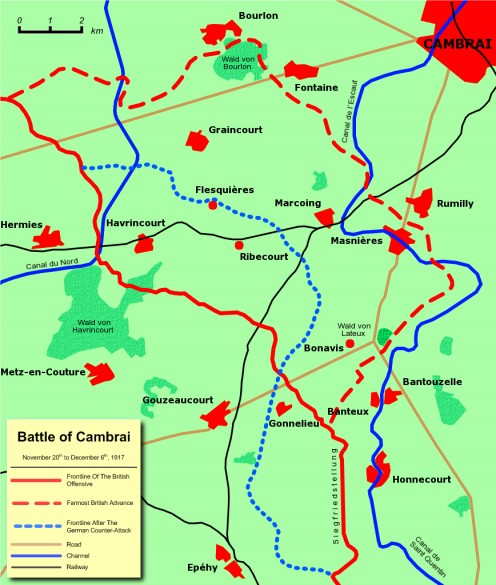
The British high command chose an area along the Hindenburg line. This was a heavily fortified point and had seen little action compared to some parts of the front line. There were tremendous walls of barbed wire fencing and also three lines of German trenches. The particular area of the front line was more heavily fortified than most areas. It may have been a reason why there had been little action in the area compared to the Somme or other places. The ground was hard and this made the area more suitable for the tanks. In secret, the 375 tanks were brought close to front-line positions via train transportation. Everything was done under a cloak of secrecy. The closest major town was Cambrai. This was on the German side of the line. Along an eight-mile stretch of the British line, the British Empire forces assembled their 375 tanks. The assault was scheduled to begin at 06.20 am on the 20th of November. Shortly before the designated time, the first of the mark IV tanks started to roll forward on their screeching tracks, over the uneven earth towards the German positions. It would still be dusk. The morning light was yet to come. The cumbersome looking metal beasts could only move at around four miles an hour, but the uneven landscape was unable to prevent the advance of these newly designed tanks.
Authentic Film of British Mark IV Tanks.
The Metal Monsters Slowly Advance.
At the right moment, the British Empire forces unleashed a horrendous artillery barrage upon the German trenches. The mark IV tanks moved doggedly forward with the bombardment raining down upon the German positions. As the giant steel contraptions smashed through one barbed wire barricade after another, the horrified German soldiers began to panic. Their machine gun fire that had previously scythed through the walls of enemy infantry were of little effect upon the tanks. Some of the German artillery pieces managed to score hits upon the advancing metal monsters, but many of these were taken out in turn by the barrage of enemy artillery fire or the tanks shooting back with forward moving cannon or machine gun fire. Some British tanks were stopped but not enough. The Germans had a tidal wave of iron monsters coming at them. Nothing like this had ever happened before. On this late autumn morning, many of the German soldiers must have thought they were witnessing some sort of apocalyptic event. The steel mechanisms continued to approach ominously. All the while firing cannon and machine guns at their entrenched positions. The tanks ripped through the barbed wire entanglements as though they were nothing but cotton and once upon the trenches, the female tanks with their machine guns would have an evil harvest upon any enemy soldier courageous enough to try and stand.
The German enemy fought hard, but could not immediately frustrate this new type of warfare. At this point of the battle, the British Empire forces were advancing with limited casualties. The offensive had taken the Germans by surprise. However, the speed and ease of the encroachment had also taken the British by surprise. The success had been beyond their expectations. Of the 375 tanks, 179 were put out of action. Most of these were because of breakdowns, but around 60 were destroyed by enemy fire. Some of the metal contrivances advanced too far. They were unable to consolidate the ground they overrun because back up infantry forces were too far behind.
The Area of the Tank Action 20th November 1917.
Deborah the Female Mark IV British Tank.
One British tank crew advanced towards a small village called Flequieres. This small hamlet was French but was on the German side of the lines. The lone British vehicle had briefly lost sight of other advancing British tanks and seemed to be driving rouge. As the crew of the female mark IV tank, named Deborah, went close to the enemy held French village, they experienced a hail of machine gun fire hitting the armoured plating of their tank. The eight men inside had been proceeding under enemy fire and fighting back all day. This situation had persisted for almost five hours. It would have been approaching the afternoon. Their own machine guns returned fire and a brief gun battle ensued. The tank driver, Lance Corporal Marsden, steered the mark IV slowly south of the village. Away from the buildings and back into the torn and smashed landscape of No-man’s-land.
The officer commanding the tank crew was twenty-three-year Second-Lieutenant Frank Gustav Heap. He ordered the crew to stop the tank. They were in No-man’s-land and the rugged mounds of soil may have offered some security. For a few moments the tank crew would take a breather, perhaps get their bearings. The young officer decided to step out and stretch his legs. Maybe urinate while the opportunity was there. Who knows? He had stepped outside the iron contraption for mere seconds and walked a few steps away from the tank into the torn and abandoned backdrop. He was suddenly startled by the impact of an enemy shell smashing into the stationary tank – Deborah. The point of impact left a hole in one side of the tank and exploded inside ripping out a bigger hole on the other side of the vehicle. The young officer had missed death by a matter of seconds.
The tank exploded as more shells hit the stationary frame. The tank driver David Marsden had miraculously survived the impact. He had got up from the driving seat and moved to the back of the vehicle to do some required chore. Somehow he got out of the burning wreckage with one other crew member. The other five crewmen were killed in the violent explosions resulting in the destruction of Deborah – the Mark IV tank.
Second-Lieutenant Frank Gustav Heap, Lance Corporal Marsden and one other unknown tank crew member had to leave their five dead comrades in the burning tank and make their way back towards their own positions. This they managed to accomplish.
Deborah in the Barn Museum.
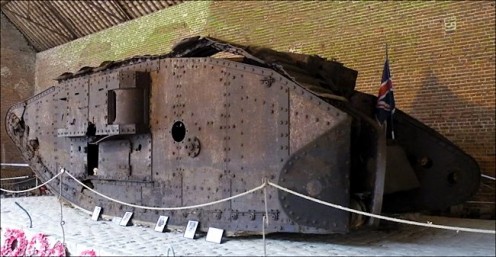
Finding Deborah - The Old Mark IV Tank.
There was a later German counter-offensive and much of the ground overrun by the British tanks was recaptured by the German forces. However, some sections of the advance were held. Including the village of Flequieres. The village was actually on the new front line for a time. The wrecked tank Deborah was found by a group of Scottish soldiers. The five corpses of the British armoured crew were taken from the vehicle. The wreckage was pushed into a trench and used as a gun position according to some. A young French girl living in the village observed this from a distance. Her scrutiny would become very useful in later decades when she was an old lady. For she witnessed the tank as it was being buried.
In 1918, the Great War ended after much horror and more killing on both sides. Twenty years later, there was a second war. The long periods of peace in this part of Europe that followed saw the tortured land return to its normal agricultural splendour. The meadows returned to the former ways of farming and French national prosperity settled upon this farming area. The children knew of the land’s dreadful history and sometimes the young boys would find things from the bygone war in the fields. One such youngster was called Philippe Gorczynski. He developed an interest in the history of the area and became an amateur historian. He acquired a hotel and become a hotelier by trade. One member of the village told him about a British tank buried out in the field. She had seen such an event when she was a child. The lady was the very person mentioned in the previous paragraph.
Philippe Gorczynski searched in vain for six years but could not pinpoint the location of the wrecked British tank named Deborah. He was certain it was there and never doubted the old lady who told the story. Eventually, he hired a private light aircraft to fly over the field. Philippe went up with the pilot and he was able to see things from above with an amateur archaeologists’ eye. With his new and improved aerial opinion, he hired a mechanical digger and got permission from a farmer who owned the field he wanted to dig. At his chosen location, the digger came upon something metal after digging for about two meters. He then called in an archaeology team to help dig out the discovery. In a short time, they were convinced of their find. It was a destroyed female mark IV British tank from the First World War. It was the tank known as Deborah. The very armoured vehicle that Second-Lieutenant Frank Gustav Heap and two of his crew had escaped from back in 1917.
The tank was brought up from its muddy preservation. It was then taken into the village of Flequieres and put on display in a barn come museum. There are photos of the crewman and a general description of how the tank came upon its fate. One of the people that came from Britain to pay homage was Frank Gustav’s Grandson Tim. He was able to elaborate on the story of what happened to Deborah. His Grandfather who escaped from the dreadful ordeal with his two surviving crewmen lived to be sixty-four and died in 1956. Lance Corporal Marsden, the tank driver, lived to be almost 82. The event with the tank happened five days before his thirtieth birthday. He died in 1969. The other survivor remains unknown.
The men that are buried from the tank Deborah are in a cemetery at Flequieres. Their names are as follows; Private W.G. Robinson, Gunner William Galway, Lance Corporal G.C. Foot, Gunner Joseph Cheverton and Gunner F.W. Tipping.
© 2017 colin powell


