Showing posts with label F1 Motor racing. Show all posts

Monday, 4 December 2017

The Knights Are No More - Formula One 1958

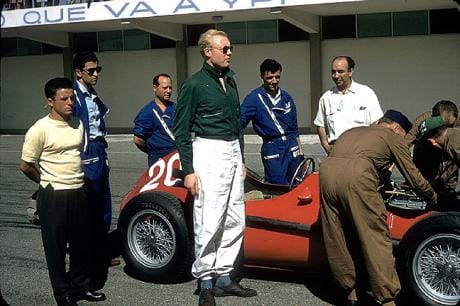
Mike Hawthorn.


The 1958 Formula One Season.

During the 1958 Formula one Championship there were three men who indulged in a tremendous rivalry for the competition’s winning prize money. All three raced for the car designer kingpin named Enzo Ferrari. As most people will know, the Ferrari reputation is legendary around the world for super performance cars. The name is a brand beyond comparison. By the 1950s, Enzo Ferrari had become an entrepreneur. He had founded the Scuderia Ferrari Grand Prix motor racing team. His cars would scream and echo their remarkable quality throughout the oncoming decades.
Enzo Ferrari always needed young men who lived on the edge of life. Glory Hunters and Dream Chasers. These were the calibre of young men who dared to race in the 1950’s decade. There was a wealth of such men to choose from. Risk-takers with a dash of recklessness. Brave show-offs who would race Ferrari’s constantly evolving racing cars. Many young men in the motor racing world would come and go. Some would perish in the fireball of flames and the burnt out wreckage of his super-fast cars.
To the spectator looking in at this world, it has a vivacity of manly glory. But then so does the era of gladiator fighting in ancient Rome. But how many of us would want to participate in such a thing? So too, does heavyweight boxing. I would never get into the ring with anyone. I could never drive such beasts of cars. Yet many of us enjoy watching those that would take a chance on such things.
The adulation of the masses must be intoxicating when the sportsperson wins. While in the background, are the impresarios. The silent kingmakers. Men that will no longer die in the fireball of reckless glory hunting. But men who will profit bit by bit from the enhancing reputation of their evolving dream machines. The little gods will come and go. There will always be a pool to choose from. Enzo Ferrari knew this. He encouraged the dash and rivalry among his racers. It was good for his brand.

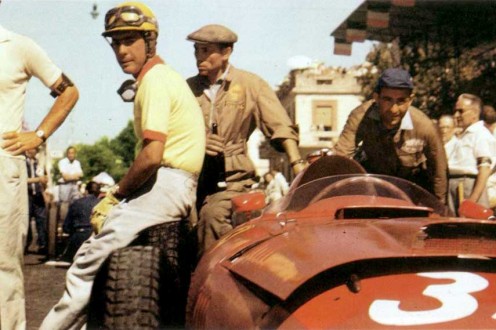
Luigi Musso


Three Rivals Want Glory.

In the 1958 Formula one championship, Ferrari had recruited three glory hunting young men who coveted the grand prize of the championship. Two were Britons. Mike Hawthorn and Peter Collins. The other was Luigi Musso – an Italian man from Rome.
In the 1950s, Formula one had many fatalities. The dead were mounting statistics. The sport was tremendously dangerous. Every year there were multiple fatalities. Big names perished. But some young men will always push themselves to the limit. Just to get a sniff of glory. Some attained the grandeur only to perish at a later date trying to re-fulfil the dream. These were the sort of men that Enzo Ferrari liked to recruit. Some argue that Ferrari’s dream machines were his cars first and foremost. Perhaps the young men that took up the challenge of Formula one motor racing were mere pawns? This risky sport was not for the faint-hearted. The entrepreneur has to have a ruthless streak to be successful. The driver must too. But the driver is below the pecking order against the business mogul.
Young men love the thrill and it is said, that when one reaches a certain limit, a driver enters the zone. A zone where everything becomes sublime for a few moments. A tussle with something ultimately daring. Every racer wants to achieve this. If one is at the head of the pack where the chancers or the glory hunters are; then one is in a zone of fleeting perfection. Cross the finish line in such a state of excellence. Stand upon the podium of performance. Then, for a glorious moment in eternity, that chancer is held in awe. Supreme and glorious veneration.
However, this is just one race win. One must collect the performance points over a serious of races throughout the racing season for the ultimate accolade. A good driver needs to keep this daring venture up for many races to become the Formula One Champion. With such an achievement comes money, glory and adulation beyond belief. The lure of the challenge is like an intoxicating drug for some racers. Many of the reckless men were burnt out living in the fast lane. Yet still, they continued.
Mike Hawthorn had been racing in the Formula One Championship since the early 1950s. He had won many podium places and had finished fourth in other Formula One competitions. He did win the 1955 Le Mans race, though it was amid much controversy when a racer named Pierre Levegh collided with a racing car that had swerved to avoid Mike Hawthorn’s Jaguar. The resulting crash also killed 84 spectators in one of the most horrific crashes of all time. The victory for Mike Hawthorn was bittersweet. He wanted the Formula One Championship and in 1958, he returned to the Ferrari team. He had raced for them before.
Peter Collins was also in the Ferrari team for this championship competition. He was a good friend of Mike Hawthorn and they had an agreement. If either of them won the Formula one competition, they would share the prize money. Peter Collins was a rising star and many expected him to be the first British Formula One champion. He had been in a team with the legendary Juan Manuel Fangio. He had given his car over to the Argentine during the 1956 season. This sacrifice dropped him to third place behind Stirling Moss. However, Fangio (Collins teammate) went on to win the competition because of Peter Collins grand gesture. He married an American actress and moved to a yacht in Monaco. Thus he was able to escape doing national service.
Luigi Musso was a seasoned racer of 33 years. He was the oldest of the three Ferrari racers in this 1958 season. He had gained some important podium places and was also looking good to take an overall Formula one championship. He had been racing for the Maserati team before joining the Ferrari team. Musso owed a great deal of money to creditors. He needed wins and to collect the prize money to pay off such loan men. He had confined such to Peter Collins. In turn, Collins relayed the news to Mike Hawthorn. Perhaps Collins was to attempting to allow Musso in on a third-way share of the prize money. Whatever the reason, Hawthorn refused to help Musso.
Hawthorn needed prize money for a love child. A young lady had borne him a son. He had met the woman in 1953 after winning the French Grand Prix. Maybe, he thought Musso was reckless to get into such financial debt in the first place. It is not known for sure.

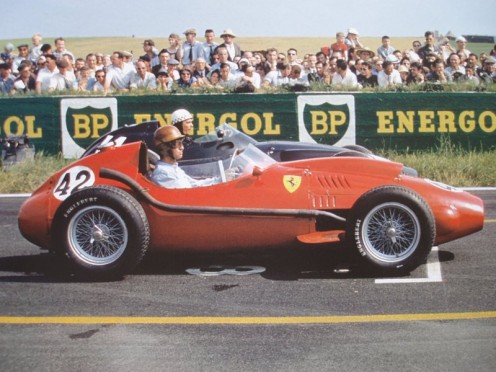
Peter Collins British Grand Prix 1958


Outside the Ferrari Bubble Are Other Glory Hunters.

As the 1958 season progressed, the three Ferrari racers battled between one another. Also, the Vanwall team of Tony Brooks and Sterling Moss were picking up wins. It is hard to work out how the points system works for the 1958 season. This is because Stirling Moss won most first places in the races. Tony Brooks had more wins than Mike Hawthorn too. In fact, Mike Hawthorn only won one race at Reims, the French Grand Prix. If one looks at the wins during the 1958 season, Stirling Moss wins four races, Tony Brooks wins three races and Mike Hawthorn wins one. Yet Mike Hawthorn amassed 42 points against Stirling Moss’ 41 points and Tony Brooks’ 24 points.
At Reims, Luigi Musso tried recklessly to gain on Mike Hawthorn. The rivalry had developed over the competition. On the 10th lap of the 50 lap race, he tried to chase and catch his leading teammate. He took a particular curve at an angle that was too wide. His racing car struck a ditch. His car somersaulted and smashed to pieces. The injured Luigi Musso was pulled from the burning wreckage and airlifted to a hospital. He died of his injuries shortly after.
It was another race where the price of victory was bittersweet for Mike Hawthorn. The French Grand Prix was the largest monetary prize of all the races. Hawthorn would give his part to the lady who had borne him a son. As he and Peter Collins left the hospital in Reims, Mike Hawthorn was deeply affected by his team mate’s death. There was a beer can in the road and he kicked it nonchalantly as he left the hospital. Peter Collins kicked it back. This was seen by the late Luigi Musso’s girlfriend. Her name was Fiamma Breschi and she understandably saw this as a mark of contempt. It was not intended, but this was not a good thing to do in front of a dead friend’s lover. Perhaps they did not think they were being watched. Whatever the reason, the two British racing drivers were forever held in contempt by Fiamma Breschi.
The next race was the British Grand Prix. Here, Peter Collins would win and Mike Hawthorn would come second. Peter Collins victory would be his penultimate race. For he would perish under the same type of circumstances as Musso, at the next Grand Prix in Germany. He was 26 years of age. His teammate Mike Hawthorn retired from the race. He would finish second in the next three races. The steady gathering of points from these overall second positions were enough to clip the championship by one point.
Despite the championship win, Mike Hawthorn had had enough of the Formula One motor racing world. He had seen a lot of good friends die. Death was always a companion for these racing drivers of the age. It would continue to be for the coming decades. Le Mans had been a diabolical triumph for Mike Hawthorn. So had the 1958 Formula one championship. Collins and Musso had perished.
Hawthorn collected his prize and announced his retirement. He had lived through the testing times. Finally, with the coveted achievement, he could leave the sport. It was October 1958. He had endured and survived. Many had not. Enzo Ferrari would find other daring young men.
Tragically, Mike Hawthorn would live for three months after his retirement. He was killed in a car crash driving on a public road. The date was 22nd January 1959. He was believed to have been racing his Jaguar car against a Mercedes that was being driven by Rob Walker. Perhaps a little foolhardy camaraderie with the 'Johnny Walker Whisky' related man. It was a little ironic, to say the least. Luigi Musso’s girlfriend Fiamma Breschi might have thought poetic justice had been served. Who knows for sure?
The great entrepreneur Enzo Ferrari would move on. There would be other names to come. He would live to be 90 years of age. His brand name cars still go on to this day. The sport is less dangerous in this day and age.
But as Jan Struther, a lady famous for her children’s hymn, once wrote; ‘And the knights are no more and the dragons are dead.’

Mike Hawthorn


Mike Hawthorn Shortly Before His Tragic Demise.

One of Mike Hawthorn's Last Speeches.

Just prior to his tragic death, Mike Hawthorn made a small speech. There was a little humour, as one might expect. It gave thanks to all his fans and supporters during his racing career.

Sunday, 29 November 2015

Giving You F1 Legend Jim Clark.

Jim Clark Lotus 1967


This was another ornimental gem that I could not resist. Jim Clark's Lotus stand proudly on the side board. Little nostalgic memories of my boyhood.


From the mind of a seven year old boy

My only memory of Jim Clark, as a young seven year old, was from his prestigious reputation. I did not know what F1 racing meant, but I knew what racing cars looked liked. Racing cars were different from ordinary cars. Even though ordinary cars did race if they had stripes, and numbers painted on them, and were put on racing tracks or in fields. They still were not proper racing cars though.

Real racing cars were different and they went faster and you only saw them on television because they did not drive on streets. I also had hundreds of toy cars and knew what racing cars looked like. I knew the name Jim Clark because he raced such cars. The UK in the 1960s decade was full of names in various and exciting iconic interests. Interests that came to us from pop stars, film stars, football stars, comics of great British war heroes - we were fed on a diet of great heroes.

In school, or somewhere, I knew of Jim Clark. He drove racing cars and won trophies of great prestige because he was a champion racing car driver. I had no idea what he looked like. But when we kids played motor racing cars in the school playground or out on the streets, everyone argued over who was Jim Clark.
"I'm Jim Clark."
"No, I'm Jim Clark."
Needless to say the toughest kid in the group was usually Jim Clark.

It was in the summer of 1968 when I went on holiday with my cousins, who were a little older then me. We were playing in the garden of a guest house, where we were staying, and decided to play racing cars around this huge boat that was being made in the garden. I'm not sure if it was in Margate, Ramsgate or Broadstairs because we always seemed to go to one of these places every year. This boat looked like a miniature ark and someone was in the process of building it. While we were at the guest house; whoever was trying to construct the boat, must have left the project, because we never saw anyone working on the partly completed boat. All the wood was new and I remembered wondering how they would get such a big boat off of its stands and to the sea.

We were running around this partly constructed boat playing and laughing. Then decided we were racing cars, and around the boat was the racing track.

"I'm Jim Clark," I shouted enthusiastically. My elder cousins were very tolerant and not like the kids in the playground and in the street. I had a good chance of being indulged and getting my way.
"You can't," replied my cousin Danny. "Jim Clark is dead."
"No he's not - he's a racing car driver."

He went on to tell me that Jim Clark was killed in a racing car crash, in a real racing car race, only a short time ago. I was stunned and shocked. Jim Clark was dead and I never even knew it, or what he looked like.

As years rolled by and other F1 names came and went from the sport, I learnt more of Jim Clark through watching interviews with Jackie Stewart and Graham Hill. He was a very special champion that was liked and respected in the F1 sport across the world.

Below is a link to a documentary of Jim Clark that is on YouTube. It's a very moving documentary.


Driving Jim Clark's Lotus


Driving Jim Clark's Lotus 25 would be a dream come true for anyone who enjoys formula one and its high octane, fuel injected, excitingly dangerous history. Where the thin line between winning glory and devastating acceleration into the afterlife can happen in the flicker of a blink.

Jim Clark tasted both sides - the euphoric adulation of winning while skimming the danger of death and finally the flip side of the formula one coin. His name now echoes in eternity and the thought of driving one of his actual cars is something close to the legend he has become. I would be too terrified to even contemplate racing in formula one, but to take one on a spin on an empty open track? Oh yes! I think I could manage that.

David Coulthard got to do just that, but then he is one of the many who have tweaked the nose of Formula one danger. I have a Lotus 25 diecast 1:18 of Jim Clark's 1967 Dutch Grand Prix car. It has pride of place in my little office room. I enjoy watching Formula One, but I get this interest in fads. I am going through such a fad of interest at the moment. It will settle down, but its Ron Howard, the late James Hunt and Nikki Lauda's fault.

For now, I'm enjoying going through a retro buzz  and the great Retro Brit names of the 50s and 60s are compelling me to look at the sport. Jim Clark, Mike Hawthorn, Peter Collins, Graham Hill, John Surtees and Jackie Stewart. That fifteen years was a golden age for British Formula One. Great days with only some of the vehicles of some of the ghosts that have left us.


Interview with the Legend


Jim Clark won the Formula One Championship on two occasions. 1963 and 1965. He was killed during a minor none F1 race in Germany 1968. Had he lived beyond his 32 years, I believe he would have undoubtedly gone on to win at least one other championship.

Sunday, 29 March 2015

Chancers and the Compelling, Consuming, Monster of Speed - Isle of Man TT


Formula one motor racing is still exciting to watch though I would say that it has tamed down more since the advent of better safety procedures and protocols. All this is for the better, but somewhere something is lost to the sport's excitement.

I keep asking myself why I prefer to watch the Isle of Man TT as opposed to the Motor Bike Grand Prix of today? The answer is because the Isle of Man TT is more dangerous. Why do I enjoy reading about the past Formula one races in the 50s, 60s, 70s, etc as opposed to the races of today? Again, it was more dangerous back then. 

I'm compelled by the danger of the Isle of Man TT even though I would never possess the dare to indulge such a sport personally. Almost every year, a rider is killed in a high speed crash. 2014 saw two racers killed. I feel great sorrow for the men who pitted their wits and lost, but I can't help thinking there is something inside us all that makes everyone want to be a chancer now and then. It obviously varies in degrees and subject matter. A chancer that can some how narrow the odds by pitting ones self against the elements in a chosen field (of some kind.) A business or industry - perhaps sport, like a dynamic footballer where the prospects of failure can be soul destroying, yet not life threatening. Then there are lone crusaders like boxers and motor racers. (True warriors or gladiators) The level of challenges vary and for some chancers it becomes death defying feats - to run parallel with the threat of oblivion in the mortal world, where defeat is ultimate, or to come out of it victorious and buzzing. 

Usually we do it for some type of adulation or gain - a trophy beyond that of a mere silver shiny cup. Something else like a moment in eternity that one might live off for the rest of his/her life. What drives us to do such things and what compels people like me to get a buzz out of watching the courage and insanity of the riders who try to defy the odds in a contest of speed along roads that twist and turn, go up and down with solid obstacles, like brick walls, at so many turns if not negotiated right?

The TT contest is an absolute beast that devours many people who want to be consumed by the danger and spat out at the other end of the ordeal intact and alive, carrying the dramatic memory forever when they ran parallel with potential and fatal death, yet did not succumb. Some even evolve to try and do so better then any of the other contestants. For many, it is just to watch the chancers as they pit their wits against one another along the circuit of road going around the island.

The Isle of Man is a haven for such dare devils that attracts people from all over the planet. Many come to be consumed by the monster called the Isle of Man TT. Contestants and spectators alike. For a few days the rules are changed and the knights can come out to play their dangerous and sometimes fatal game, while we spectators can watch and enjoy the wake of the high speed buzz. Even become appalled and saddened by those who will fall prey to the consuming monster. We can't help it because we are all compelled by the intoxicating danger. It is a small Haven were the beast remains untamed and gloriously vicious and brutal.


Wednesday, 11 June 2014

On An Island There Is A Celebrated Monster That Devours People

When I was a kid, the only hymn, I liked was: 

When a knight won his spurs, in the stories of old,
He was gentle and brave, he was gallant and bold
With a shield on his arm and a lance in his hand,
For God and for valour he rode through the land.

No charger have I, and no sword by my side,
Yet still to adventure and battle I ride,
Though back into storyland giants have fled,
And the knights are no more and the dragons are dead.

Let faith be my shield and let joy be my steed
'Gainst the dragons of anger, the ogres of greed;
And let me set free with the sword of my youth,
From the castle of darkness, the power of the truth.

This hymn stirred me and made me wonder about all the heroes of the world. Where have they all gone? Well... they have not gone anywhere. It is in us all, but some will explore that to the limit. Many of us do not have that courage or perhaps feel it should not be spent too lightly. There is a huge grey area concerning such things. However, I can't help admiring some of these people who endeavour or fail and at great risk. 


Knights from Around the world battle the compelling monster


Upon our ancient Isles there is a much celebrated monster. This monster devours people and many like to be devoured and spat out again by this monster. Many of us watch excitedly, though most years there seems to be someone that gets devoured for good - a competitor that perishes and leaves our world. These are the road knights that do not come out of the monster. It is that danger that makes the monster the compelling and evocative thing it is. 

It is not among the usual nations of the Isles. Not Ireland, England, Wales or Scotland, but upon a smaller island between Ireland and Britain and in the Irish sea between Liverpool and Belfast. This grand monster devours heroes and heroes go to the island to be devoured by the compelling lure of this monster. Heroes come from all over the world to pit their wits against the monster before spectators that are equally aghast by the dream chasers. Almost every year lives are lost to the monster, yet still we love this sport and celebrate those who pay the ultimate price in pursuit of this compelling quest.

It is, of course, the Isle of Man TT. A motor racing sport that has a circuit around the island and is not confound by formula one racing rules. The Isle of Man TT is unique and beckons to knights from all over our world to come and try their hand. This monster race is a magnet for all the knights and cowboys that still live in our world. Those that would skim the edge of death at high speed motorbike racing, where rules and red tape are kept to a minimum.


For Gary Hubble killed at Isle of Man TT 2014 and all those who have gone before him to the grand monster of the small island of Man.

Saturday, 25 January 2014

Isle Of Man TT Speed Needs of the Chancers


The Isle of Man TT is a Motorbike race like no other. The regulations are less stringent, so the safety aspect is reduced. The race is dangerous, to say the least. The Isle of Man TT is like a Mecca for those with an unyielding need to push themselves to the limit. Sometimes with dire consequences.
Watch the above clip and get an idea of the speed these racers go to and see what can happen with just the merest lapse in concentration.


Tuesday, 21 January 2014

Review of The Limit (Life and Death on the 1961 Grand Prix Circuit) by Michael Cannell


I loved this era of Formula one racing and Le Mans too. The 1950s was one of the most dangerous times during the history of motor racing. This book delves into the life of American F1 hero Phil Hill, German hero Wolfgang Von Trips and car designer Enzo Ferrari who had both the racers on his elite motor racing team. All the other great are featured as well, including Hawthorn, Collins, Ascari etc.

It is buzzing with excitement and eye witness accounts of many fatal crashes, including Le Mans 1955. Old time greats come into this historical account. I honestly could not put this book down. It was a cracking read. If you love the history of Motorsports; you'll love this. I have not enjoyed anything on par for a long time. We see Hill and Von Trips advancing up the rankings of the Ferrari team as those drivers above are killed.
We see the relaxation life of the driving superstars as they go around the world waiting for the next big race and who will be dining and laughing afterwards. These guys are speed gladiators and one of them: Stirling Moss survived all this. This is a real eye opener.

The Limit
Michael Cannell

Thursday, 6 June 2013

Take out the Pit Stop Team and Hang the Blasted Race


A F1 racing driver wallops a few members of his pit team who did not get out of the way quick enough as his vehicle came in for a pit stop. This was during the Brazilian Grand Prix.