Read the epic Dark Age novel Saxon Quest. Set in West Britain during the year 567 AD. Saxon Migration pushes further west across the British Isles. The Christian Romano-Celts decide to make a stand against the pagan English tribes.
Check out crowdspring.com for all sorts of designs. I've put up a project for a book cover to see what type of bids and ideas come forward. Looking forward to see what creative designer ideas are out there.
This is a new cover for the novel; Meeting Boudicca. It is a fictional story of a secret encounter between the Iceni Warrior Queen and Cartimandua of Brigantes. When Boudicca lost her final battle against the Roman Empire she went into the wilderness to take poison and die. Her body was never found.
However, prior to ending her life and leaving the cruel world of Roman Britain, the warrior queen must play one last part in the drama of another British queen of the Brigantes. Her name was Cartimandua. She was everything that Boudicca was not. A friend of Rome.
George Orwell is an enigma to me. A very great one. I just get engrossed in anything he has written. He has the ability to be depressing, defeatist, morose and yet... I can't put down anything he writes. I've never known anyone as compelling as this man.
This is a biographic tale of his soul-searching exploits during the Spanish Civil War. I think this is the pinnacle of his lifetime endeavour and real sacrifice for an alternative way of life via socialism. His personal quest.
This is the journey, through his remarkable life, where I believe he realised equality can't work. Especially when he tried to fight in the anarchist's brigade during this terrible civil war in Spain.
After this came Animal Farm and Nineteen Eighty Four. Orwell's great works of defeatism reigning supreme. They are the final stage through his life's journey of searching and deep thinking. Sometimes via essays, biographical experience or theoretical fiction.
This author is truly brilliant and you can see the development of his thinking if you read his publications in order.
Homage to Catalonia is a very important book - a very important book indeed. I think it marked the turning point of his search. The part where he threw in the towel while searching for a better way. I think he gave up at this point and the two of his greatest works were to follow.
Tom Hunt, the son, of the late James Hunt - British Formula one racer of the seventies decade. Here Tom Hunt talks of memories concerning his late father and the new film called Rush. It concerns the rivalry and friendship between Niki Lauda, the Austrian Formula 1 driver, and James Hunt. Both were in the McLaren racing team of 1976. The movie follows the Formula 1 competition in which Niki Lauda had the horrific crash and then went back to his racing car six weeks later.
It was James Hunt's only Formula 1 championship competition win and follows his flamboyant playboy lifestyle alongside his rivalry and friendship with the dynamic young Austrian driver who won three Formula 1 championship competitions in 1975, 1977 and 1984.
Tom Hunt was only seven when his father, James Hunt, died of a heart attack in 1993 at the age of 45. The film set in 1976 is when James Hunt was in his late twenties, ten years before Tom Hunt was born. The film has had sound reviews and caused great interest from many people, including Niki Lauda who is now 64 and helped director Ron Howard with the film.
As Thomas Plunket fired his dynamic shot most believed he reclined in this manner.
Some say November 1808 and other reports say early January 1809. Well, it was during the Peninsula War and Britain was retreating before the French forces of Napoleon’s army. Sir John Moore was head of the British army at this time before Sir Arthur Wellesley (AKA Duke of Wellington) took over. This was a dire time for Britain and the French were almost routeing many parts of the rapidly retreating British as they made towards a port called A Coruna in Spain.
One body of the British army had maintained discipline and these particular men were of a special rifle brigade of sharpshooters called the 95th Rifles. They wore a green uniform and stood apart from the scarlet jackets of other British foot soldiers. These men carried special Baker rifles that differed from the muskets of the rest of the British army. They were often at the rear guard of the failing forces, trying to buy time for the retreating army. The sharpshooters of the green-jacketed 95th rifles would target the advancing French, trying to halt the enemy advance as best as possible.
The last of Sir John Moore’s British Army, led by Henry Paget (Lord Paget) arrived at a bridge outside a small Spanish village called Cacabelos. These men were the stragglers making for A Coruna. Also by the bridge was a group of the sharp shooter green jackets of 95th rifles. There had been rioting and confusion at Cacabelos and as the order was being restored to guide British soldiers over the bridge, reports were brought before Henry Paget of advancing French Chasseurs – dreaded cavalry units of the French Napoleonic army.
These mounted French forces were led by Brigadier General Auguste Francois – Marie de Colbert – Chabanais – a thirty-one-year-old veteran of many battles, including Egypt, Marengo, Austerlitz and many other campaigns. By all accounts, he was a charismatic heroic young officer that made his way up through the ranks from the start of the French revolutionary wars. On this particular day, he came upon this staggered formation of the retreating British soldiers and managed to capture fifty of them. He saw more British soldiers making for the Bridge and decided to press home his advantage. However, he noted the British positions of defence and decided to form his cavalry in formation for the proper attack.
As Colbert led his mount forward, a shot rang out well beyond the normal range of 200 to 300 meters. The gallant French cavalry officer was struck in the head by the projectile and he fell back upon his mount and slid down onto the snow layered ground. His fellow cavalrymen looked on in shock and bewilderment. All believed General Marie de Colbert to be out of range and in an area of relative safety. All the British soldiers would have assumed so too. All except one 95th rifleman of the British forces. The shot was fired by an Irishman of the 95th called Thomas Plunket. The sharp shooter hit Colbert from beyond the normal range of expected accuracy. As the Irishman began to withdraw and reload his Baker rifle he stopped once more and fired a second shot. He killed another officer riding to aid the already stricken Brigadier General of the French Chasseurs. In one fatal moment, the enigmatic young French officer was no more. The sharp shooter of the British army had dealt a vicious blow to the French cavalry as a minor battle ensued. Around 200 men on either side were killed before the French halted and the British withdrew in the enveloping darkness.
Thomas Plunket's shot was a mind blowing distance of the time.
Some say Thomas Plunket’s shot was around 600m though many rightly challenge that. However, most believe it was in excess of 300m and the Irish sharpshooter performed this task twice killing two high-ranking officers of the French cavalry. This was witnessed by Henry Paget and Sir John Moore from a hilltop overlooking the action. Again, this account is questioned. It seems distance and reality might have been twisted when the story was recounted sometime later. Some accounts say Thomas Plunket advanced to meet the enemy before laying upon his back and steadying the rifle with his foot. This advance could have cut the distance down from some of the exaggerated accounts. However, the undeniable fact is, that Thomas Plunket shot and killed two officers of the French Chasseurs.
Thomas Plunket went through the entire Peninsula War and saw the final victory in that theatre of the campaign under the Duke of Wellington. He would later take part in the Hundred Days War when Napoleon returned from exile on the island of Elba. During the Battle of Waterloo, Thomas Plunket was wounded, but he still survived. He recovered from a wound to the head and was discharged from the army. He was awarded 6d a day pension but re-enlisted back into the army where an officer who knew him, got his pension awarded to one shilling a day and rank of corporal. No one knew exactly the year Thomas Plunket was born in Ireland. It is possible he may not have known this either. He died in Colchester, England in 1851 and is remembered in history for his exceptionally long range shot that killed Brigadier General Auguste Francois – Marie de Colbert- Chabanais of the French Chasseurs. 1. Frenchempire.net http://www.frenchempire.net/biographies/colbert3/
I believe the legend of King Arthur comes from fact - he once existed, but I'm not sure if it was during the Dark Ages because Roman culture Britons would have been literate after four hundred years of speaking Latin. It does not seem feasible that Angle, Saxon, and Jutish kings were known of from the supposedly pagan English times, yet the learned Celtic Britons have no substantial record of the real King Arthur, the Arthur knights, the Arthur sword, Merlin the wizard, and of course the round table. I am no long sure of King Arthur of Cornwall and his queen, Guinevere living during the Dark Ages. After all, these were the ones who could put pen to paper at this time.
I have recently become sceptical of this mass migration of Anglo-Saxon tribes suddenly arriving in Britain when the Romans abandoned the Isle. I have seen documentaries where Saxon sites have been dug up and DNA samples of bones suggest Britons predominantly living in Saxon sites. This throws so many things into confusion and even the evolving of English language, from Frisian or what Dutch people speak.
Some historians of language think it was adopted with heavy British (ancient Welsh) influence. How this was explained was a little beyond me, but there seems to be a general agreement that pagan English tribes were already in the south east of Britain or speaking such a dialect when Rome still ruled. Were these people Christian because by this time Romans and Britons were? Names of Teutonic Gods would suggest that there was a pagan belief, but not the old British Druid system of religion. Therefore this Teutonic religion must have been imported. There are so many unanswered questions especially skeletons of Saxon settlements being mainly Briton in DNA testing.
However, as said previously, much of the DNA is still Celtic British. I wonder if Arthur and his legend were old even during these times - a folk tale back then and perhaps Saxons, Angles and Jutes replaced Romans as the enemy of Arthur's kingdom. I honestly think this mythical king of Celtic Britons was around before, English language or pagan English tribes were in Britain.
Perhaps Angles, Saxons, and Jutes speaking a strange tongue and believing in an un-Christian religion would have found themselves ostracised by Romanised Britons who were literate in Latin. Why write off these people yet not Arthur? I think he would be much more chronicled if he lived in the Dark Ages.
This is the reason I did not mention such a British Celtic King by name in the novel Saxon Quest. I think two cultures clashed in Dark Age Britain, but I can't commit to there being a King Arthur of this time. I believe he goes much further back.
Even if David Cameron loses the next election he will leave the idea of yearning desire for EU withdrawal. This issue will not go away - the die is cast. He can't win concessions from the EU because they simply can't make one rule for the UK and different ones for the other members. This would be unfair.
Big business pro-European newspapers say The UK is on a downward road to EU withdrawal - tremble, tremble. I think it could also be argued that we were on a downward road to European political union, which most Brits never wanted in the first place - yawn, yawn.
It's not that Brits dislike Europe - they want to get along with fellow Europeans, but do not want to be governed by them. The reasons for this are much more simplistic then Banking regulation and human rights law, which the average British voter does not care about. The ruling classes are more angered by such laws, but they do not account for the majority of the voters.
There have been good working laws from Europe too and although Brits were not too keen on the EU, they never really wanted to get up on a soapbox over financial issues concerning bank regulation and all. They often saw good laws brought in by well-meaning yet un-elected people. There was not much interest in big boy politics for Brit political classes and other Euro political classes. Let them squabble and get on with it, while we might sigh with detached amusement over wrong shaped banana stories.
Then the problem concerning European law of free movement of people throughout the EU became apparent when Eastern European countries joined the EU. It has resulted in mass and very irresponsible migration, leaving our country accountable for vast numbers of migrants. One might argue that Spain has vast numbers of Brits living out there, but the reality is, that most of these Brits take wealth out there too. The migrants coming to the UK don't. Like it or not, it is a simple truth and voting people are prejudice - like that or not. They become quite and resentful with no words to argue against trendy liberals who talk them down or smile patronisingly while pretending to listen.
Then one day the EU passes financial laws that stamp on the Brit big boy's toes and all of a sudden, the EU is forcing us into a political union - they have enforced a single currency on nations that can't cope the way one overall powerful nation economy is.
Er... tell the electorate something they don't know, or tell them something they care about. We're a bit more fickle than that, but the two heavyweights (UK political class v EU political class) don't get the picture.
Our Brit ruling classes seem to have said: "Oh dear, never mind let's threaten the EU and tell them to make new laws for us or we'll get the electorate, who are simmering nicely and offer a referendum."
The EU are too financially hamstrung with the currency crisis and the Mediterranean nations that no one realised was cooking the books - hmmm! Also, they can't and will not entertain the grumbling financial institutions of the UK without new legislation. They can't afford too and irresponsible mass migration will blow over. Perhaps it will one day, but not in time for the UK in the EU.
Then the Brit rank and file voter see UKIP has suddenly given the voter a real voice. "Hello, big boys out there - our little issue on mass migration is still very important to us and no one is listening. Your squabble does not matter, we want out anyway."
The EU does not realise they don't have anything we want. They do have this freedom of mass migrations, which we are sure that we don't want and that is all the rank and file voter can see. It's like they are trying to sell us excrement with sugar and our Brit ruling classes are saying; "We will not let you sell them excrement with sugar unless you give us banking and other financial withdrawal rights." Don't bother big boys, we can tell them ourselves and you can run your financial institutions under your laws, but hey, you can't have the benefits of the EU because we don't give a dead rat's backside about it. Oh dear, that wasn't in the script, was it?
The notion of UK leaving the EU is now very real and desirable. I don't think people in Britain are scared of this - many look forward to it, and the key issue is this uncontrollable migration from eastern Europe. This is not what bothers Tories or the political classes. They are more interested in EU regulation upon the city of London and Tory desires for EU withdrawal are based upon this matter of controlling huge corporate finance industries inside the UK. As the political ruling classes go; they can tap into this immigration rank and file frustration for their own ends - large resentful masses of people to use for their own desires, but the notion that we are real people with issues of our own does not seem to have entered the script. Playing politics with people must involve the real important issues at hand and if we are reading from different scripts it is very easy to get wrong. Perhaps the resentful masses are grateful too because now the EU is treading on our big boy's toes, they have found an unwitting and unwilling champion who accidentally opened Pandora's box for us.
David Cameron thought calling the EU's bluff on a referendum would quash UKIP and the notion of the UK leaving the EU. He would force the EU to the negotiating table and then get a better EU deal that he believes the rank and file voters want. It has not and all we see is more excrement with sugar. It just stokes the fire more. It is mostly immigration that the majority of voters are concerned with and they don't care about the other things. The British political classes don't seem to realise this and neither does the EU. They are too busy fighting other battles while this uncontrolled immigration issue is locked away. UKIP will not go away because they keep arguing on this matter at home, where it counts. In the EU Parliament, Nigel Farage can switch into EU issues for his own ends, concerning the failing currency and the un-elected elite. He does not make too much of mass migration in the Euro Parliament because there is a slight danger that someone might have the notion of doing something about it - clever boy Nigel.
The EU is checkmated on Brit desires to withdraw from the EU. (The real rank and file I mean) The Brit political elite feels they may have shot themselves in the foot too because they wrongly believed they might blackmail the EU to make concessions or hoodwink the voters to pretend they are getting them. It has not worked because of UKIP who are screaming "Beware of being hoodwinked."
The political classes are being too closely scrutinised now and we (the real rank and file voters) are aware that the Tories might pretend to get meaningful concessions that they will try to sell the UK voters before the referendum. It'll just be more excrement with sugar. More of what we don't give a hoot about.
Unfortunately for the UK political class and the EU; (both contestants who do not want the UK leaving the Union), The matter has slipped from both grasps. Neither are going to get what they want because they are arguing on issues that do not concern the main electorate.
No matter how the leading political parties dance around this issue or try to play it down; the average voter feels his country is being taken away. All other laws concerning city finance and regulation from the EU don't create too much interest to most voters. Go North, West, East and South across the Isles and the average people are very concerned about mass migration. London is where all the fat cats live and most rank and file voters have little interest in EU regulation, but more in EU law allowing mass population movement across the EU. Every time leading politicians try to play this down it drives people to UKIP. Call people fascist, racist or whatever you may like - they are fed up with being put down on these issues and they can vote and someone has captured the imagination for better or worse.
UKIP
This political party might not have proper leadership policies on the internal welfare of our country, but the play host to such ideas and address the key issues. The mass migration topic is the big hot potato that they are not scared to tackle and other things can go hang for now (even though this might be fickle and wrong in the long run.) People are not racist for this, though we are prejudice, which can't be helped. Also, it is possible that UKIP might also have concrete plans other than such things as uncontrolled migration - who knows? Conservatives or Labour will not win the argument on this, even if they are right because David Cameron has put the cat among the pigeons with the referendum promise.
The opposition Labour party will not voice an opinion either way. If they want to champion EU solidarity, they must start to champion the complete in vote. That would mean nothing on uncontrolled migration and no party is going to be seen doing such a thing. This, of course, seems suicidal at such a moment in time.
On the other hand, what would happen if Europe allowed individual states across Europe to control migration in-house? By this I mean the EU must revise the free movement of people within the Union for now. Make that law across the EU. This is, after all, what is going to cause UK voters to leave the EU. It is why I will vote for UKIP. It will also cause problems in other nations too. Can Germany and France take all these peoples?
The only press that seems to grasp this is the Irish media that looks into the UK from outside. They seem to know what is going on more than our own big newspapers. Britain's political classes seem to be dancing around the hot potato of uncontrolled and very irresponsible mass migration. It has to be tackled. We don't dislike eastern Europeans and many are very friendly people who do work hard, but there are too many coming here and we are fed up with it being played down when we complain.
Even if the Tories lose the next election, which seems very likely, the referendum will not go away. I believe UKIP might get enough votes to prop up a government that would allow one. Unless Cameron stays in office till the election and makes the sacrifice of not joining such an alliance allowing an uncommitted Labour party in power without a promise of an EU referendum. It is possible that our political classes might kick the can further down the road again.
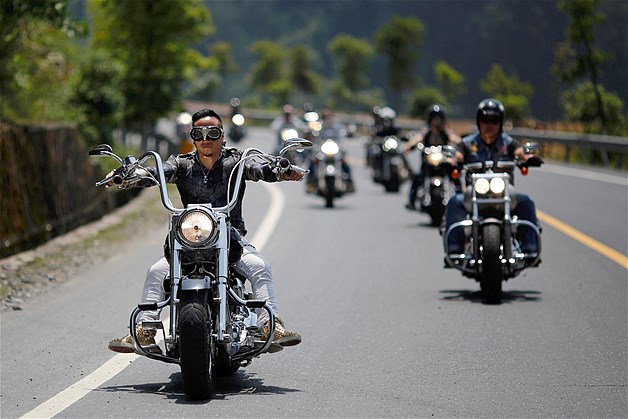
1,000 Harley Davidson enthusiasts gathered in Qian Dao Lake, Zhejiang, China to celebrate the 5th Harley Davidson National Rally, as part of the company’s 110-year anniversary. Harley Davidson motorbikes are considered by Chinese tax authorities to be luxury items, so they are taxed at extremely high rates – sometimes the tax alone is equivalent to the bike’s US price tag. Traffic and transportation authorities have also placed Harley's in the same category as electric bikes, horses and bicycles – they cannot be on highways and major avenues. So, in China, the chance for like-minded Harley enthusiasts to meet and celebrate their love of biking is never missed.
These are some of the world's most famous ancient ruins - as seen from space. Machu Picchu, the Pyramids of Giza and the UK's Stonehenge all appear in the high-flying collection. They were captured by the Ikonos observation satellite, which launched in 1999. Here, the pyramids at Giza in Egypt are pictured.
In May 1943 19 aircraft, crewed by 133 young men, took off on the daring and innovative Dambusters raid.
What is less well known is that the bouncing bombs dropped from those legendary Dambuster raids were tested in a series of secret operations on a Scottish loch.
The tests were carried out on Loch Striven, which is on the Glenstriven estate in Argyll, with locals being evacuated from the area so they would not know what was going on.
Loch Striven was also home to two dormant gas carrying ships, the Nestor and the Gastor, for 14 years. Two Harland and Wolff oil tankers were also laid up in the loch for almost 20 years, while an X-class submarine was lost in the water due to an engine leak in November 1942.
As the nation prepares to mark the 70th anniversary of the raid, a retired fighter pilot has revealed the true extent of the damage the mission caused to Nazi Germany.
Clive Rowley, a former commanding officer of the RAF's prestigious Battle of Britain Memorial Flight (BBMF) turned aviation historian and author, said the military and strategic significance of destroying three dams in the industrial heartland of Germany in 1943 has only just been realised.
The 133 men who went on the mission in 19 aircraft, 56 of whom did not return, were also incredibly courageous and skilful in carrying out the daring low flights, he said.
Operation Chastise, the attack on German dams immortalised by the 1955 film starring Michael Redgrave and Richard Todd, took place 70 years ago on May 16, 1943, during the Second World War.
The mission was launched from RAF Scampton, near Lincoln by 617 Squadron.
At the time it was hailed as an incredible success even with the loss of life, but for decades afterwards its effects were downplayed or even condemned as a waste of resources by a succession of historians.
Now, extensive research carried out by retired Squadron Leader Mr Rowley suggests that the loss of water caused by the dams' destruction had a far greater effect than many realised even at the time - from making firefighters powerless to put out the flames of British incendiary bombs to cutting vital German steel production due to a lack of water for cooling.
The cost of repairing the damage caused by 617 Squadron's raid ran to the equivalent of £5.9 billion in today's money and 7,000 workers who would otherwise have been building the Atlantic Wall to prevent the D-Day landings had to be called away to fix the ruined dams.
It was an economic disaster for the Third Reich that diverted significant resources away from Germany's war effect at a critical point during the conflict.
Four power stations were destroyed, 12 war production factories, about 100 other factories damaged, railway bridges were incapacitated, bridges knocked down, and 3,000 acres of farmland destroyed.
Coal production also dropped by some 20,000 tonnes in the month that followed and steel production by about 180,000 tonnes in the month that followed.
Mr Rowley said: "In that sense it was truly militarily important, strategically important, and I think that more modern research has uncovered that and hasn't been widely recognised until now."
Mr Rowley, who in addition to flying one of the Coningsby-based BBMF's Spitfires and commanding the unit also flew BAC Lightning jets, has published his findings in a new bookazine called Dambusters.
It combines his detailed research with previously unpublished pictures and original artwork to provide a full and unvarnished account of the raid - arguably the most daring mission in the RAF's history.
The timescale in which the raid came about - the Lancaster had only been in squadron service for 17 months, and there was only 56 days from the formation of the squadron to the bombings - was nothing short of amazing, Mr Rowley said.
He went on: "Then you were asking these men, 133 men went on the raid in 19 aircraft, to fly these enormous bombers with 102 foot wingspan at 100 ft, 60 feet on the attack run, in the dark.
"I've spent a lot of my life as a fighter pilot flying around at low level normally at 250 feet in fast jets, sometimes lower, often quite a bit faster than the Dambusters flew, but generally in daylight.
"I can state categorically that the courage, the skill, the tenacity to carry on doing what they were doing - and actually it would appear that they were enjoying the thrill of it -is nothing short of amazing.
"It was a combination of bravery, skill, ingenuity, science, technology, all came together in this one precision raid."
The Dambusters crew would have been fearful, he said, but appeared fearless in order to boost morale among their fellow airmen.
They are also sure to have enjoyed the thrill of low level flying, Mr Rowley added. "To them it was just a job and they just got on and did what they were asked to do and paid an enormous price for it.
"42% of the men that went on the raid did not come home, and they knew that was highly likely, and yet they volunteered for the new squadron, they volunteered for the mission. They wanted to make a difference.
"When it came to the actual getting in the aeroplane and doing it they tended to have a fatalistic attitude. From now on what will be will be.”
Remembering and commemorating the mission, especially with such heavy losses was vital Mr Rowley said, and even more so now to acknowledge the full extent of the effect on Nazi Germany.
He said: "It is important to recognise that it was worthwhile and that the results were worth their death, if anything ever is worth a man's death."
Here is an overview of how the mission came about and how it was executed.
The idea
The plan for the Dambusters raid originated early in the Second World War - some sources cite as early as 1940 - when aeronautical engineer Dr Barnes Wallis, proposing the use of a 10 ton bomb from an altitude of about 40,000 ft on German dams, was forced to re-think as no bomber aircraft was capable at the time of flying at that altitude with such a heavy payload.
He realised a much smaller explosive charge would suffice, if it could be exploded directly against the dam wall below the surface of the water, but the major German reservoir dams were protected by heavy torpedo nets to prevent such an attack.
With a team at Vickers, Wallis designed the 'bouncing bomb', a missile that would skip across the water, hit the dam and roll to the bottom.
It needed to be dropped at the right height, the right speed and the right distance so it would skim for a significant distance over the surface of the water in a series of bounces before reaching the dam wall.
Its residual spin would run the bomb down the side of the dam to its underwater base. Using a hydrostatic fuse, an accurate drop could bypass the dam's defences and enable the bomb to explode against the dam.
March, 1941
Wallis researches, writes and circulates a paper entitled "A Note on the Methods of Attacking the Axis Powers" among military and political circles. The outcome is the formation of the 'Aerial Attacks on Dams Committee' to take his suggestions further.
February 26, 1943
Wallis' idea was put forward to Bomber Command and after several conferences was accepted. While Wallis' team worked to perfect the 'Upkeep' bomb design, Bomber Command assigned the mission to 5 Group.
March, 1943
For the mission, named Operation Chastise, a new unit, 617 Squadron, was formed with 24-year-old Wing Commander Guy Gibson in command and based at RAF Scampton, just north-west of Lincoln.
Even Gibson, a veteran of over 170 bombing and night-fighter missions, did not know the reason behind the formation of this squadron. His task was to mould and train the crew members, volunteers all into a squadron capable of carrying out a difficult single raid.
He was soon to find out what his targets were to be, to divert attention away from the truth. A rumour was started that the aircraft were about to attack the Tirpitz battleship.
The new 617 squadron began training, which was to consist of flying and navigating at zero feet. They then switched to flying over water. This created its own problems for the pilots, who complained they could not judge height over water.
Gibson's men began test runs over reservoirs around England, including the Derwent Valley.
Many problems were encountered, and practice runs at Reculver Bay continued using the test Upkeep bombs. Finally everything came together and a date was set for the full moon on May 16/17.
Only on the eleventh hour did any of the crews find out what the real targets were. They were charged with flying across the English channel, to cross the Netherlands and Germany at zero feet and to drop a bomb on the Ruhr dams.
May 13, 1943
Following their final testing, the Upkeep bombs were delivered, with the goal of Gibson's men conducting the mission four days later.
May 16, 1943
A total of 19 aircraft set out at dark; nine were to attack the Mohne dam, then proceed to the Eder; five were to attack the Sorpe; and five constituted a 'flying reserve'.
Gibson's crews flew at around 100 feet to evade German radar. On the outbound flight Gibson's Formation 1, consisting of nine Lancasters, lost an aircraft en route to the Mohne when it was downed by high tension wires.
Gibson led the attack on the Mohne dam and successfully released his bomb. He was followed by Flight Lieutenant John Hopgood whose bomber was caught in the blast from its bomb and crashed.
To support his pilots, Gibson circled back to draw German flak while the others attacked. Following a successful run by Flight Lieutenant Harold Martin, Squadron Leader Henry Young was able to breach the dam.
With the Mohne Dam broken, Gibson led the flight to Eder where his three remaining aircraft negotiated tricky terrain to score hits on the dam. The dam was finally opened by Pilot Officer Leslie Knight.
While Formation 1 was achieving success, Formation 2 and its reinforcements continued to struggle.
Unlike Mohne and Eder, the Sorpe Dam was earthen rather than masonry. Due to increasing fog and as the dam was undefended, Flight Lieutenant Joseph McCarthy from Formation 2, was able to make 10 runs before releasing his bomb. Scoring a hit, the bomb only damaged the crest of the dam.
Two aircraft from Formation 3 attacked as well, but were unable to inflict substantial damage. The remaining two reserve aircraft were directed to secondary targets at Ennepe and Lister. While Ennepe was unsuccessfully attacked, Lister escaped unharmed as Pilot Officer Warner Ottley was downed en route. Two additional aircraft were lost during the return flight.
Aftermath
Operation Chastise cost 617 Squadron eight aircraft. A total of 53 airmen, who only had 11 weeks from go-ahead for the project to execution, were killed during the raid and three were made prisoners of war.
The successful attacks on the Mohne and Eder dams released 330 million tons of water into the western Ruhr, reducing water production by 75% and flooding large amounts of farmland.
In addition, over 1,600 were killed though many of these were forced labourers from occupied countries and Soviet prisoners of war.
While British planners were pleased with the results, they were not long lasting. By late June, German engineers had fully restored water production and hydroelectric power.
Though the military benefit was fleeting, the success of the raids provided a boost to British morale and aided Prime Minister Winston Churchill in negotiations with the United States and Soviet Union.
For his role in the mission, Gibson was awarded the Victoria Cross while the men of 617 Squadron received a combined five Distinguished Service Orders, ten Distinguished Flying Crosses and four bars, twelve Distinguished Flying Medals, and two Conspicuous Gallantry Medals.
The young men flying the daring Dambusters raid have gone down in history as some of the bravest and most elite airmen.
Their mission took place at a vital time in the war and not only caused a great deal of damage in Germany's industrial heartland, but also lifted morale at home.
The task at hand was almost inconceivable - to fly Lancaster bombers at just 60ft above the ground - incredibly low when compared to the 250ft aircraft must fly at nowadays - in the dark across northern Europe, and successfully deploy bombs on German dams.
Tragically, almost half of the crew members who went on the raid did not return.
Guy Gibson
The name Guy Gibson, the 24-year-old Wing Commander who was placed in command of the crews who were taking part in the mission, has become synonymous with the Dambusters raid.
He was a veteran of over 170 bombing and night-fighter missions and immortalised by Richard Todd in the 1955 film The Dam Busters.
Following the Dams raid Gibson left the squadron but remained in the RAF.
After returning from a trip to America with Winston Churchill he found time to write a book entitled Enemy Coast Ahead, but this was no replacement for flying, and he is said to have continually harassed the Ministry to get back in the air, and eventually succeeded.
On the September 19, 1944 he flew out of Woodhall Spa on a bombing mission flying a Mosquito from 627 squadron.
Having completed the bombing raid Gibson went on to check anti-aircraft positions, but the mosquito tragically crashed and killed both Gibson and his navigator Squadron Leader JB Warwick. Gibson was just 26 when he died.
Leonard Cheshire
Group Captain Leonard Cheshire led RAF No 617 Squadron (or Dambusters) for eight months during the Second World War.
He became one of the youngest commanding officers and the most decorated bomber pilot of the war with the award of the Victoria Cross in 1944.
Cheshire had pioneered a new method of marking enemy targets, flying in at a very low level in the face of strong defences.
In four years of fighting against the bitterest opposition he maintained a standard of outstanding personal achievement, his successful operations being the result of careful planning, brilliant execution and supreme contempt for danger.
For example, on one occasion he flew his P-51 Mustang in slow figures of eight above a target obscured by low cloud, to act as a bomb-aiming mark for his squadron.
Cheshire was, in his day, both the youngest Group Captain in the service and, following his VC, the most decorated.
On his 101st mission, he was official British observer of the nuclear bombing of Nagasaki from The Great Artiste, an event which profoundly changed him.
On his return from the mission he left the RAF and went home to his house, Le Court in Hampshire.
He founded a hospice which grew into the charity Leonard Cheshire Disability and he became known for his work in conflict resolution. He was created Baron Cheshire in 1991 in recognition of his charitable work.
He died in 1992, at the age of 74.
Described by his family as a man of peace and not war, the brilliant and often eccentric engineer Barnes Wallis became synonymous with designing the bomb that almost brought Germany to its knees during the Second World War.
His efforts brought extensive flooding and devastation to dams in the Ruhr but also aided then Prime Minister Winston Churchill in negotiations with the United States and Soviet Union.
His much-celebrated genius, for which he was later knighted, also came with some particular quirks; it is said he used to eat three spoonfuls of porridge and eight prunes for breakfast and always ate cold rice pudding when he got home.
He lived until the grand age of 92, having been born in Ripley, Derbyshire on September 26, 1887.
He was two years old when his parents, Charles Wallis, a doctor, and Edith Ashby, moved him and his three siblings to London.
Wallis was educated at Christ's Hospital in Horsham. He was a natural at maths, English and science, but was said to have been lacking in Latin studies.
By the end of his successful education he had decided that he wanted to be an engineer. Unable to afford university once he had finished school, he started an indentured apprenticeship at the Thames Engineering Works at Blackheath.
He worked on many projects but in 1908 transferred to JS Whites shipyard at Cowes working on Naval destroyers.
While there Wallis blossomed and was promoted to the design office.
In 1912 the young Hartley Blyth Pratt joined the firm from armament firm Vickers and he and Wallis quickly became great friends.
Wallis's work with boats had given him a sound grasp of fluid dynamics and when airship design again became fashionable Pratt was called back to Vickers.
It was only a few months before he called Wallis and arranged for him to join the massive organisation of Vickers as his assistant.
When the Second World War broke out, Wallis was Assistant Chief Designer at Vickers Armstrong Aviation section at Weybridge.
Here, independently of any Air Ministry requirement he spent time investigating how the energy sources of the axis powers (Germany and Italy) might be reduced or eliminated.
Specialist publications provided him with all the necessary background information on the German dams and he formed the opinion that knocking out the water reserves of the Ruhr would curtail steel production severely.
Wallis proceeded to experiment and explore the possibilities and limitations that might surround attacking German dams. What emerged was the 'bouncing bomb' and Dambusters raid.
After the war, he never stopped designing and inventing.
He carried on until he was forced to retire, at the age of 83, and even then did not cease. He is reported to have had ideas for swing-wing planes, such as the Swallow, hypersonic aircraft and other modifications and improvements for the air industry.
He also invented the non-misting, glassless mirror which is made out of unbreakable and non-flammable polyester.
Wallis received a knighthood for his work and service to his country in 1968.
He was also presented with a £10,000 government award which he gave to his old school and made an Honorary Fellow of the Royal Aeronautical Society.
Wallis married Molly Bloxam on St George's Day in 1925. He was 16 years older than her and they were step cousins.
They had four children, Elizabeth, Christopher, Mary and Barnes and also adopted Molly's sister's children when their parents died.
They spent most of their life living in Effingham. Wallis's children soon grew up and had 20 children of their own to create an extensive family.
Wallis died on October 30, 1979, aged 92.
Dambusters - published by Lincolnshire publisher Mortons Media Group, is available online and though WH Smith.