Showing posts with label Dark Ages. Show all posts

Wednesday, 15 May 2013

China's Easy Riders

China's Easy Riders


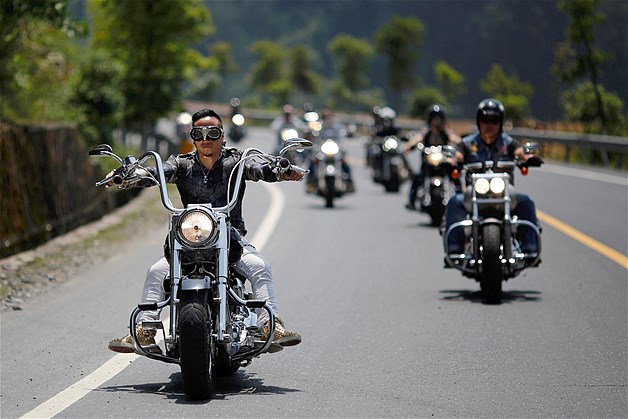
1,000 Harley Davidson enthusiasts gathered in Qian Dao Lake, Zhejiang, China to celebrate the 5th Harley Davidson National Rally, as part of the company’s 110-year anniversary. Harley Davidson motorbikes are considered by Chinese tax authorities to be luxury items, so they are taxed at extremely high rates – sometimes the tax alone is equivalent to the bike’s US price tag. Traffic and transportation authorities have also placed Harley's in the same category as electric bikes, horses and bicycles – they cannot be on highways and major avenues. So, in China, the chance for like-minded Harley enthusiasts to meet and celebrate their love of biking is never missed.

Sunday, 10 March 2013

Sven Hassel 1917 to 2012 - Danish Pulp War Fiction Writer?


When John Wayne died, everyone was shocked. No one thought he would die. For people who read Sven Hassel; well they could be forgiven for thinking likewise. I could not believe Sven Hassel was dead, yet unlike the actor; the Danish writer's fame had a certain anonymity.

Being a Brit and growing up in the sixties, I had a diet of British heroic stands against National Socialist Germany. Our grandparents fought against them, our shops were full of weekly comics that told stories of brave Brit, Canadian, Ozzie or Kiwi soldiers gritting their teeth and confronting the faceless enemy of autonomous entities in jack boots. This faceless enemy seemed so inhuman and unfeeling to me. Then one day, around my friends house, I came across a grubby paperback called SS General by Sven Hassel. The picture was that of a high ranking officer in an open topped car while the steepes of Russia were in flames. I was allowed to have this book and started to read it. I was about twelve or thirteen years of age and got totally sucked in by this group of soldiers like Porta, Tiny, the Old Man and of course Sven watching them. I suddenly realised that the enemy was very human and they too, had a sense of humour and morality as they tried to survive their Hell on Earth in a world gone mad.

Sven Hassel 1917 - 2012

I was shocked to learn that Sven Hassel had passed away aged 95 in Spain on September of 2012. This was with regret because I read so many of his stories in my youth. I thought them graphically compelling. I went from horror to laughter because of Porta and Tiny plus many more of Sven Hassel's wonderful friends.

Sven Hassel as a young soldier

Sven Hassel was a Dane who is believed to have fought in a penal battalion of the German Army during World War II. There is some controversy surrounding such claims and there are people that dispute him being in the Panzer battalions. Some of these people claim he got his notion for stories from veterans who fought upon the Russian Front. Some think he was in a collaborating Danish Nazi police force. There are all sorts of things said and claimed and no one seems to really know for sure. 

Most believe that Sven Hassel joined the German Army in 1937 and tried to go AWOL after a time. He was caught and put into a penal battalion and saw action in many parts of Europe during World War II. He was captured in Berlin in 1945 and interned where he began writing of the war.

From a movie of his book
Wheels of Terror

He wrote a story called Legion of the Damned which won international recognition. After this he began to write more with the same characters in different theatres of the war. After release from internment, Sven Hassel was considering joining the French Foreign Legion, but he met a lady who became his wife and she encouraged him in his writing. They moved to Spain after Sven recovered from a long spell of ill health.

Perhaps he found a winning formula with his  friends from Legion of the Damned because they become much more developed in other stories and we all come to love the same collection of the roguish characters of his books, which were believed to be based on real friends he knew during the war. Again some dispute this, but writers do use people they know, to develop characters in fiction. In Legion of the Damned we go through the war with terrible outcomes for many of Sven's much loved characters. In the other stories; they are set at events between the time of beginning and end of Legion of the Damned.

Indeed, Sven has his friends fighting in so many theatres of war that they could not have gone to all places from Russia to Western Front to Italy. However, his pulp war stories are very good with horror and brutality of war plus fabulous humour of his friends. Sven Hassel is among these soldiers writing in first person singular. He is not the main character but just an observer in the background running about with them most of the time. He also interacts with them, so his stories come across as memoirs.

The formula of writing that Sven Hassel uses makes for excellent reading and one does become immersed with this group of misfit soldiers that try to survive the Hell of a world gone mad. You feel for them and like them despite the wicked and cruel things they must do to survive. They are often governed by ruthless officers and on occasion do not hesitate to eliminate them if they are out in the wilderness. They also make wonderful friends who have tragic demises. The stories are very good and if his friends are real, and I like to believe they are; then I hope they are all living the laughter times somewhere else.


Saturday, 21 July 2012

How Ancient Phoenicians Traded with Primitive Britain Using Bireme Boats to Travel the Seas and Collect Tin

Main areas of Phoenicians
The Phoenicians were a Mediterranean race of seafarers that travelled many seas in search of trade. They were among the first of the great cargo transporters developing complex international trade among the great and emerging civilisations of ancient times. The lands that these people came to occupy during their greatest era was Lebanon (mainly) but also parts of what is today, Israel, Palestine and Syria. The prominent times of the Phoenician sea traders were between 1200 BC and 800BC. After this time, the Phoenicians began to be swallowed up or ruled by other Mediterranean powers, though their seamanship skills were still hailed and used.

In their heydey; the Phoenicians sent out explorers to settle the various area and even went beyond the Mediterranean sea in search of trade. They were known to go along the west coast of Africa, Spain and France. It is also believed that some settled in Ireland too. There is also a strong belief that the Phoenicians began to trade with Britain for tin, which was abundant in Cornwall. Some historians believe that the tin was traded for in the north west of France as a secondary seller, acting for south west Ancient Britain - a sort of middle man. However, if a seafaring race like the Phoenicians know that tin can be got across a channel of water, it is very likely that seafarers would go directly to the source once known. I, therefore, believe that the Phoenicians and probably Israelites travelling with them might have come to Britain and traded for tin.
Phoenician Bireme used to travel across great seas

There are, of course, no written records in existence of Phoenicians visiting Britain because when Carthage fell, to the Roman Empire many of the historical writing of Phoenician explorers was lost in the destruction of the great city, long after the time of the great Phoenician trade routes and explorations.

Imagine what the Phoenicians might have thought of the Celtic Neolithic stones of Gaul, Ireland and Britain - especially Stonehenge, for I believe these Mediterranean traders would have seen such places. But then coming from lands of Pyramids and other great building feats of monumental achievement; perhaps the stones would not have been too amazing to such well travelled people.

I try to visualise the scenes of Ancient Britain through the eyes of a Phoenician sailor or Jewish trader looking for things of interest to buy and sell. The lands of North West Europe would have seemed very lush green and densely forested - a raw untamed view of mystical Celtic Britain via the eyes of a first time visitor.


Sunday, 8 July 2012

The Woodlands in Night (Gothic Music - The Eternal Forest)


Has anyone ever walked through woodland at night? Your mind starts to play tricks on you in strange and wonderful ways. It can be eerie and spiritual too. Your mind can drift a little and you think you've been to the place before in another time and place.

Saturday, 30 June 2012

Tony Robinson Reflects British Taxpayer's Anger About the UK Banks


In the UK, there is a new scandal that has blown up concerning British banks. This threatens to rock the core of the British banking establishment and may cause criminal investigations into unlawful interest rate fixing. The consequences of this will anger the British public who have seen tax payers foot the bill for these failing banks. Above Tony Robinson reflects the angry mood of the British nation in Question Time.

Saturday, 23 June 2012

Britain During the Time of Ancient Druids


Ancient Britons tended to build round dwellings with mud rendering around wicker frames in the south. Further north, Britons would use stone instead, though still in round wall design. The thatched coned roof was also common. They did not use chimneys and would have a fire burning in the middle of the dwelling. The smoke would rise up inside the thatched and cone shaped roof to slowly seep through the straw and out into the open. This stopped birds and insects nesting in the thatch. Sometimes these dwellings were clustered within great hill fort Palisades and had done so for many hundreds, if not thousands of years. The Great Hill Forts were like market towns where people would come to trade farm produce and other manufactured items, like tools. The people were illiterate before the time of the Romans and would have spoken Celtic dialects like that of the Welsh, Cornish or even Bretons of North West France. They had a religious culture based on Druidism, which today is thought of in romantic and mystical ways, though it is possible they did practise human sacrifice on occasions. This adds a more sinister aspect to the druid priests.


In Gaul, today's France, young apprentices were sent to Britain to be schooled in the ways of druids. It must have been done through word of mouth and been a very hands on method of tuition if they were illiterate and they may have had some form of rune carving that meant certain things. This religion was all but vanquished after the first couple of hundred years of Roman rule, and when Christianity came it would have diminished further.

Many of the communities throughout Britain lived in such abodes seen above until the Romans began to build villas and great cities. 

Ronnie Barker - Mispronunciation Comedy


Mispronunciation is always a cause for a giggle, but if you can do it and keep a straight face it becomes so much more laughable. I think British retro comedians explored these things and exploited them wonderfully. We still have fine comedians today, but much is based on cheap and vulgar hits on people, or so it seems. I'm not saying they were not vulgar in the past; but they often used more clever innuendo to soften the blow.

Sunday, 27 May 2012

Am I the Only Pro-Euro Brit?


Is it just me, or am I the only pro Euro Brit? Our best British elected Euro politicians are Euro sceptic, articulate and very clever people. But I can't agree with their solutions to the EU problem; fundementaly pulling the UK out of the EU. What good is that?  All the main critical points raised concerning unelected leaders and economists running the show are correct. I just wish some Brits could sugest ways forward for the UK within the EU. I would like us to get out of the mess as Europeans.


Saturday, 12 May 2012

Dark Gothic Dream Sound


I think this piece and the artwork look and sound great. I hope you enjoy this too, it's Chakra Meditation Music. It makes a morbid graveyard give death a compeling allurment and, dare I say, beauty.

Saturday, 28 April 2012

Shocking Blue - Venus - retro 1969


The late Mariska Veres was from Belgium and here she is in 1969 singing Venus with her band Shocking Blue. The song has been done by other bands since, but Mariska is still my favourite for this particular track. Good old sound of the retro sixties and I'm sure there are many of you out there that can go back and remember these times of a rather rummy decade. Click and enjoy...  :)

Sunday, 8 April 2012

Steeleye Span - Mooncoin Jig


I've always liked this folk jig done by Steelye Span - though I'm sure the jig is much older then this and has been done by many folk musicians prior. It a very jolly rum ditty tune.

Wednesday, 4 April 2012

Prehistoric Monster Snake Once Terrorised This Planet.

titanoboa in display The sheer size of Titanoboa meant it had no trouble devouring prey as large as alligators


 A recently discovered prehistoric monster snake provides answers about the past - and raises questions for the future.

Around 58 million years ago, a monstrous snake slithered out of the swampy jungles of South America and began a reign of terror.

Weighing more than a tonne and measuring 14m (approximately 50ft) the giant reptile could swallow a whole crocodile without showing a bulge. But a few years ago, scientists never even knew it existed.

"Never in your wildest dreams do you expect to find a 14m boa constrictor. The biggest snake today is half that size," says Dr Carlos Jaramillo, a scientist with the Smithsonian Tropical Research Institute and part of the team that made the discovery.

'World of lost reptiles'
 
Thought to be a distant relative of the anaconda and boa constrictor, the snake - named Titanoboa - was not venomous. Instead, it crushed its prey with the constricting force of 400lbs per sq inch - the equivalent of lying under the weight of one and a half times the Brooklyn Bridge.

“Start Quote
Changing climates and changing continents are the fuel of evolution. But things that happen very quickly can result in the types of change we might not view very positively”
End Quote Jonathan Bloch University of Florida

The fossils were exposed by excavation at the massive Cerrejon open-face coal mine in northern Colombia. In 2002, scientists had discovered at that site the remains of a tropical rainforest from the Palaeocene Epoch - perhaps the planet's first.


As well as fossilised leaves and plants, they unearthed reptiles so big they defied imagination.


"What we found was a giant world of lost reptiles - turtles the size of a kitchen table and the biggest crocodiles in the history of fossil records," says Jonathan Bloch, an expert in vertebrate evolution at the University of Florida.


They also found the vertebrae of a colossal snake.


"After the extinction of the dinosaurs, this animal, the Titanoboa, was the largest predator on the surface of the planet for at least 10 million years," says Dr Bloch. "This was a major animal in any sense of the imagination."

Search for skulls
 
But scientists needed the snake's skull to get a full picture of how it looked, what food it ate and how it might be related to modern species. Last year, a team set out to find it, with little expectation of success. Because the bones of a snake's skull are so fragile, few survive.


"Unlike our skulls, snake skulls aren't fused together. Instead they're connected with tissue," says Dr Jason Head, a snake specialist from the University of Nebraska.


"When the animal dies, the connective tissue decomposes and all the individual bones are generally dispersed. They're very thin and fragile too and often get destroyed. Because Titanoboa is so big and the skull bones are so large, it's one of the few snakes that do make it into the fossil record."


To their amazement, the team recovered the remains of three skulls from which the reptile could be accurately reconstructed for the first time.


Giant animals in history

  • Blue whale: still swimming today, blue whales measure 30m (100ft) long
  • Brachiosaur: this dinosaur measured 23m (75ft) long and 12m (40 ft) high
  • Chan's Metastick: this stick insect, native to Borneo, measures 56.7cm, (22.3 in)
  • Pterosaurs - this flying reptile had a wingspan of 5.1 meters (16ft)
Source: US Geological Survey, National Geographic, New Zealand Museum of Natural History

From that, they were able to get a better sense of how Titanoboa lived and looked. A life-sized replica is now on display at the Smithsonian Natural History Museum in Washington, and will begin a nationwide tour in 2013.


Aside from the excitement of discovering a new and enormous species of snake, the reptile can tell scientists a lot about the history of the Earth's climate - and offer a glimpse of the possible effects of global warming today.


Snakes are unable to regulate their own temperature and depend on external heat to survive.


"We think the Titanoboa became this large because it was much warmer on the equator after the dinosaurs died 60 million years ago," says Dr Bloch. "We think that's why reptiles in general were larger.


That ability to thrive in a warm climate could be relevant in the event that global temperatures rise according to the projections of climate scientists, Dr Bloch adds.


"It's evidence that ecosystems can thrive at temperatures of the levels that are being projected over the next one or two hundred years."


Return of Titanoboa?

But the climate changes that produced Titanoboa took millions of years. Scientists are less certain about the effects of sudden temperature change.


"Biology is amazingly adaptable. Changing climates and changing continents are the fuel of evolution. But things that happen very quickly can result in the types of change we might not view very positively," says Dr Bloch.

Excavators sitting outside of a mine
Add caption
The Cerrejon open-face coal mine where the fossils were discovered

As well as being warmer, CO2 levels were also 50% higher during the period of the Cerrejon rainforest.


"One big lesson we are learning from the fossils in Cerrejon is that tropical plants and the ecosystem in general have the ability to cope with high temperatures and high levels of CO2, another major concern with the current trend of global warming," says Dr Jaramillo.


"Perhaps the plants and animals of the tropics today already have the genetic ability to cope with global warming."


Does that mean the Titanoboa could one day return?


"As the temperature increases, you have the probability they will come back," says Dr Jaramillo. "But it takes geological time to develop a new species. It could take a million years - but perhaps they will!"

Sunday, 1 April 2012

Moyra Melons' Commotion Causing Favorite Ear Rings

Once again, Moyra Melons' happily over excited husband came home from work, to be asked for the benefit of his opinion, concerning her new ear rings.

"What do you think of these?" she asked as he walked into the lounge.

For a brief moment, he was taken aback; as one might well imagine. His reply was a little confused at first.

"Think of what?" He babbled as his eyes almost bulged out of his head.

"Do you like what you see? I have to make sure I get it right and create an impression when we go to your works function," Moyra added excitedly. She was rather fond of these particular ear rings.

"Well I certainly think you'll cause a commotion dear," came his startled answer.

Moyra frowned and looked confused. "A commotion? Oh dear, I just wanted to turn a few heads with these."

"Oh, I can guarantee you'll turn a few heads Moyra."

Moyra Melons calmed down a little as she continued. "Well that is fine, but it still does not explain why I would cause a commotion."

"Oh well," replied her husband. "Perhaps I should demonstrate why you would cause a commotion."

"Please do," replied Moyra as her smiling and appreciative husband closed the lounge door.

Afterwards, Moyra wanted to show him the dress she intended to ware because she had an inkling that he might have been confused on certain matters concerning what she would be showing at the works function besides her ear rings.   


Thursday, 29 March 2012

Druid - Medwyn Goodall


This is a very haunting and compelling slice of music from Medwyn Goodall. It makes me drift and imagine Celtic Britain in pre-Roman times. 

Wednesday, 21 March 2012

Roman Emperor Vespasian fought in Britain - Attack at Great Hill Fort (Mai Dun) Britain's Durotriges Tribe

Mai-Dun - Ancient British Great Hill Fort Attacked by Vespasian.

Mai-Dun - Celtic for (Great Hill)
Imagine the inner rampart walled by a wooden palisade
In 43 AD the Roman Invasion of Britain was well underway and led by the Roman Emperor Claudius. There had been a huge raid by Julius Caesar over ninety years prior, but this was mainly to stop a British war chieftain acquiring too much territory in neighbouring Celtic kingdoms and forming a British union of tribes that may have aided Vercingetorix and his Gaul nations.
By 43 AD Emperor Claudius had designs on bringing Britain into the boundaries of the expanding Roman Empire and to this end, he decided to send Roman soldiers to invade the Isle and subjugate Britons to imperial Roman rule. It is fair to say that the Britons had little concept of the might and organisation of the Roman forces and many would learn the hard way as to what mighty Rome was capable of.
To the west of Britain, in today’s county of Dorset, England, UK, the second Roman Legion attacked the British kingdom of the Durotriges. There would have been fighting in many areas of Britain as the Roman conquerors began to systematically take over the lower southern part of the British Isle. This particular campaign was noted because of the siege of Mai Dun Fort, where the Durotriges attempted to secure themselves from the Roman Second Legion, commanded by Vespasian – a man from a noble Roman family who would one day become Emperor during the year of four Emperors in 69 AD. However, this was 43 AD and Vespasian was proving himself as a strong Roman soldier who commanded his men well.
Today Mai Dun Fort is known as Maiden Castle, but its original Celtic name of Mai Dun means ‘Great Hill.’ It was a flourishing centre by the time the Romans arrived and had its beginning back in Bronze Age 1800 BC. For over eighteen hundred years people had come to the great hill fort of Mai-Dun and it went through various stages of progression with earthworks and ramparts being built. It was a huge centre of attraction – perhaps trade and commerce in the form of a market town. Around 450 BC the Celts built more extensive earthworks and the place became a larger more fortified town of dealing among the Britons. It was certainly attractive to the Romans in 43 AD and the Durotriges Britons seemed to have an ill-deserved confidence in their ability to defend Mai Dun against Vespasian and his Second Legion. The Great Hill Fort (Mai-Dun) had a huge palisade that was surrounded by various ditches and ramparts that afforded the defenders a good view of any attacking force. They also had thousands of slinging rocks to propel against the Roman Second Legion.
The defenders came up against advanced Roman ballista siege warfare and were unable withstand the modern engineering of Rome’s more precise technology. A great siege ensued and the Durotriges finally fell to Vespasian’s Second Legion of Roman soldiers. It is believed to have been a fierce and bloody battle with Roman Legions eventually marching upon the fort after heavy ballista bombardment of darts, fire and stone projectiles.
Model impression of Romans attacking British Durotriges at Mai Dun Fort in 43 AD
In the 1930s excavators found several buried bodies of Durotriges defenders that were killed during the siege and one person had an arrowhead embedded in his spine, believed to have been shot from a ballista machine equipped to discharge several darts at a time – like a small magazine of multiple arrows. One might imagine a young Durotriges warrior manning the palisade and being taken out of the action by a scattering of high-velocity darts, one of which strikes the young defender in the back and fatally injures him. Perhaps these buried men were killed during artillery attacks and were then laid to rest before the fort fell. So it may have been that the Great Hillfort (Mai-Dun) held for a few days, at least, while Roman ballista weaponry softened the fortifications before the soldiers attacked.
Arrowhead lodged in spine of stricken Durotriges defender buried at Mai Dun Fort
There may have been a Roman military presence for a short time afterwards and there was a temple erected in the fourth century that fell into ruin, but mainly, the site of Mai Dun became an apocalyptic place as the many people that inhabited the thriving and commercial fort left after the fall to Rome’s Second Legion lead by future emperor to be; Vespasian. It became a lonely place of abandoned ramparts and remains so to this day.


Sunday, 11 March 2012

Nic Jones - The Bonny Bunch of Roses


This song called; The Bonny Bunch of Roses is about Napoleon and his invasion of Russia in 1812 and Britain's stand against him. I always liked the lyrics on this and it starts of with young Napoleon talking to his mother about conquering Britain. Young Napoleon is either the grandson or son of Bonaparte. It is a song that 'bigs' itself up, but then we all like these type of things some time or other. This rendition is sung by Nic Jones but there are others that sometimes sing this song too. Fairport Convention being one of them. Hope you enjoy this version.

Monday, 6 February 2012

Silly Sisters - My Husband's Got No Courage in Him


Maddy Prior and June Tabor did this wonderful folk album and the above track; 'My Husbands Got No Courage in Him,' refers to the lack of lead in the said husband's pencil. In this particular case; his penis. This info is for people not of Brit persuasion who might not understand. It means he is not sexually capable of pleasing his wife. It is a comical song and would have probably been more for the ale houses of the time or at a village gathering when all were inebriated and being frivolous and naughty. 


Tuesday, 17 January 2012

Lindisfarne - Lady Eleanor


I've always loved this song by Lindisfarne. It takes me back and all sorts of retro Brit memories flood my mind. It brings reminiscences of prior 'coming of age' years.'


Spider Web Silk farmed from Goats - strongest substance mass produced.


Just outside of the city of Montreal in Canada, there has been an amazing breakthrough to produce spider web silk in large quantities. Spider web silk is an extremely strong fibre and could be used if large quantities could be produced. One would need millions of tiny spiders to produce the needed silk in large quantities and if millions of tiny spiders were kept in close proximity on a farm, they would fight and kill each other fighting for territory. In short, it could not be done.

Scientist have come up with an idea to genetically use goats to mass produce the fibre in large quantities while producing milk. The spider silk is cultivated out of goats milk. This has become possible by adding a spider gene that produces spider silk with the goats milk. One goat can produce silk in large quantities and herds of such goats can produce even greater amounts. This amazing breakthrough is mind blowing and the possibilities of this strong fibre are endless.