I forgot I had this photo on my phone. It was taken back in August on a rather hot day. Carole and I took Granddaughters, Millie and Rosie to the bird hides. We passed the rickety old cottage along the way and I thought it a good excuse to take a photoshoot on the mobile.
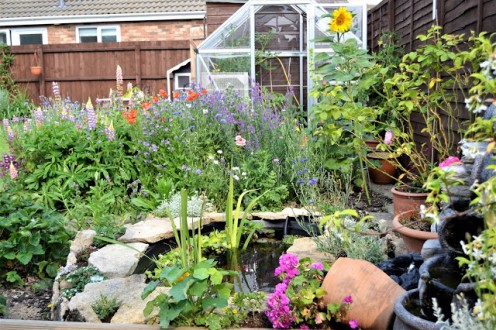
We bought a new and bigger pond liner a few weeks back. Then we decided to dig deeper and widen the pond. We took all of the fish out and put them in a big black bathtub. My step-son Graham went on a mammoth digging mission. The surplus earth was displaced around the fence perimeters and more rock wall for the plant boundary etc. This I did with the wheelbarrow as graham filled it with soil.
Eventually, we were able to lay the new pond liner refill and then put the fish back in their new home. Graham went and bought two new Ghost Carp adding to the nineteen fish we already had. We sat down and decided that next year, we'll get a mini digger and some railway sleepers and make the pond double the size it is now. That way the Koi, Ghost and Israeli Carp will grow even bigger.
The frogs and newts have come back within days. They seem to approve. My wife and I move the small table and chairs and stare down at the fish. It is becoming rather therapeutic.
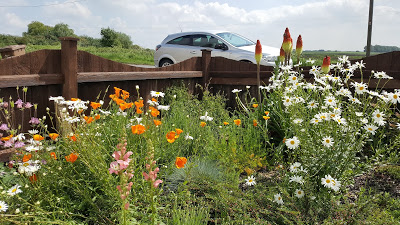
The village of Benwick in the Fenland of Cambridgeshire. I rumble out to this place every other day via Chatteris, where I work most times. Benwick is a rather small village. If you blinked while driving through, you could miss it entirely. As one can see from the photos. The wildflowers along the bank, look very special as I drive into the little village. There are a few bins to empty and then I go to the village shop for a can of drink and maybe a chocolate bar. I can't help liking the mad and undisciplined array of flowers. There are many clusters about areas of various riverbanks too. This little one is outside of someone's corner house. On the owner's side of the fence and the outside too. It is a joy going to work in the Fenland during the summer months. Everywhere is alive with nature's wild calling.
You wake up in the morning and look out of the bedroom window at this. You have several days off and you think, "Yes, this works for me. Especially, on a day like this."
Everything is done and dusted. The winter cruise is waiting to break up the winter months. For now, it is summer and the wheat fields to the front of the house are causing me to sneeze. I think I may have mild hay fever, but it is nothing I can't bare.
Carole and I wandered down the town and bought some bird seed for the many hanging feeds etc. The only fly in that ointment is the Sparrow Hawk that knows they various Finches and Sparrows go to the feeds. I hung the feed plates in the tree to make it more difficult for the Sparrow Hawk to attack the fledgelings.
I'm no gardener. Yet I love my garden. My wife is the gardener. I get to say what flowers I like and she seems to know about the presentation and all. In this sense, I'm lucky. When I'm at work, she potters about in the garden all day. I think she is in her element.
The front is done with a wild cascade of flowers too. I like the more wild and unconventional look. I like cosmos and cornflowers plus the many poppies. I like everything going undisciplined and mad. Nature doing its thing.
My wife, Carole, and I spent hours in the garden yesterday afternoon. I bought some beers and they were slipping down very easily. We put the world to rights with our small talk, but it did not matter. We were just enjoying the fruits of the many good things we have. Especially the nice garden on a summer evening. The dog and the cat were in on the act too. They were laying about with us. Spoke with my sons on their mobiles and went out to a few of the surrounding market towns earlier in the day. Including King's Lynn, where we had a wander over the retail parks. All nice casual meandering about Norfolk and Cambridgeshire. Then back home in time for feet up on the decking looking out at the cornflowers. I do like the cornflowers each year.
Every time my wife and I do our pond, we sit back and decide to make it a little bigger. This is the third one. Now, we are thinking of railway sleepers around it to give a little more depth. We can do this with the pond liner. Obviously, there would be some sort of creeper and hanging plant garnish around the sleepers. It would stop them looking to bland among the plants.
I am also wondering about a new filter system with a more elaborate waterfall effect. This oxygenates the water nicely and the fall is therapeutic when we sit on the decking.
The fish are multiplying too. Last year, we noticed a lot of minos zooming around the plants. Twelve of these new fish have survived among the eight we purchased. The minos have grown. At first, they began to wander in a group of their own. Now, they have started to interact with others. Their black colour is changing below the belly area.
All this makes for pleasant debate when my wife and I sit on the decking in the summer evening.
The flowers are beginning to bloom now. Lots of little delights. The wife is in her element because she loves the garden. The fish are multiplying. The various breeds of birds are coming to the feed tables. With this comes the Sparrow Hawk who seems to know that birds tables mean Sparrows or other types of small birds to eat.
Wicked aspects of nature when we see fledgelings emerge and fall victim to the Sparrow Hawk. The bees are out too. A usual thing when flowers bloom. It is all very tranquil in some ways. Also cruel from the predator and prey point of view. But then nature must take its course.
Today is going to be a splendid day. I just know it. The sun is out and old retro aircraft are flying over from the Duxford air show. All kindly things for a relaxing afternoon.
It was a glorious sunrise over the Fen. We had got up before driving to King's Lynn on a shopping expedition. This is before coming back and finding a Soviet Tank in front of the drive - as you do. The kind morning moment allowed for reflection of a kind autumn day. We had a coffee and watched from the gate as the sun came up. A fine start to my four days off of work.
I got home from work and went into the back garden. My wife had been pottering about in her much-loved domain for most of the day. Our little dog Darcey was wiggling her bottom and tail waiting for me to make a fuss of her. Which I did. Something that must be done upon my return home each afternoon.
I told Carole about the Common Buzzard I had seen on the telephone pole and she told me of a Red Kite being pestered by crows above the fields to the front of our house.
It was then that I noticed the flora around the garden pond. I made some 'wow' type comment and Carole said a new little aspect of flora had grown about the new pond we had put down. I thought it looked splendid. In a few weeks, the whole garden will look bleak and so will the fields and tree clusters. The winter stillness will come with its new look. Bleak and sad. Windswept but not too bad.
Yesterday, Monday the 3rd of September was a very hot day. I went into the rural Fenland collecting fly-tipping and emptying the smaller village bins. From one end of the Fenland to the other. Close to the Lincolnshire and Norfolk borders. Tydd St Giles, Tyd Gote, Four Gotes, Foul Anchor. These little villages looked resplendent in the dying summer. A last and late burst before the autumn starts to set in.
We finished down a country lane with harvested fields in all directions. All with the exception of one field. I looked out at the colourful array of roses. All various colours. They looked ripe for the picking. Gardens up and down the country waiting for new Rose bushes of a colour one may choose at leisure.
Late in the afternoon, I was chatting with Carole on the garden decking. We were interrupted by a commotion. The overexcited sound of crows. Almost in panic.
In the distance and coming towards us was a cluster of the carrion above a Red Kite that seemed to lazily twist and turn from the harassing carrion. Almost as though the raptor could not be bothered.
As it passed above the garden, I was able to grab the camera and take some multiple shots. As usual, after about twenty-five photo shots, I selected the ones I thought best. It was rather high and I used the computer to magnify.
It was taken on my Nikon D3100 at 300mm. I'm still toying with the notion of buying the Nikon P900. It has a range of 10,000mm. I can't help wondering how such a camera would have captured this fine bird in flight.
It is grand to sit on the decking with a cold beer and chat with my wife as the summer days linger. The decking overlooks this wonderful mad display of flowers. It will be like this until September. Various flowers will bloom and die as the cycle goes on.
With a few days off, I'm going to the market at Ely. Perhaps I will take a fancy to a new shrub on the garden stalls.
The Fenland garden colours are getting ready to go wonderfully mad. Every morning I go out and see the Lupins are blooming to life. There are all sorts of colours coming about. It is very exciting. The cornflowers too. The Snow on the Mountain white around the pond and at the front of the house. It all makes for a glorious show.
Away from the smoke of the city. The countryside is ambient and calming.
I Love the Fenlands
The Fenland
The entire area is tranquil. There are a few old market towns but most of the Fenland is like the video below. Much of this is what I see every day. Coming from a big city, I found it hard to adjust at first. Then it gradually grew on me. When I visit my old abode, I can't wait to get back to this tranquil solitude. The way of life is different. No one is in a rush. It looks bleak in the winter but the Fenland is far from this. Things happen all of the time.
The Fenland Garden
An Ambient Little Pond Feature for the Fenland Garden
One of the sad and annoying things about my job is fly-tipping. I live in a very rural and beautiful part of England. Yet still, we have the odd few who spoil the countryside. They drive out into the isolated areas and get rid of their rubbish in a small layby or wooded area. Sometimes I find the odd thing of use. However, the vast amount is garbage.
A short time ago, I found the mould of a small garden pond. It was dumped along with fly-tipping down a country lane. It was brand new. Never used. There were no punctures and I was at a loss as to why it was cast away. I brought it home and left it in the garden before returning to work. When I returned home after work, my wife Carole had dug a hole and placed the pond within. We had a lot of loose stone and rock which she had placed around the pond. Filled with enthusiasm, we went for a drive to the village of Murrow. There is an aquatic pond life centre there. Here we purchased a water pump and waterfall. We also bought some oxygenating plants.
We were like a couple of excited school kids. In no time at all, the filter pump and waterfall were working. The pond plants were put in. Our next trip was to a huge garden centre where we bought rockery alpine plants and peat. We even stopped and picked up bags of horse manure. Carole and I were on a roll. Our garden pond would be a delightful addition to the already developing garden. A couple of days later we acquired some pond fish. Six in all. In no time, we were sitting on the decking and listening to the ambient sound of the water feature and the waterfall. The alpine plants took to the task of enhancing our wonderful pond feature. It all looked and sounded relaxing.
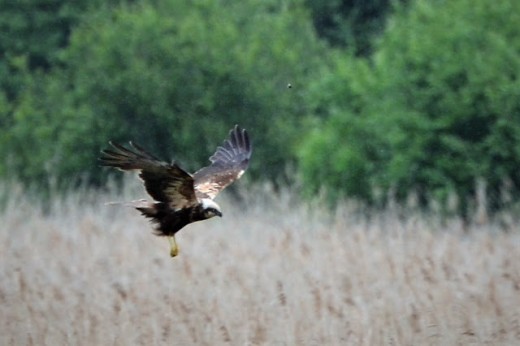
Marsh Harrier
The bird hides of Manea
Everything is wonderful in the Fenland when it is summer. The winter has its appeal too. However, the fields are no longer full of vibrant crops. Everything is back to the ploughed and furrowed earth. The birds of prey are always easier to spot in the leafless trees. Especially the Common Buzzards as they stand sentinel over the bleak rutted fields. Often we go out down the country lanes towards a village called Manea. There are bird hides here. These scattered hides command a view across a Fen that floods and turns into a lake from November to March. The River Delph bursts its banks and the marshy meadows become a natural floodplain. In the distance, and often through marshland mist, we can see the spire of Ely Cathedral.
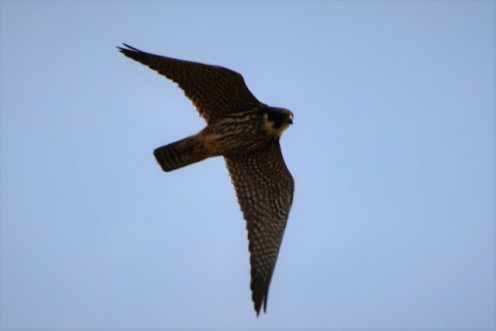
The appearance of the lake attracts all sorts of waterfowl. They are bobbing about in their hundreds. Various breeds. Carole, and I sit in the hides for a few hours looking at the many birds. I’m just interested in the birds of prey. The marshy fen is a favourite haunt for the many Marsh Harriers that come across the lake. The waterfowl always give us a warning when such graceful predators are gliding by. The game birds all start squawking and scattering. Their wings flapping in panic as they try to make way for the raptor. The spot that is vacated by the flustered multitude is always where the more fearsome bird’s flight path will be. I home in with the camera and hope for the best. Through the melee of confusion comes the unwelcome guest. Usually, the Harrier is too far off to get a good photo shot, but sometimes the odd one comes out fine. There are also other birds of prey to see. We have seen Hobbys, Buzzards, Red Kites, Kestrels and a Short Eared Owl. These raptors are always about the isolated bird hides. Carole and I go here regularly through the year.
During this summer, the lake vanishes and one can see the River Delph. The fields are occupied by grazing cattle again. The whole scene looks fresh and new. The trees are full of lush green leaves when they were bleak and bare a few months earlier. The whole land has come to life. The spring and summer bring swallows and swifts. There is a Kingfisher that comes along the River on the hunting patrol. There are rivers and Kingfishers everywhere. Also Reed Buntings and Reed Warblers.
The Hobby.
Fenland Birds of Prey
Common Buzzards, Red Kites, Marsh Harriers, Sparrow Hawks, Hobbys, Kestrels and many types of Owl. I have seen them all in the bird hides of the Fenland.
The Garden is full of Growing Wildlife.
Carole and I have some fabulous days. Not just at the hides but at our home by the open Fenland. Our bungalow looks out across the meadows. She loves the garden and is always tending the flowers and lawn. We have a grand decking area where we sit. Here, we enjoy the summer evenings when I return home from work. Over a period of time, we have put up bird boxes to try and entice Finches and Sparrows etc. The bird boxes have not been taken yet, though we did have a Jenny Wren look one over. Carole says a Jenny Wren male will make several nests. The female will then inspect the various choices of home and choose where to lay her eggs. Sadly our bird box was rejected by the female Jenny Wren. Perhaps next year she might look more favourably on the bird box.
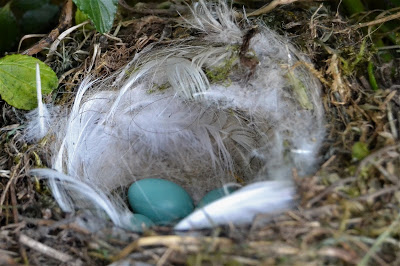
However, in our ceonosis bush, Carole came upon a small nest. The bush is inside the coop where our ducks are kept. Carole was collecting the morning eggs lay. She saw a small Dunnock (hedge sparrow) leave the bush from the top and over the fence. She peeked into the ceonosis bush and found a nest with tiny blue eggs inside. Also, our magnolia tree had a pair of Goldfinches build a nest close to the top of the tree. I took some photos of the Dunnock eggs and then left the tiny birds to do their thing.
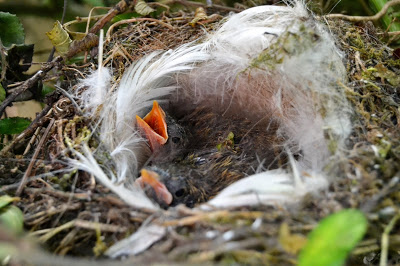
We had bird feeding tables put up and we watched the various small Finches, Sparrows, Robins and a Pied Wagtail. A blackbird was using the pond waterfall as a shower each morning and in the afternoon. The whole garden was a hive of activity. We enjoyed watching the creatures of habit. Carole and I were feeling exceptionally pleased with ourselves. In a short time, we noticed the Goldfinches coming backwards and forwards to their nest. Their eggs had hatched and the male and female were taking it in turns to bring food for the young. The three Dunnock eggs hatched too. I managed to get another photo shot of the young.
The Dunnock's Eggs and Nest.
The Hatched Young of the Dunnock.
The Goldfinch Nest.
Then one morning as I was making a cup of tea, Carole came in from the garden. She was all flustered and said that the Goldfinches were jumping from the nest. One had fallen in front of our Ragdoll Cat, Bob. He is fat and very lazy and will not run after anything. But the helpless Goldfinch was right before him. Food from Heaven. He snatched it up, but Carole managed to get the poor thing from his jaws. I went into the garden and heard a fearful commotion from the top of the magnolia tree. The infant Goldfinches came fluttering down from the top of the nest. They were panicking because a group of sparrows were attacking them. They were just shy of fledging and in a terrible dilemma. Three of them landed on the lawn. I gathered the little creatures up and took them into Carole. The sparrows were still making a racket by the nest as I got my step ladders. As I placed them on the tree, the sparrows flew away. I climbed the ladder to the nest and saw the last baby Goldfinch. Sadly, it was blooded and dead.
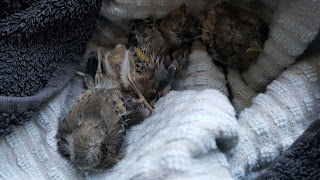
The Goldfinch that our cat Bob had picked up died soon after. I think it was traumatised by the ordeal. The other three baby Goldfinches were also huddled and quite. Carole phoned the animal sanctuary and they gave us a number of a rescue centre close by. A lady answered and told us to try and keep them warm and in a dark place. We put them in a small hamster cage with some bedding and then in an airing cupboard. In a short time, a volunteer from the charity came up the drive. The lady was another helper from the rescue centre. She began to feed the chicks with a syringe and the little things responded well. One of them started hopping around the cage. The Volunteer seemed very confident that the birds would soon fledge. The woman took the Goldfinches away to nurse them through the final stages of their growing cycle to fledging successfully.
The Goldfinches were attacked by Sparrows.
The Goldfinches Deserted Their Nest
Of the five Goldfinch chicks, only three survived. I would not have realised sparrows could be so destructive. The parent Goldfinches came back and were stressed that their young were gone. They would not know that three of their chicks had survived. Eventually, they abandoned the nest and flew off.
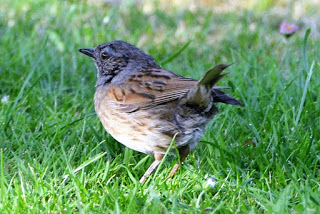
Dunnock (Hedge Sparrow)
The Sparrow Hawk
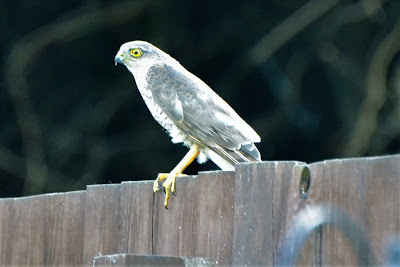
Over the next few days, the Dunnock chicks left the nest and began to hop about the garden lawn. They always returned back to the Ceonosis bush where their nest was. One day when I was at work, I got a call on my mobile from Carole. She said she was sitting on the decking doing her Sudoku book. She was alerted by a commotion. A Sparrow Hawk had banged into the passionflower shrub growing up the side of the fence. The bird of prey’s high pitched screech filled the air. It was caught up in the vines, but got lose and flew off. It had one of the fledgeling Dunnocks in its talon. There were three of them. Now there were two. When I came home from work, Carole was telling me all about the Sparrow Hawk. We were sitting on the decking and the camera was on the table. Sometimes a Buzzard flew over and I was chancing for a photo shoot. Low and behold. As though on call. The very Sparrow Hawk, Carole spoke of, landed on the fence. It was looking for small birds that went to our bird table. I managed to take a few shots of the little raptor before it shot off. It was so quick. It dived low and then rose across our garden. Then swooped upwards and shot over the fence. Talons first it hit a huge bush in the garden next door. I don’t think it got anything, but it was an attempted strike at some small hedge bird. Carole or I could not see a catch as the Sparrow Hawk flew off.
This raptor passed by on a daily basis. Our garden was part of its hunting ground. The two remaining Dunnocks fledged and moved on. At least that is what we assumed. Also, the other smaller birds that visited the bird table seemed to continue. We never saw another Sparrow Hawk strike in the garden for the rest of the summer. It probably got results in other gardens.
I view the approach of winter with sadness. The autumn is here and everything is dying. My wife and I always take a holiday in winter because we don’t feel the need of one during summer. The Fenland is always marvellous then and why leave the area at such a glorious time? But it is October now and our garden is fading. Once there was something here. But it fell into decline. The dazzling glory of the summer months is gone. The fall our floral empire. The garden will become a sad ruin. Still, a cruise to the Cannery Islands in December and trips to York and London during January will break down the cold season nicely. By the time this is done, the spring will come around again. New ideas and more time for the garden and the surrounding Fens.
We are fortunate not to have too many severe winters in the East Anglia area of Britain. We get the odd snowfall in the winter, but even these are unusual. There has not been one for about the last five or six years. Not one that people could speak of. In the Fenland, where I live, the whole area is mostly rural and sparsely populated compared to other parts of England. The entire region is given over to farming and food processing. In the winter, the fields become ploughed expanses of mud. As far as the eye can see. There is nothing but derelict furrowed fields awaiting spring. The scattered copses of trees are all bare against dull grey skies with groups of Crows, Ravens and Rooks flying about. We see all of this from our living room window. For a few brief weeks, all is void of greenery.
All looks still and desolate in the morning mist as I go to work. Within the bleakness is a feeling of isolation. The biggest town of Wisbech no longer has a railway station. It was closed down during the Beeching reports of the 1960s. Sometimes the Fenland feels a little cut off. But then this has its charm for many, in an inadvertent way. The feeling of being out of sight and out of mind. I suppose I’m trying to paint a picture of the worse aspect of rural living before I get to the kind parts. Well, even this dreary time has many wicked charms if one ventures out.
The unchanged parts of winter.
The birds of prey are very visible because they stand out more when perched in the trees looking out for rodents in the bare fields. My wife, Carole, and I often venture out to watch them. Not that Buzzards or Red Kites favour such hunting pursuits. They are generally lazy predators. There is an abundance of roadkill along the verges and I see these raptors circling along the country roads often. They are no different in the Fenland than anywhere else. Buzzards and Red Kite will have a free lunch if it is available on the verge of the roadside.
The smaller Kestrels will hunt with enthusiasm as they hover on the spot searching for prey in the fields. Their perfect vision singles out any unwary rodent. Then they suddenly dive when there is a chance of a kill. Also, there are the Sparrow Hawks. Wicked yet beautiful birds of prey that will swoop down upon any small bird. I’ve seen it happen. One moment the little sparrow is hopping about in search of bug or worm nutrition then the creature becomes a raptor’s sustenance. Vanquished in a dreadful blur. All these things are more visible in the barren landscape. It happens everywhere. But in the open Fenland, it is more noticeable.
Preparing for the spring.
Carole is always busy in the greenhouse. She has lots of pots and many seeds. I’m not the green finger of the relationship, but I get intrigued by what she does. When we are out shopping, I’m always looking at the various seeds. Especially cornflowers and the more wild looking types of flora. I like the garden to look crazy and unconventional as opposed to neat little rows of bedding plants. A mad cascade of colour with blues, reds, yellows and all else within the spectrum.
I often stand there watching and talking while she prepares for the oncoming spring. She’ll give me pots and I’ll put soil in and then seeds. I work to her instruction because she knows what to do with the garden far better than me. Many of the cornflowers will grow again from the previous year, but we always get a few extra seeds just in case. This emergency came about because of the wandering ducks and chickens we left out a few winters back. They ate everything and the spring plants suffered because of the unwelcome attention of our poultry. It was a mistake we did not make again.
Gradually things start to happen.
March is the month when things begin. The fields sprout. Little fine stems of green as the crops push up through the soil. The trees start to bud and there is a flurry of bird activity. Sparrows, Finches, Robins and blackbirds are full of song. Our garden feeders are stocked up too. Gradually the first flowers start to grow. Daffodils, Crocuses, Snow Drops and Bluebells as the spring gets into motion. The austerity of winter fades rapidly as the Fenland wakes from sombreness with a vengeance of colour. Our muddy little garden suddenly comes alive. The Magnolia tree blooms with fine pink flowers and the Ceanothus Bush has vibrant blue within the dark green leaves. Everything is uplifting and fine. New ideas are on our horizon. What can we do for the garden this year?
The first project comes about.
I found the plastic cast of a small garden pond fly-tipped. It was with a load of household rubbish. I was sent to remove the discarded waste while at work. I clear the Fenland as best I can with a team of street cleaners. We patrol our section of the district. All the little droves and country lanes. That is how I get to see so much of what goes on about me. The vast majority of inhabitants of the Fenland love the area, but we do get the odd few who fly tip in obscure locations. This can be a blot on the landscape. We try to clear and report as quickly as possible. The pond casting I found was brand new and unused. I had been looking for such a commodity and was about to buy one. It seemed a shame to take this item to the rubbish tip when I could make use of it. I took it home and put it in the back garden. Carole was delighted by it. She said it was a perfect size and selected a place right close to the decking. We had a collection of terracotta pot plants and a running water feature here. This was the little ambient section where we often sit when relaxing and reading in the garden. The chill place, as some might say. I had to be off back to work as I was on the way to the tip with the rubbish I had collected. I said I would dig a hole to lay the cast when I got home. Then we would discuss the other things needed. I should have known better with Carole. Sometime later, when I was back at a small hamlet called Chatteris, I got a call on my mobile from Carole. She had dug a hole and put the pond cast in. When I got home from work there was a decorative rockery around the pond too.
Within a few short hours, the garden pond was beginning to look like a splendid idea. With all the cornflowers and other plants about the new feature, we could see how this pond would make a kindly addition to the ‘chill place.’ The sacred decking where we sit.
To make sure the pond water would not stagnate, we had to acquire a filter and oxygenating plants. With the filter would come a small water pump. This is a major addition for oxygenation. This added help needed a small waterfall beneath the overflow pipe of the filter box. The small steps along the waterfall cast would allow water to trickle back down to the pond where the gentle cascade added to the soothing sound of our other water feature. This is very good for the pond water where fish are concerned. The water is continuously recycled via the filter that collects mud and other impurities from building up. It needs cleaning out once every three months. This is a simple process and the silt collected within the filter can be scrapped onto the garden beds. This is full of nitrates and helps the soil. The cleaning takes a few minutes.
We went to a small pond centre in a village close by. Here we got some splendid advice from the establishment. The whole area was geared up for garden pond features. Our pond was rather modest compared to some of the huge pond casts the man had on display. He showed us various types of water pumps. The device we chose could keep our pond water clean for water features four times bigger than the one we had. This pump and filter were the smallest. It was more than perfect for our needs. I selected a small plastic mould that had various steps for a cascading waterfall. One bowl filled and then trickled down to another bowl. Then another and finally back into the pond. The small pump could be laid on its side at the base of the pond where it sucked in the water through a filter and then up through a hose into the box at the side of the pond. Inside the box is another sponge filter. The water comes through this clear of impure sediments which are stopped beneath the sponge. Hence the need to clean every three months. Once the clean water starts to rise within the box, it reaches the overflow pipe. Here, the overflow pipe allows clear water to trickle back via the top of the plastic waterfall and so the whole process continues to go full circle. Time and time again. So long as the pump is left plugged in. There is a robust cable that leads to the house. We did have to drill a hole in the brickwork for this. The cable runs for a short distance along the side of the decking and is concealed from sight and the elements. It is reasonable to know how far your pond will be from a power source to work your water pump.
The pond centre also had the various types of plants that help to oxygenate the water. Some of them were in pots that can be placed below the water line. Others have no base and float about. Some multiply rapidly and need to be culled or the pond can become overrun. It is a small matter to keep the right consistency. I could name so many types, but because our pond is small, we had to pass on some of the more spectacular plants. We had Water Hyacinth. This floats on the surface and is one that multiplies rapidly. Scirpus, which is a type of water grass. Also Lilaeopsis another pond grass. These are very good oxygenators. We got a water Lilly and a water Iris. Some of the underwater oxygenator plants consume disbanded minerals. Especially dissipated salts. Algae would rapidly spread without these useful pond plants.
Around and the rockery – the pond’s perimeter, we planted Snow on the Mountain, Forget me Not and other various Alpine plants that cling and spread. Some will do better than others. Just let nature select. It will look pretty whatever flowers become dominant. All this flora in and around the pond does not take long to establish. One will notice within days. After weeks much of the layout will look sublime. One sits on the decking with the terrific sound of running water.
Of course, no pond centre would be without pond fish. We were advised to take about six fish for our garden feature. This seemed reasonable for our pond size. We choose three Golden Orfe and three Shubunkin fish. They looked like a type of goldfish. When one gets these pond fish, they come in water filled transparent bags. Do not tip them straight into the pond because the sudden change in water temperature can shock the fish. Leave the plastic bag with water and fish laying on the pond water for a short time. The water temperature will gradually adjust. Then loosen the bag and ease the water and fish into the pond.
As time goes by all sort of things develop with the pond. Some of the birds enjoy the waterfall. We have a Blackbird that comes for a morning and afternoon shower. He likes to wash in the little waterfall. Four frogs have moved in too. Perhaps we might get some Newts in time. It does not take long to get established. The fish are thriving but we have had to put a small wire mesh over the water. This is because we have a number of Herons flying about. They have spotted the pond and would clear it of fish and frogs very quickly without protection.
Flowers everywhere.
As the summer arrived, everything in the garden started to happen. In the front of the house, our Red Hot Pokers flowered. As did the Australian Bottle Bush. We had an array of orange Californian poppies. There was Lavender, clusters of Snow on the Mountain and other assortments of Alpine plants. My favourite is always the cornflowers. These are usually blue, but there are also other colours, which I think are hybrid. I say this because wild Cornflowers always seem to be blue. There is an unconventional and mad look about scattered cornflowers. I personally find this alluring and these flowers are low maintenance. They attract bees and various butterflies too. I suppose all flowers do, but it’s the Cornflowers that I always find myself watching.
Our surrounding fencing is gradually acquiring scattered trellises. These are great for the climber plants like Clematis, Jasmin and Hydrangea. We also have various shrubs too. There is a Plumb tree, a Cherry tree in the Duck coop and also an Apple tree just outside by the duck fencing. Not forgetting the bigger Magnolia tree in the centre of the garden.
The lawn is cut regular as the summer can make the grass grow very quickly. I’m sure anyone with a garden will know this. An electric rotary mower is good for a quick cut. It’s efficient and easy to keep on top of the lawn in a small garden. If you would like a closer and neater cut, I would recommend a cylinder mower. Even if it’s a basic push mower. Obviously do a rotary cut first and then go over with a cylinder. It gets the grass down neat and pristine. Almost like a quality haircut.
We also have Strawberry, Gooseberry and Blueberry plants. Each year we get a good little intake from these plants. So many people have horses in the Fens. There is always bags of horse manure on sale along the roads. We feel the strawberry patches with this once autumn comes. It gives it a fair time to break down and we also add compost on top. Come the season, the edible plants I’ve mentioned spring up in abundance.
From our garden, and besides the fruits I’ve mentioned, Carole gets Horse Radish, Cucumber, various Tomatoes, Peppers, Spring Onions, Lettuce and Chives. With the poultry, we also have a regular supply of eggs.
Gardening is definitely something that is growing on me. I used to have a garden in my other house, but I just kept and mowed a lawn. Since being with my wife Carole, I have learnt about so many other things. Since we moved to the rural Fenlands, it is almost impossible not to get used to the more open environment and the way the outdoor world is. Every time I think we have completed our garden look. Something else always seems to crop up. There are the bird boxes too. Little hidden abodes scattered amid the climbing plants in the hope of attracting nesting couples. We’ve had a few this year but not in the boxes. I’m told that sometimes they need to be about for a few years and then one or two might get taken.
The bird box was visited by a little Jenny Wren a few weeks ago. It was male and he seemed to be layering the bird box with feathers. I got a photo shot of the bird coming and going and did a blog of this. Sadly, the bird box was not chosen by the Jenny Wren female. Her partner will make a number of nests and she will choose the one she thinks is the most appropriate. On this occasion, my bird box did not pass the test.
Therefore, I decided on a new plan of action for next year. The bird box was too exposed and the Jenny Wren likes to be more concealed. Also, I was told the box was a little too high. I have now moved the box by a trellis with Jasmin growing up and gradually covering the potential nest. It is also lower. The Sparrowhawk would have definitely discovered their exposed nest as it is still visiting all the gardens on a daily basis. It seems to hunt for the fledgelings.
Our little garden pond is coming along nicely. We added some pond plants and they have taken very well. The fish are swimming around contently and the little waterfall that works via the filter pump is trickling along nicely. We get a regular visitor who is a male blackbird. He loves to bath in the waterfall most days. He seems to have got used to us watching him from the decking where we sit.
To my delight, a Frog has moved in too. I knew it would not take long and do hope it will find a partner for the next spring so that the frog spawn will come about. Then we will have tadpoles and such. Perhaps newts too.
The Sparrowhawk Finds My Garden a Good Hunting Ground.
I was called on my mobile while at work today. It was my wife concerning the Dunnock chicks. I have written about them in the blog on several occasions. Today, Carole told me that the birds had fledged and were hopping around the garden. However, one had been taken by a male kestrel. (We later found out this bird of prey was a sparrowhawk. So the mistake was ours.)
It was the Fledgelings first excursion into the world after leaving the nest. Unfortunately, the cruel side of nature starts to bite straight away.
When I got home, I sat in the garden and saw the two remaining baby Dunnock chicks hopping about. I went to get my camera in the hope of getting a few photo shots of them. When I came back out in the garden, Carole said that the two fledgelings had returned to the Ceonosis Bush and everything went quiet.
As I sat down I realised why the birds were no longer chirping. On the fence sat a male Sparrowhawk. I told Carole and she confirmed it was the very raptor that had killed one of the Dunnock fledgelings in the afternoon when she phoned me at work. I managed to get a few photo shots of the bird of prey, but it shot off across the garden and attacked something in a tree over in the garden next door. It was so quick that I'm unsure whether it got a small bird or not. It flew away from the area very instantly after the attack.
The Dunnocks are learning to hide. Hopefully, they’ll live to fly off into the world.
Checked the Dunnock chicks today and they are coming along very well. It will not be long before they fledge and leave the nest. In the meantime, I can't help keeping an eye on the distant crows and other types of carrion that are about. Especially the Jays. If they get sight of the nest they will clear it out.
I notice how the Dunnock parents always seem to land in the duck coop and skip about below the Ceonosis Bush before entering the nest from below. The little hedge sparrows (Dunnocks) are very secretive and careful. I've a strong suspicion and hope that the chicks will fledge. It can't be too many days now.
As the summer moves on, the garden looks better all the time. As I often say, the cornflowers are splendid and in various colours. The usual blue it there, but the other colours are about in wonderfully mixed clusters. I always think they have not taken at first. But then one starts to bud. Then another. I get happy when a couple of blue ones open. Then all of a sudden, everything seems to explode with colour.
We have had a few heavy rainfalls but once the sun comes out that seems to be the remedy. Lots of water followed by bright sunshine. It does the trick every time.