Showing posts with label Battleship. Show all posts

Monday, 16 July 2018

Victorian Battleship HMS Devastation - The Pattern for the British Empire's Future Battleships.

HMS Devastation.

The Pattern for Future Battleships.

HMS Devastation.
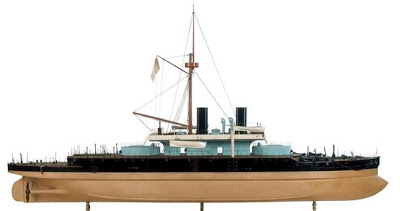


The Dawn of Battleships Without Sails.

Ships made of iron came about during the mid-nineteenth century. There were many prototypes in various countries. France built some wonderful ironclad ships and Great Britain got into an arms race with them. It was a natural competitive way of the age. France and Britain had been natural enemies, but they had been fighting side by side as allies during the Crimean War.
The American Civil War saw some very innovative designs too. People were inventing all sorts of ways to destroy other ships. Anything that might give them an advantage in marine warfare. The Confederate forces even managed to build a submarine. They mounted the first ever successful submarine attack upon a battleship. The cost was high because the submarine was sunk too.
Great Britain wanted to build a ship made of iron and without sails. They hoped for a steam driven ship. Engines fuelled by coal which in turn, rotated a prop shaft attached to a propeller at the stern of the ship and below the water. This gave them propulsion without the aid of sails. On the 12th of July 1871 at Portsmouth, the Royal Navy launched HMS Thunder Child. This battleship was state of the art during this time. There were no sails rigging and the ship’s guns were inside revolving turrets encased in iron walls. The whole ship was constructed entirely of iron. It was the first of two Devastation class battleships. The other would be named, HMS Thunderer.

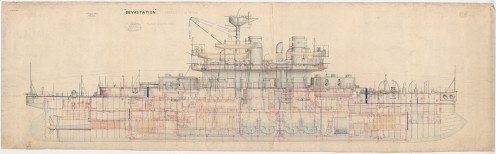
Plans for HMS Devastation.


A New Innovation.

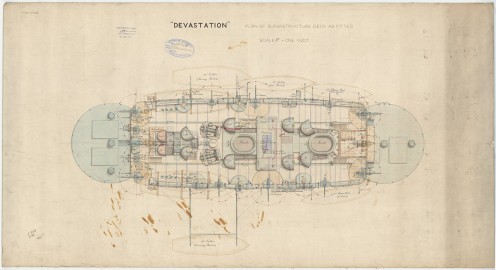
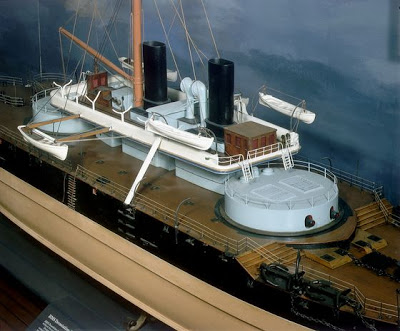
The ship sat very low in the water. The stern and the bow were a mere eight foot above the sea line. The central freeboard area of the vessel was raised higher. To move from the stern or bow to the freeboard, a crew member would have to walk up port or starboard stairs. The fore and aft of the upper freeboard area contained the revolving turret guns. Between was the small superstructure. There was an internal ladder leading up to the open superstructure deck. Also at the back of the revolving turret guns’ metal wall was an attached ladder. A crewman could get on top of the turret, where a stair gantry leads down from the fore and aft of the superstructure. It was raised above the actual turret – the last step suspended in mid-air. This allowed the turret gun to rotate and the stair gantry ending a step above could not interfere with the rotation of the turret. All delightful little innovations of the time.
The ironclad ship must have appeared very odd to the Victorian public of Britain. Especially the fact that the entire ship was made of steel. They would have been awe-struck that such a vessel could float. The complete lack of sails and rigging would seem extremely unusual. There was also a pointed ram at the bow. This sat below the water as the ship ploughed through the sea. Even in a moderate swell, the sea would have cascaded over the bow and capstan area of the deck.
The first guns to be placed inside the turrets were muzzleloaders. This means the shell and charge were rammed into the gun via the front of the barrel. Similar to the old ways of cannon loading. The charge first and then a shell. All rammed down before ignition. The breech-loading guns with shell canisters would not be adopted for a number of years by the Royal Navy. This seemed a little lacking for the time. Even though it was 1871. Each turret contained two guns. They were on wheels and there was a type of small rail that the wheels sat upon. As the two mounted guns were wheeled back inside the enclosure of the turret, they could be tipped forward so the front open barrel pointed down to the floor. There was a hole in the deck leading to a lower storey. At this lower level was a gutter like ramming system. Here loaders, below deck, could put a charge and push it up the grooves and into the dipped barrel through the ceiling. Then the shell was added to sit upon the charge. When this operation was completed, the guns were pulled back upright in the turret above. When the guns were level placed, they were rolled forward upon the rails. The front barrels barely protruded from the gun ports as one can observe in early photos.

Bird's Eye View of Devastation's Superstructure and Revolving Turrets.


Costly Design Flaws.

Of course, this only lasted for a short time because breech loaders were brought in by the Royal Navy to replace the old muzzle-loading guns. This change came about because of an accident during a gunnery exercise on board Devastation’s sister ship, HMS Thunderer. This occurred in January 1879. As the guns on the forward turret were fired, the gun crew held their hands over their ears. According to accident reports after the event, only one gun had fired. The gun crew pulled the muzzleloaders back upon the rail and tipped them forward for a second reloading. The gun that never went off was reloaded with another charge and another shell. Therefore, one of the guns had a charge and shell, plus another charge and shell all sitting in the same barrel. When the guns were rolled forward for another firing, the results were horrendous. The gunnery crew never stood a chance in the confines of the revolving turret. The catastrophic mistake caused the deaths of 11 crew members. A further 35 were injured as the explosion ripped through and out of the forward turret.
When the accident investigation was concluded this reason was given for the calamity. However, there were some investigators that believed there were faults with the hydraulic power-ramming system. There persists another theory that a part of the hydraulics broke off and blocked the barrels during the loading process. Whatever the actual reason was, the Royal Navy decided to invest in Breech loaders. This meant all gun loading could be done inside the turrets.

The Fore Turret and Superstructure of HMS Devastation.


Never a Shot in Anger.

HMS Devastation would never fire her guns in anger. Despite being in service for 32 years. She saw duty in the Mediterranean for much of her naval use and in home waters too. She was taken out of her role in 1905 and sold for scrap in 1908. During her time, she underwent various modernizations. Some of these improvements were for her boilers and guns. Her various crew was believed to have been fond of the ship, but the design did have critics too.
The press seemed to loathe the Devastation class ships. They wrote criticising reports of both vessels. These articles led to the Naval Constructor, Sir Edward Reed losing his maritime position. They ship’s had come into being under a cloak of controversy when they were launched. I think the ships were not the problem, but Sir Edward Reed was. He had been accused of taking ideas, about the revolving turret, from another designer. He had been accused of decrying the former designer before adopting the late man’s gun turrets for Devastation. This had caused some controversy with the late designer’s widow. I think this made Reed unpopular in parts of the Admiralty and this was filtered through to the British press.
Many new ships evolved from this Devastation design. It was a prelude to the Dreadnoughts. The original Devastation class ships were medium size battleships that could attack and destroy an opponent with speed. They were heavily armed and manoeuvrable. How formidable they may have been can only be speculated about. The Royal Navy was extremely intimidating in this day and age. There was not a force to be reckoned with it. After the Napoleonic wars ending in 1815, the last threatening confrontation would not come until 1914. This is a period of almost 100 years.
I can’t help wondering about HMS Devastation. I like the look of the ship because she has that primitive aspect of a metal battleship. Yet parts of the design are stuck in the old galleon times. Especially with the little stumpy muzzleloading guns scarcely protruding through the gun ports of innovative revolving turrets. I suspect she may have had a lot of vulnerabilities in battle. Yet I’m thinking of her up against a dreadnought. A further adaptation.
What would she have been like against a sailing galleon battleship like HMS Warrior? I’ve been aboard the Warrior. She is now an exhibition ship. Part of the Naval Museum at Portsmouth. I think the old HMS Victory of Nelson’s day would be outmanoeuvred and easily destroyed by Devastation. But I suspect the Warrior may have been able to put up a good account because she is also an ironclad. She has a line of port and starboard guns. Her armament is bigger. Yet she has sail and rigging. Perhaps these parts of the old ship would be susceptible to Devastation. Then I think of the number of guns Warrior has. Surely some of these would find the mark? Even on a fast moving vessel like Devastation. If there are any ship enthusiasts, please comment on how you think such a duel would make out. I would be interested to know.

Short Clip About HMS Thunderer of the Devastation Class.

Tuesday, 12 June 2018

The Mauritius Command by Patrick O'Brian (My Goodreads Review)

The Mauritius Command (Aubrey/Maturin Series, Book 4) (Aubrey & Maturin series)

My rating: 4 of 5 stars

Another fine Aubrey/Maturin story. Every bit as good as the others. This time Aubrey is a temporary Commodore and in charge of a small squadron of ships. He must confront a skilled French enemy operating out of Mauritius. The enemy is attacking and capturing British ships upon cargo routes from India to Britain. The islands of Mauritius are strategically placed to capture a wealth of British plunder. Bonaparte's Navy is making good use of the advantage. The Royal Navy is intent on eliminating this French ability. What follows is some strategic confrontations. Battles, where advantages are won, lost and then won again in an ever continuing cat and mouse adventure game upon the high seas. Splendid action scenes throughout and wonderfully atmospheric.


Thursday, 10 May 2018

Post Captain by Patrick O'Brian (My Goodreads Review)

Post Captain (Aubrey/Maturin, #2)

My rating: 4 of 5 stars

This is the second Aubrey/Maturin story. They are set during the Napoleonic wars at sea. In this story, we see our heroes up against it with debt collectors threatening. Jack Aubrey needs a ship because while at sea, he can keep the creditors away. The dialogue is splendid and some of the narration has that old fashion feel too. It all makes for a great atmospheric feel. The battles at sea are particularly gripping. Even if, like me, you know nothing about sailing at sea; you'll get sucked up into these dazzling adventures. I'll definitely go for the third story after being thrilled by the first two adventures. I can't express how good the dialogue is. I know I've mentioned it before, but this is what makes the story so fine. The speech is how one might well imagine how people of such times would talk. I felt as though I was there. Walking about the old port towns and visiting well to do people. Some of these parts of the story had an almost Pride and Prejudice - Jane Austin feel about it. Then there are the descriptions of men at sea and the workings of such magnificent vessels.


Sunday, 8 January 2017

Captain Semmes of C.S.S. Alabama


In England during the year of 1862 in the day and month of 29th July, a ship was launched with no pomp or ceremony from the shipyards of Birkenhead, Merseyside. The ship was called Enrica and she had been built by shipbuilders called John Laird Sons And Company. The vessel slipped discreetly out of Liverpool into the Irish Sea.

A Confederate Agent called James Dunwoody Bulloch had procured the ship for the new Confederate Navy – a collection of states that had decided on secession from the United States of America. The contract had been arranged through Fraser, Trenholm Company – a cotton broker in Liverpool with interests in the Confederate States.

Bulloch went with the ship and had carefully arranged for a civilian crew to take Enrica to Terceira Island in the Azores.

A few days later on August 5th, another ship left Liverpool bound for the same destination in the Azores. This vessel was a steamer called Bahama and one of its passengers was to become a figure that would burn his name in history. He was a thin-faced man with a small beard and moustache who came from Maryland, in today’s USA. However, in 1862 the state of Maryland had joined the Confederate cause and this particular man had left the US Navy and joined the Confederate Navy. His name was Captain Raphael Semmes.
  
When he reached Terceira Island in the Azores he was greeted by Agent Bulloch and both began to oversee Enrica’s refitting. Another ship called Agrippina docked bringing special supplies for the newly constructed ship. This included ship’s cannon, coal, food and other necessities for a long voyage. When all of the loadings had been completed, there was a small ceremony which took place about a mile off of the island in international waters. The men of all three ships Enrica, Bahama and Agripinna stood on Enrica’s quarter-deck with 24 officers of the Rebel Southern States – all of them in full dress uniforms.

Captain Raphael Semmes read out his commission from President Jefferson Davis, which gave him the authority to take over the newly built ship. When he had finished his speech, musicians began to play “Dixie”. The British colours were lowered and the Confederate battle ensign was raised. As the new flag fluttered in the sea wind Captain Semmes proclaimed the vessel by a new name. Alabama – CSS Alabama.

The renamed C.S.S. Alabama and was converted into a Navy cruiser. The newly armed vessel would become a commerce raider and the world’s sea would have an abundance of Union shipping to attack in the name of the Confederacy.

There was one small dilemma that needed to be overcome. Captain Semmes had 24 officers but no crew. Confederate sailors were hard to come by in the Azores as none could be got out of the blockade. He looked to the mainly British crew that had brought the ship to the Azores as the civilian Enrica. He made a bold speech about the Southern cause and invited the Brits to sign up for an unspecified time. Unfortunately, the mainly British listeners were not too enthusiastic about a foreign civil war, so then he changed his tact, realising that Southern morality would not win Brit minds as opposed to the bulging wage packet. He, therefore, offered double wages, to be paid in gold, and additional prize money to be paid by Confederate congress for every destroyed Union ship. This induced a bold response as 83 excited Brits felt a sudden flurry of Rebel patriotism – in short, Captain Semmes had acquired a crew of mercenaries that would prove to be well and truly up to the task at hand. He was still 20 men short but knew he could find more sailors in other ports. Many of the British mercenaries completed the full voyage – an extraordinary two-year high sea adventure with Captain Semmes who they came to admire greatly.

Captain Semmes began his rampage instantly in the Eastern Atlantic capturing and destroying all northern merchant ships that the Alabama came upon. These vessels were mostly whalers and the Confederate raider accounted for ten of them. Captain Semmes then ranged north and back to Bermuda, attacking 13 more Union ships and destroying ten of these vessels.

He then took his ship to new hunting grounds in the West Indies and attacked more enemy commerce, making Union shipping dread the sight or name of C.S.S. Alabama. Then in January of 1863, when sailing in the Gulf of Mexico, Alabama came up against her first military vessel – a Union side-wheeler called USS Hatteras. The Confederate ship quickly attacked and sank the ship, capturing the crew.

Next, she went south off of the coast of Brazil and took 29 prizes, wreaking havoc before venturing back across the Atlantic to South West Africa where she worked with another Confederate vessel called C.S.S. Tuscaloosa. Next, she went into the Indian Ocean for six months and attacked and destroyed seven more Union vessels.

Altogether the C.S.S. Alabama was accountable for the destruction of 65 Union ships – mostly merchant vessels. Prisoners were never harmed and were handed to the nearest neutral ports or passing vessels. While roaming the seas and boarding vessels the C.S.S. Alabama never visited a Confederate port – she would have been incapable of breaking the blockade. She took over 2,000 prisoners without a single loss of life of her captured or crew.
  
In June of 1864, the C.S.S. Alabama docked at the port of Cherbourg in France to have repairs done. She had been at sea for a long time and was in need of an overhaul. A pursuing Union sloop-of-war U.S.S. Kearsarge arrived outside of Cherbourg three days later and waited for the Alabama to leave port and come out into international waters. Before he had arrived, the Union Captain John Ancrum Winslow had telegraphed for assistance from man-o-war U.S.S. St Louis with supplies for a long blockade of the Confederate ship if Semmes chose to stay in the French port.

Captain Semmes was a fighting man by nature and would not entertain the notion of being blockaded in the port of Cherbourg. He chose to sail out and engage the U.S.S. Kearsarge

On the 19th of June, the Alabama sailed out to confront the U.S.S. Kearsarge. Cannon fire was exchanged and soon the two ships were locked in a duel with Alabama outmatched against the Union sloop-of-war. The Confederate ships most poignant shot was fired from a seven-inch Blakely pivot rifle, which hit close to the Union vessel’s vulnerable sternpost. The shell failed to explode. If it had done it would have crippled the ship’s steering.
  
The Union ship was armour-clad and was more durable to shell fire. Eventually, the Alabama began to wane due to the pounding and after an hour she was badly broken up. One shell tore into her amidships below the waterline allowing water to gush in and drown her boilers. The Confederate ship began to sink.
  
As Alabama went down many of the survivors clambered into lifeboats and ship’s Doctor David Herbert Llewellyn managed to get many of his wounded patients aboard boats before going down with the ship. He was a Briton from Wiltshire and was awarded the Southern Cross of Honour. There is a memorial tablet and window commemorated to him in a church in Wiltshire and another tablet in Charing Cross Hospital where he once worked.

U.S.S. Kearsarge picked up most of the survivors, but a further 41 men were rescued by a British yacht called Deerhound. Captain Semmes was among these men and he escaped to Britain.
  
Captain Semmes held good on his promise to the crew who were all paid in full when they got back to Britain. He returned to the Southern American States and finished the Civil war fighting on land with his naval men as infantry in the dying months of the war. The Confederate cause was lost and he was interned for a few months after the South surrendered to the Union. After the war, he became a judge and a newspaper editor. He died in 1877 age 67.
  
In 1984, the French Navy found the sunken wreck of the C.S.S. Alabama and since then there have been joint French and US archaeological dives of the wreck.


The USS Hatteras tried to engage the Confederate raider CSS Alabama. Hatteras was sunk in the ensuing battle. It was one of many ships that the CSS Alabama attacked. The rebel ship was known as the Shark of the Confederacy and it would wreak havoc upon much of the Union's navy.


Wednesday, 25 November 2015

Giving You A War of the Worlds Adaptation USA


Growing Interest in Adaptation


The Last Days of Thunder Child is a War of the Worlds adaptation on sale in the USA and to be sold in the EU from August 2016, seventy years after the passing of the great H.G. Wells - the master science fiction writer of the late Victorian age.

Fascinating new perspective.

The pastiche story goes aboard the battleship/ironclad and the readers sees the Martian invasion unfold via the crew's perspective. At first, just rumour and speculation from semaphore stations. The plucky battleship is destined to confront and fight the alien invaders, as in H.G. Wells' War of the Worlds the old retro sci-fi story. Today it is more of an alternative history as well as Science Fiction. It could also be a steampunk story due to its Victorian setting. It all makes for a fun read of Victorian battleship verses alien invaders from Mars.

The story offers two lines of adventure: 

1. The noble Scottish Captain McIntosh and his crew aboard HMS Thunder Child as they cruise around the channel into the North Sea and up along the south east England coastline.

2. On land, the shy and reserved English Albert Stanley, a minor administrator from the Ministry of Defence - the messenger who brings HMS Thunder Child's last minuet orders. Instructions that stop the ironclad going to the salvage yard.

The Final Outcome

The adaptation story has the alternative history - retro science fiction - steampunk feel about it. Readers can purchase the novel in paperback or on Kindle download USA.


War of the Worlds Fans

Have you ever enjoyed H.G. Wells War of the Worlds, an all time classic Science Fiction story written in 1898? It tells of a Martian invasion that begins in Britain in the County of Surrey just South West of London. Close to a town called Woking. In fact, if you ever visit the town there is a statue of aMartian tripod in the shopping center. If you have read this story, you will know of the ironclad H.M.S. Thunder Child that is forced to defend the paddle steamer full of refugees. Do you wonder what it would be like to join the crew a few days before the event? You could follow the brave men on their terrible journey around the coastline and up the River Blackwater to Maldon and the final confrontation with three Martian tripods? 


From Mars, the meteorites shot through space bound for Earth and conquest over all lifeforms that live there. The Martians were unfeeling towards mankind as humans are to sheep or other lesser creatures.

The meteorites land in fields and woodland. After a time, there emerges the terror of mankind. Colossal tripods, before which, humanity flees as the onslaught of the fighting machines begins. People are destroyed by heat rays and black toxic gas. Those that survive are forced to flee the persuing devestation.

Aboard H.M.S. Thunder Child, the crew are blissfully unaware of the savage terror. Only the new Captain knows and only upon the journey, at sea, do the crew begin to learn the unbelievable news from semephore stations.

Fear grips the population and hordes of refugees make for the coastline to flee the country. Their world is gone and only death and destruction follows. Ships of all nations and sizes must aid the mass evacuation...

Amid all of this, the mighty little ironclad, H.M.S. Thunder Child must play her role to the full and rely on the bravery of a small crew.


Sunday, 28 June 2015

Victorian Battleship Model

I saw a model ship from Victorian times in a military Museum in Norfolk as I drove along the coastal road back to my home in the Fenlands. It was a pleasant surprise because the museum had a little more to look at than I expected.

In one section I saw a number of model boats. One of them HMS Hornet of the Dreadnought class or just pre-Dreadnought. I wrote a pastiche novel of H.G.Wells' War of the Worlds. It is called: The Last Days of Thunder Child. Although in my book, Thunder Child is visualised as a ship looking more like HMS Devastation the HMS Hornet, the models figures of the sailors on board would look the same. I loved the look of the superstructure and the wheel house and the figure standing about in their RN uniforms of the era.

I could not help but excitedly snap the model in order to get a look at the sailors aboard. It sets my old imagination going into overdrive.  


To my further delight, I saw a paddle steamer called the Waverly. This little boat still exists and goes all around the British Isles to various seaside locations each year. When I lived at Southend-on-Sea she often came to the pier and took people out on excursions. I based the paddle steamer on the one in H.G.Wells' War of the Worlds when I wrote the Thunder Child pastiche story. Therefore, I had to click all. I have the image of the sailors aboard HMS Hornet for the uniforms of the day, the paddle steamer Waverly (re-named Southend Belle) for the fleeing boat full of refugees and the model of HMS Devastation for my mind's image of the fictitious  HMS Thunder Child.  


The model of HMS Devastation with her short barrelled muzzle loading guns are what I imagined Thunder Child to look like. Outdated, even in 1898, but able to pack a punch for the people on the paddle steamer in the Last Days of Thunder Child.


Sunday, 13 July 2014

Cursed 16th century Swedish Warship

16th Century Swedish Shipwreck from National Geographic Magazine.
The Mars lies at the bottom of the Baltic Sea, where it sank during a naval battle in 1564. A diver at upper right provides scale.
COMPOSITE PHOTOGRAPH BY TOMASZ STACHURA, OCEAN DISCOVERY  
Jane J. Lee
PUBLISHED JULY 7, 2014

It was the largest and fiercest warship in the world, named the Mars for the Roman god of war, but it went up in a ball of flames in a brutal naval battle in 1564, consigning 800 to 900 Swedish and German sailors and a fortune in gold and silver coins to the bottom of the Baltic Sea.
Now, a few years after the ship's discovery, researchers have concluded that the one-of-a-kind ship is also the best preserved ship of its kind, representing the first generation of Europe's big, three-masted warships.
Naval historians know a lot about 17th-century ships, but very little about warships from the 16th century, said Johan Rönnby, a professor of maritime archaeology at Södertörn University in Sweden, who is studying the 197-foot-long (60 meter) wreck.
"It's a missing link," said Rönnby, whose work is funded in part by a grant from the National Geographic Society's Global Exploration Fund. The 1500s is an important period, he said, because it's when big three-masted warships started being built.
Researchers have found cargo from early warships called galleons—slightly later iterations of the type of vessel the Mars exemplifies. And they've recovered pieces of actual ships, including the English flagshipMary Rose, which sank during a battle in 1545. But never have they found something as well preserved as the Mars.
Rönnby and his team want to leave the Mars on the seafloor and instead use three-dimensional scans and photographs to share the wreck with the world.
Rönnby, with help from Richard Lundgren—part owner of Ocean Discovery, a company of professional divers that assists in maritime archaeology work—and others, has been piecing together photomosaics and scanning the wreck to produce 3-D reconstructions. With funding from the National Geographic Society/Waitt Grants Program, they are working this summer to complete their scans of the entire ship.
Bringing a ship out of the ocean is expensive, and it can cause significant harm to artifacts. The laser scans Lundgren and colleagues have taken are accurate to within 0.08 inches (2 millimeters)—more than enough to satisfy most researchers.
Using some relatively new tools and methods, archeologists now have a chance to reconstruct the last minutes of the ship and the souls onboard, Lundgren said, and gain some insight into how people behaved on a battlefield.
Finding the Mars
Treasure hunters, archaeologists, and history aficionados have sought the Mars over the years. But they were unsuccessful until the late spring of 2011, when a group of divers located one of maritime archaeology's greatest finds in 246 feet (75 meters) of water. (See "5 Shipwrecks Lost to Time That Archaeologists Would Love to Get Their Hands On.")
Legend has it that a specter rose from the inferno to guard the Mars, the pride of the Swedish navy, against ever being discovered.
The discovery was the culmination of a 20-year search by Lundgren, along with his brother Ingemar and their colleague Fredrik Skogh. The men had dreamed of finding the mighty Mars since making a childhood visit to a Stockholm museum housing another iconic Swedish warship, named the Vasa. Richard and Ingemar Lundgren became professional divers in part because of that dream.
Graphic of the Mars shipwreck location.
NG STAFF, JAMIE HAWK. SOURCE: RICHARD LUNDGREN, OCEAN DISCOVERY
War Machine
The Mars sank on May 31, 1564, off the coast of a Swedish island called Öland. She came to rest on the seafloor tilted to her starboard, or right, side. Low levels of sediment, slow currents, brackish water, and the absence of a mollusk called a shipworm—responsible for breaking down wooden wrecks in other oceans in as little as five years—combined to keep the warship in remarkable condition.
What makes this find even more exciting, said Lundgren, is that the Marsdidn't sink because of a design flaw or poor seamanship.
"Mars was a functioning war machine that performed extremely well in battle," he explained. She sank loaded to the gills with cannons—even her crow's nests had guns—sailors, and all the accoutrements needed to run a ship built for war (including eight different kinds of beer).
This warship had "totally unheard of firepower" for her time, said Lundgren. And it's those cannons that played a role in her demise.
Watch video of the underwater Mars wreck.
A Fiery End
The Mars went down while engaged with a Danish force allied with soldiers from a German city called Lübeck. The Swedes routed the Danes on the first day of battle, said Rönnby. So on the second day, the Germans decided to press their luck.
German forces began lobbing fireballs at the Mars and eventually succeeded in pulling alongside the burning ship so soldiers could board her. As gunpowder on the warship fueled the inferno, the heat became so intense that cannons began to explode, said Rönnby.
Those explosions eventually sank the warship. Legend, however, tells a slightly different story.
The Swedish kings at the time were busy trying to consolidate their position, Rönnby explained. "[But] the Catholic Church was a problem for the new kings because it was so powerful," he said. So in trying to diminish the church's power, monarchs like Erik XIV—who commissioned the Mars—would confiscate church bells, melt them down, and use the metal to make cannons for their new warships.
Legend has it that carrying those repurposed church bells doomed theMars to a watery grave. The warship carried either 107 or 173 cannons of many different sizes.
A Time Machine
"It's not just a ship, it's a battlefield," said Rönnby. Diving on the wreck, "you're very close to this dramatic fire on board, people killing each other, everything was burning and exploding," he said.
In fact, when Lundgren and colleagues brought a piece of the ship's hull to the surface, they noticed a charred scent wafting from the burnt wood.
"In the end, I think, that's the aim of archaeology—to discuss ourselves and the human aspects of a site," Rönnby said.

Wednesday, 16 April 2014

HMS Monitor - A World War I warship is to be turned into a visitor attraction

Taken from Newspaper clipping

WWI HMS Monitor M33 to become Portsmouth tourist attraction


A World War I warship is to be turned into a visitor attraction after winning Heritage Lottery Fund (HLF) backing. The £1.79m grant will see the interior of HMS Monitor M33, a coastal bombardment vessel which served in the Gallipoli campaign, refurbished. The work on the ship, built in 1915, will be done at Portsmouth’s National Museum of the Royal Navy (NMRN).

Minister for Tourism Hugh Robertson said the vessel provided a “tangible and compelling” link to WWI. The ship initially saw action during the Gallipoli campaign in 1915, supporting allied troops attempting to land on the coast of Turkey. The 180 ft (55m) ship’s role was to provide cover for troops landing on beaches using a pair of 125mm guns on board. It returned to Portsmouth Harbour after being involved in the Russian Civil War in 1919 and was acquired by Hampshire County Council in 1990.

The NMRN’s Professor Dominic Tweddle said the institution, where the vessel has been held since it ceased being seaworthy, was “absolutely thrilled”. “We’ve long seen M33 as both culturally and historically important, and this symbolises the start of a new era for her.” The restoration work, funded by the HLF alongside a £250,000 grant from the county council, will see the rusting interior turned into a visitor attraction, which will illustrate what life was life for sailors on board.


Monday, 2 September 2013

Wednesday, 29 May 2013

Sunday, 7 October 2012

Is there a Tenth Planet in Our Solar System? (The Gods From Planet X FREE MOVIE)


Whatever you believe or disbelieve; this is a very compelling talk. I don't think such a thing is real, yet there is a part of me that would like it to be so. Because of this, I enjoyed watching the talk. Just because I remain sceptical, does not mean I disrespect the believers. I don't and will continue to listen to such things. Maybe one day, there will be stronger evidence because it is not completely wrong to believe that we may have been visited or are visited and watched. Watch and enjoy.


http://www.amazon.com/Last-Days-Thunder-Child/dp/1907140050


Saturday, 26 May 2012

Save the European Union - Is the Dream Dying?


First I want to say that I'm a Brit who believes and would like to see the European Union succeed.

Beyond all things, I want to see Britain along with fellow Europeans getting on well with one another and I believe in fiscal union in the long run. I think it is a great idea and a dream that could have been realised if only it was not steam rolled through. Its like wall papering your room without prepping the walls first - there are lumps, bumps and holes roughly covered over. It begins to get worse as time goes on. 

In the YouTube clip above is Nigel Farage correctly stating the bad things of the European Union, as it stands at this moment in time. His condemnation is correct and much of his analysis, as to why this is happening, is right too. However, his solution that the UK should quit Europe seems wrong to me, though I have to admit, he is gaining support in the UK. I do not want to see the UK leave the European Union. I do believe this would be bad in the long run. I think the EU dream is in tatters, but this terrible mistake can be corrected. I also believe that the southern European nations have got to try and adapt too. It can't all be left to Germany. This is unfair on their part (Greece, Italy, Spain) I think Germany is getting all the blame when she has done things correct. Angela Merkel (Germany's Chancellor) is correct in her austerity talk because the southern Mediterranean countries need to do this if they want help.  

Nigel Farage is so correct, at this moment in time, concerning the failure of the Eurozone, but his solution is wrong, wrong, wrong concerning the UK quitting Europe. We Brits cannot be like this and much of what is happening in southern European countries is the fault of these nations - they got themselves into this. It is not fair on the voting population of Greece, Italy, and Spain, but their politicians and economists did not do the ground work properly when joining the Eurozone. They can't blame Germany either, because she did do her groundwork properly concerning her own nation's ability. Germany's only fault was to naively believe the southern nations were telling the truth. Now the strongest economy in the EU is damned if she helps and damned if she doesn't.

This steamrollering through of the Euro currency is like taking two steps forward and now we seem to need to take three steps back. The EU must not fail and all nations of the EU must do their best to rectify the situation. The southern European nations have got to take some bitter medicine and so to, must the EU Parliament where unelected statesman are concerned.

The EU Parliament is just fuelling the crisis more and destroying their own dreams of the United Europe with unelected presidents and economists leading over 500 million people who never voted for them. These people allowed the southern Mediterranean countries to borrow huge sums of money with very low German interest rates. This is not Germany's fault, its the economists who lent the money in the first place. For Christ sake listen and go for a federal system where all Europeans have a voice. Try and do this properly without steam rolling through plans because we Europeans are being denied a dream of Union. I don't want Nigel Farage and his ideas of the UK outside Europe. As clever as he is at criticising the EU - as right as he is concerning condemnation of unelected EU politicians; his solutions are not right in the long run.

An Irish entrepreneur summed it up when he spoke of all his wealth vanishing due to the Eurozone crisis. It is like putting a small non-league football team in the same league as Bayern Munich. They are not good enough to compete with such teams on such a level yet!

Its not the good teams fault, its the bad teams for trying to gamble in the first place. We all know the mistake now and as Europeans we have all got to try and sought this out. The UK as stood back on the side lines to watch this and were right to stay out of the Eurozone, but we Brits can't be smug - our much prized banks lent much of the money to these nations, so we have a responsibility here too. Stop bashing the Germans all the time, because at the end of the day; they got something right and the rest got it wrong. Also when this currency mess is sorted out; the UK will have to get into the pool with the rest of Europe one day, including the adoption of the Euro. It might seem a long way off but we might need to one day. Don't let the dream die - the EU must pull through.

Saturday, 12 May 2012

Sad Piano Music for Beautiful Bleak Worlds.


Sometimes Bleak things can be compelling in a strange way. Maybe I have a morbid streak in me, but I find these scenes and the music extremely alluring.

Tuesday, 8 May 2012

Mikasa - The Champion Battleship That Refused To Die.


In 1895 Imperial Japan decided upon a more substantial naval building program. Her nation was rapidly modernising and was seeking territory and raw resources that her island homeland could not acquire within. Mainland Asia held the answer and many of the imperial European countries of the world had claimed territories from Asia and were benefiting from the exploitation of raw resources. It was an age of empire building and though many did not know it at the time; empires were soon to crumble in the chaos of two world wars. At this time, however, countries like Great Britain, France and Russia served as examples of what could be exploited through empire and naval power.

Japan had just won victory over China’s Qing Dynasty and gained much-needed lands in China and Korea. To preserve and protect her territorial gains Japan decided to build six more battleships and six cruisers for her growing navy. She could see the threat of imperial Russian expansionism and realised that conflict with the vast Tsarist ruled nation could come about in the near future.

The United Kingdom saw Imperial Russia as a greater threat than Imperial Japan and readily agreed to build one of the Japanese Battleships. The Battleship Mikasa was ordered from Vickers builders in the shipyards of Burrow-in-Furness in 1898. The great ship took three years to build and was supplied to Japan in the year of 1902.

She became the Flagship of the Japanese fleet with Admiral Togo aboard her. In 1904, the Russo-Japanese war started and Battleship Mikasa went into action at the Battle of the Yellow Sea. She was hit around twenty times during the naval engagement but held her ground and gave a good account of herself. The Russian Navy had tried to break out of Port Arthur and link with other Russian ships from Vladivostok. The Imperial Japanese Navy foiled the enemy attempted breakout. Nine months later, the Mikasa would be Admiral Togo’s flagship in the famous Battle of Tsushima. This is reported to be one of the most important naval battles since the Battle of Trafalgar. Japan’s navy smashed the Russian fleet and destroyed all the Tsar’s hopes of gaining territory in Asia.
How gun crew looked on board Mikasa during the Battle of Tsushima
After this war ended, disaster struck the Mikasa. The great ship had come through trials and tribulations, during the Russo-Japanese War, with her bold crew, surviving great perils. But in the September of 1905, a fire started while in the harbour of Sasebo. It caused a magazine to exploded and rupture the ship’s hull. She sank in the harbour claiming well over 350 sailor’s lives. Mikasa was resting beneath the harbour’s water of around 10 meters and would take almost another year to re-float her. The ship underwent extensive repairs caused by sea water damage including new guns that had become corroded.

Because new design ships were coming into service, the Mikasa was relegated to service and importance in the Imperial Japanese Navy. Eventually, she was just a coastal defence vessel, though her adventures did not end here. In 1921 the Mikasa was sent to patrol the Askold Channel off the coast of Russia. This was during the Siberian Intervention of allied nations against Russia’s Red Army of Bolsheviks who were fighting a civil war against Russia’s White Army.

The Mikasa run aground in dense fog and needed to be rescued by other Imperial Japanese ships. She was taken to Vladivostok which was then occupied by Japanese forces for repair. After she returned to Japan and was taken from active service and put into a reserve fleet for a short time. However, it was agreed that the Mikasa should become a monument ship because of her part in the great Battle of Tsushima, and remained so during the Second World War, surviving air attacks from the United States. When this war ended with Japan’s defeat, the US forces stripped and dismantled her guns as Japan was forced to accept demilitarisation. The Mikasa was in a complete dilapidated state.
Stern of Mikasa today - Museum

But the Mikasa is a ship that will not die, and in the 1950s a restoration project brought the grand old Battleship back to former glory where she remains today, in great condition and a prime museum piece of well over a hundred years of age.