HMS Devastation.
The Pattern for Future Battleships.
HMS Devastation.
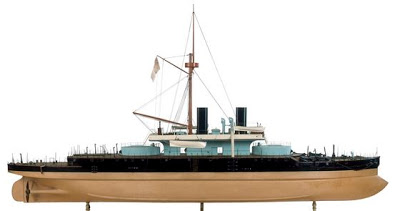
The Dawn of Battleships Without Sails.
Ships made of iron came about during the mid-nineteenth century. There were many prototypes in various countries. France built some wonderful ironclad ships and Great Britain got into an arms race with them. It was a natural competitive way of the age. France and Britain had been natural enemies, but they had been fighting side by side as allies during the Crimean War.
The American Civil War saw some very innovative designs too. People were inventing all sorts of ways to destroy other ships. Anything that might give them an advantage in marine warfare. The Confederate forces even managed to build a submarine. They mounted the first ever successful submarine attack upon a battleship. The cost was high because the submarine was sunk too.
Great Britain wanted to build a ship made of iron and without sails. They hoped for a steam driven ship. Engines fuelled by coal which in turn, rotated a prop shaft attached to a propeller at the stern of the ship and below the water. This gave them propulsion without the aid of sails. On the 12th of July 1871 at Portsmouth, the Royal Navy launched HMS Thunder Child. This battleship was state of the art during this time. There were no sails rigging and the ship’s guns were inside revolving turrets encased in iron walls. The whole ship was constructed entirely of iron. It was the first of two Devastation class battleships. The other would be named, HMS Thunderer.
Plans for HMS Devastation.
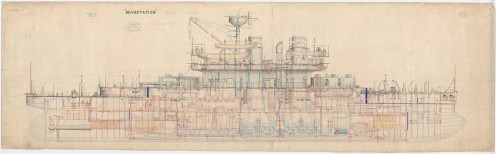
A New Innovation.
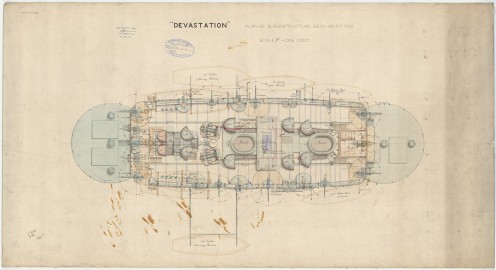
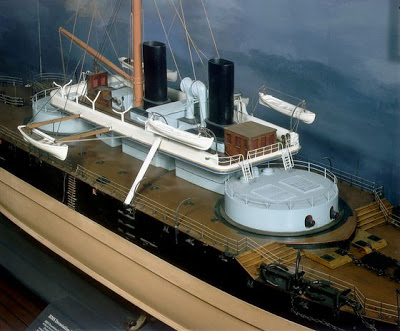
The ship sat very low in the water. The stern and the bow were a mere eight foot above the sea line. The central freeboard area of the vessel was raised higher. To move from the stern or bow to the freeboard, a crew member would have to walk up port or starboard stairs. The fore and aft of the upper freeboard area contained the revolving turret guns. Between was the small superstructure. There was an internal ladder leading up to the open superstructure deck. Also at the back of the revolving turret guns’ metal wall was an attached ladder. A crewman could get on top of the turret, where a stair gantry leads down from the fore and aft of the superstructure. It was raised above the actual turret – the last step suspended in mid-air. This allowed the turret gun to rotate and the stair gantry ending a step above could not interfere with the rotation of the turret. All delightful little innovations of the time.
The ironclad ship must have appeared very odd to the Victorian public of Britain. Especially the fact that the entire ship was made of steel. They would have been awe-struck that such a vessel could float. The complete lack of sails and rigging would seem extremely unusual. There was also a pointed ram at the bow. This sat below the water as the ship ploughed through the sea. Even in a moderate swell, the sea would have cascaded over the bow and capstan area of the deck.
The first guns to be placed inside the turrets were muzzleloaders. This means the shell and charge were rammed into the gun via the front of the barrel. Similar to the old ways of cannon loading. The charge first and then a shell. All rammed down before ignition. The breech-loading guns with shell canisters would not be adopted for a number of years by the Royal Navy. This seemed a little lacking for the time. Even though it was 1871. Each turret contained two guns. They were on wheels and there was a type of small rail that the wheels sat upon. As the two mounted guns were wheeled back inside the enclosure of the turret, they could be tipped forward so the front open barrel pointed down to the floor. There was a hole in the deck leading to a lower storey. At this lower level was a gutter like ramming system. Here loaders, below deck, could put a charge and push it up the grooves and into the dipped barrel through the ceiling. Then the shell was added to sit upon the charge. When this operation was completed, the guns were pulled back upright in the turret above. When the guns were level placed, they were rolled forward upon the rails. The front barrels barely protruded from the gun ports as one can observe in early photos.
Bird's Eye View of Devastation's Superstructure and Revolving Turrets.
Costly Design Flaws.
Of course, this only lasted for a short time because breech loaders were brought in by the Royal Navy to replace the old muzzle-loading guns. This change came about because of an accident during a gunnery exercise on board Devastation’s sister ship, HMS Thunderer. This occurred in January 1879. As the guns on the forward turret were fired, the gun crew held their hands over their ears. According to accident reports after the event, only one gun had fired. The gun crew pulled the muzzleloaders back upon the rail and tipped them forward for a second reloading. The gun that never went off was reloaded with another charge and another shell. Therefore, one of the guns had a charge and shell, plus another charge and shell all sitting in the same barrel. When the guns were rolled forward for another firing, the results were horrendous. The gunnery crew never stood a chance in the confines of the revolving turret. The catastrophic mistake caused the deaths of 11 crew members. A further 35 were injured as the explosion ripped through and out of the forward turret.
When the accident investigation was concluded this reason was given for the calamity. However, there were some investigators that believed there were faults with the hydraulic power-ramming system. There persists another theory that a part of the hydraulics broke off and blocked the barrels during the loading process. Whatever the actual reason was, the Royal Navy decided to invest in Breech loaders. This meant all gun loading could be done inside the turrets.
The Fore Turret and Superstructure of HMS Devastation.
Never a Shot in Anger.
HMS Devastation would never fire her guns in anger. Despite being in service for 32 years. She saw duty in the Mediterranean for much of her naval use and in home waters too. She was taken out of her role in 1905 and sold for scrap in 1908. During her time, she underwent various modernizations. Some of these improvements were for her boilers and guns. Her various crew was believed to have been fond of the ship, but the design did have critics too.
The press seemed to loathe the Devastation class ships. They wrote criticising reports of both vessels. These articles led to the Naval Constructor, Sir Edward Reed losing his maritime position. They ship’s had come into being under a cloak of controversy when they were launched. I think the ships were not the problem, but Sir Edward Reed was. He had been accused of taking ideas, about the revolving turret, from another designer. He had been accused of decrying the former designer before adopting the late man’s gun turrets for Devastation. This had caused some controversy with the late designer’s widow. I think this made Reed unpopular in parts of the Admiralty and this was filtered through to the British press.
Many new ships evolved from this Devastation design. It was a prelude to the Dreadnoughts. The original Devastation class ships were medium size battleships that could attack and destroy an opponent with speed. They were heavily armed and manoeuvrable. How formidable they may have been can only be speculated about. The Royal Navy was extremely intimidating in this day and age. There was not a force to be reckoned with it. After the Napoleonic wars ending in 1815, the last threatening confrontation would not come until 1914. This is a period of almost 100 years.
I can’t help wondering about HMS Devastation. I like the look of the ship because she has that primitive aspect of a metal battleship. Yet parts of the design are stuck in the old galleon times. Especially with the little stumpy muzzleloading guns scarcely protruding through the gun ports of innovative revolving turrets. I suspect she may have had a lot of vulnerabilities in battle. Yet I’m thinking of her up against a dreadnought. A further adaptation.
What would she have been like against a sailing galleon battleship like HMS Warrior? I’ve been aboard the Warrior. She is now an exhibition ship. Part of the Naval Museum at Portsmouth. I think the old HMS Victory of Nelson’s day would be outmanoeuvred and easily destroyed by Devastation. But I suspect the Warrior may have been able to put up a good account because she is also an ironclad. She has a line of port and starboard guns. Her armament is bigger. Yet she has sail and rigging. Perhaps these parts of the old ship would be susceptible to Devastation. Then I think of the number of guns Warrior has. Surely some of these would find the mark? Even on a fast moving vessel like Devastation. If there are any ship enthusiasts, please comment on how you think such a duel would make out. I would be interested to know.


