Showing posts with label WWI. Show all posts

Saturday, 24 November 2018

The Fall of House Ramanov (The Fall of Europe's Eagles)

House Ramanov

Russia, as most people know, is a gigantic country that covers over 17 million square miles. There is no other nation like it. Part is in Eastern Europe and another bigger part is in Northern Asia. It also stretches south into the Middle East near Turkey and Iran. This colossal country was always hard to govern over so vast an area with many different types of peoples.

Tsar Nicholas II
During the time of the last and final Tsar Nicholas II, there was just one railway running across the vastness of Russia into Siberia, the Asian part of the nation. This meant that much of the country was cut off. The peasants lived in humble ignorance of many things that everyday laymen in other nations took for granted. Passing news and other resources like food and machinery was extremely difficult. Much of the peasant population was neglected.

Those people that chose not to live in the countryside as peasants worked in cities like Moscow or St Petersburg. They would work in factories and live the lives of the downtrodden proletariat – low paid, bad working conditions, and horrendously crowded living accommodation. Many found food sustenance lacking and the ordinary city dweller had a very bad diet. Early mortality among the proletariat was common due to such harsh living conditions.

These people began to harbour a growing frustration and resentment towards the high ranking and privileged classes that ruled over them and they wanted to change their poor circumstance by improving their standard of living. They did all the usual things like form trade unions and strike for better conditions. Also, they tried to bring reasonable protests before the government and their Tsar Nicholas II. It was to no avail and often they would be imprisoned for, what Tsar and government thought, taking liberties they were not entitled too. The rulers would not accept a concept that freedom and fairness was a right that they (Tsar and rulers) should not be allowed to grant or take away.

Many who led such demonstrations of protest were forced into prison camps in Siberia or forced to go into exile. In 1905, things became so bad that a delegation of strikers and other citizens tried to gain an audience with the Tsar at his palace. These people hoped the Tsar would meet with them, but instead an army unit was used to open fire killing upwards of 500 protesters. More were captured and interned with others being tried and executed.


The Russian masses were willing to follow anyone with the right know how to make their miserable lives better. Living in exile were several young antagonists who believed in the doctrines of a man called Karl Marx. These were termed Marxists and one such man was called Lenin. He knew that one day the Tsarist regime and its governors would need to be replaced so that Russia could become a modern country where educated masses could all play a part in the running of the country and all would be able to have a decent standard of living. None would be able to have the privilege that the ruling classes of imperial Russia enjoyed at the workers and peasants expense.


Of course, in theory, this is easier said than done. Lenin attended meeting after meeting, addressed committee after committee, in exile, all over Europe from Britain to Switzerland. If Lenin learned one thing, while attending these meetings, it was that sometimes he would have to ride roughly shod over some of the new voices that were clambering to be heard. There were so many points of view from so many well meaningful people and no one could please all the people all the time. Some of the things brought up were obscure and secondary in significance to the needs of revolutionary change. The revolutionary groups had to be brought into line under one firm leadership that could establish control when the time for change would come.

Lenin had the foresight to see that if a revolution did take place, there might be so many small radical groups deliberating of trivia – doing the same thing back home as in exile, that it could be usurped before it got off of the ground by middle-class academics with an organised police force behind it. The workers and peasants would jump from oppression into another led by a new young middle-class intelligentsia. This he feared and he knew he would have to act swiftly if and when the time came.

That he might be an oppressor and of the young intelligentsia did not occur to him and if it did, he was the better way, from his point of view. He set about building his revolutionary groups by uniting them with the common goal of attaining power first and foremost. All else could be sorted later when a rudimentary law was established in the post-revolutionary Russia. This had not occurred yet and seemed a long way off, but he continued to try and shape a basis of Marxist power in exile – one that would be ready to enter Russia and take up the power vacuum if the weak and ineffectual Tsar was deposed.

In 1914 Russia was forced into a war with the Central powers of the Austro-Hungarian Empire and the German Empire. France and Great Britain joined imperial Russia for the biggest imperial family falling out the world had ever seen. I know to call it such is perhaps disrespectful, but I am an ordinary person sitting on a computer enjoying a look back, and this Great War was to bring about the deaths of many decent people all across the world. I can’t help but get cross by that thought sometimes. I find the events and privileged people involved in all this dreadful, fascinating and compelling. I’m sure many were good who accidentally brought about ill for the many and with hindsight; many of these grand rulers would not have trod the path they did. Perhaps I would have made exactly the same mistakes if I had been one of these high-ranking rulers. In reality, they were as much victims of their environment as others, but it was still a reckless inter-imperial family squabble that would turn Europe upside down and leave it in turmoil for much of the 20th century.

Tsar Nicholas II mobilised his army and went to war against the Central Powers of Germany and Austro-Hungarian Empire. From the start, Russia’s war effort was mismanaged. There were problems with government and logistics, industrial output and continuous replacement of high ranking officers and officials in army and government. Tsarina Alexandra was becoming more unpopular because of her influence over the Tsar. That she was also a German did not help matters. She was often referred to as, ‘The German Woman’ in cold terms. The Tsar was the absolute ruler and he often dissolved the Duma (Parliament) and called it together as and when he saw fit. He appointed ministers that would do his bidding and if they did not, he sacked them. To fall foul of the Tsarina could destroy a political career. To win her favour could bring great power.

One such person was a strange priest called Father Grigory or Rasputin as he became known. He had pleased Tsarina Alexandria because of spiritual help he had brought to her and her young haemophiliac son Alexis. She persuaded her husband Tsar Nicholas II to bestow government powers over him, much to the despair of his Duma representatives. The Tsar finally left his Tsarina wife Alexandria to watch over matters of government while he went to the front too, as he put it, share in the responsibilities of conducting the war against Germany and the Austro-Hungarian Empire.

Things got worse. On the front, his soldiers became openly mutinous towards their officers. In some parts, they shot their leaders while in Moscow and Petrograd (St Petersburg) more strikes and civil unrest escalated. Also, Rasputin, the mad monk, was killed. Eventually, some men in the Duma invoked a call for the Tsar to abdicate. A man called Alexander Kerensky who was a socialist-led the rebellion in the Duma. He was one of the very types of the young intelligentsia that Lenin feared.

As the Tsar was on board a train coming back from the front to one of his palaces to try and take control of the internal strife in his country; he and his entourage were stopped by his army along the route. He was confronted by one of his high ranking officers who tried politely to say that his signature of abdication was needed and the Duma would now be taking control of the country and the continued war with Germany and the Austro-Hungarian Empire. At first, the Tsar tried to remonstrate but then Nicholas was firmly told that the Duma and Armed forces demanded his abdication.

In layman’s terms, the Tsar was sacked but the men that did it were not so radical that they would harm the Tsar. Kerensky had every ambition of continuing the war against the Central Powers of Europe. However, other cogs of the political wheel were set in motion. The Marxist groups led by Lenin were in exile in Switzerland and his political agenda was to end the pointless imperial war with Central Europe. As far as Lenin was concerned, the imperialist aristocrats could carry on their war and leave Russia to sort her internal problems out.

Germany, at war with Russia, saw an opportunity to help replace the Russian government with one that would end the war on the Eastern front. It would allow Germany to release a large number of divisions over to the western front against France and Great Britain’s Empire forces. However, the ministers needed to persuade Kaiser Wilhelm II to allow Lenin and his revolutionary Marxists to pass through German territory into Russia from Switzerland – something that Wilhelm was not keen on. The Tsar was, after all, his cousin and he thought rightly, that Germany would be replacing an imperial power with a Bolshevik one that would one day threaten them more then Tsarist Russia could.

In the end, the Kaiser relented and Lenin and his cohorts were transported across Germany from Switzerland into Russia. From here Lenin was met by members of the new Soviet guard (loyal to his cause) and they escorted him to Petrograd. The middle-class intelligentsia of the Duma that had been trying to take over the masses and keep them in the war effort against Germany was replaced by Lenin and his men who enjoyed the support of the masses - the Marxists had won power. Some of the Duma where removed, some fled to join the White army, some joined the Marxists and others of little use to the Marxists were killed or interned. Russia’s aristocracy and upper ruling classes were about to pay the bill for years of imperialist oppression. Many that could get away fled abroad never to return – others were not so fortunate.

The former Tsar Nicholas and his wife Alexandria were handed over to the Bolsheviks along with his young son and heir Alexis – also his four daughters Olga, Tatiana, Marie and Anastasia. For a while, the defunct Royal family was transported to various locations and held in continual captivity. While any Romanov lived the White Russian forces, who still tried to fight on, hoped to restore the monarchy one day. Eventually, the inevitable decision was made by the Bolsheviks to be rid of the Romanov Royal family forever. In July of 1918 the entire Royal family, along with some Royal household servants who had remained with them, were killed as they were lined up in the cellar of a house near the Ural mountains. A Chech unit of the White army was battling the Reds close by. A group of hardened Bolsheviks came before the family and servants and shot everyone in a violent and evil end to the Romanov dynasty. The bloodline had ended and with it the Russian monarchy - forever. 


Romanov's final moments before Bolshevik executioners.

Sunday, 7 January 2018

A World War I Tank Called Deborah.

British Mark IV Female Tank WWI


The Dreadful Deadlock.

By the year of 1917, the Great War in Europe was three years old. Neither side could find an advantage. Trench systems zigzagged from Belgium into France. This wall of dugouts stretched all the way south. Two opposing forces facing one another in a stalemate with a twisted and tortured landscape separating them. The battle line continued to the borders of neutral Switzerland.
France, Belgium and the British Empire had been fighting against Germany. All along this war front, either side had sent men into the pockmarked and defiled landscape to try and push the enemy back. To overwhelm and defeat was the intention of either side as offensive, followed by counteroffensive neutered the dreadful deadlock. Neither armies had won more than a few miles of ground. When a new offensive happened, one nation or another would lose multiple thousands of men again. Perhaps conceding a few miles of ground previously won.
The colossal cost of the bitter struggle saw millions perish. Hordes of men charging across the bomb craters and barbed wire enchantments of No-man’s-land. Some regiments would spend months training fresh troops. These patriotic and idyllic minded men could often be pulverised in a few minutes. Shot to pieces as they tried in vain to cross the quagmire of mud and barbed wire stumbling blocks. And so the deadlock had continued into the late autumn of November 1917.

A Replica Mark IV British Tank of WWI.

A New Plan of Action.

The British had been trying to adapt the tank design for an all-out offensive. They had used such armoured vehicles before in small numbers. They had not been successful. The machines were cumbersome and often broke down. However, there were engineers and designers that persevered with the tank concept. With improved adaptations, some of the inventors realised that the craters, barbed wire walls and various other obstacles of No-man’s-land could be overcome by the giant steel beasts on tracks. A mark IV presentation of the armoured tank was designed. They had been secretly mass produced in a factory in Lincolnshire, England. Most of the workforce were women. These big armoured iron vehicles were comprised of two variants. One was a male tank. These had the revolving cannon on each side of the vehicle. The other type was female. The female tank had forward and back machine guns on either side of the tank. 375 of these tanks were built for a new experimental offensive. An attack that would crash through the barbed wire obstructions and easily traverse the trench systems. Advancing infantry could take cover behind the metal monsters. This was a new innovative idea that had never been tried before. Something that might break the deadlock.
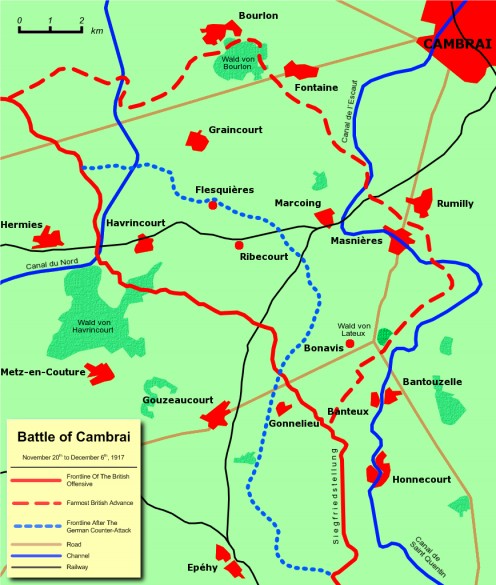
The British high command chose an area along the Hindenburg line. This was a heavily fortified point and had seen little action compared to some parts of the front line. There were tremendous walls of barbed wire fencing and also three lines of German trenches. The particular area of the front line was more heavily fortified than most areas. It may have been a reason why there had been little action in the area compared to the Somme or other places. The ground was hard and this made the area more suitable for the tanks. In secret, the 375 tanks were brought close to front-line positions via train transportation. Everything was done under a cloak of secrecy. The closest major town was Cambrai. This was on the German side of the line. Along an eight-mile stretch of the British line, the British Empire forces assembled their 375 tanks. The assault was scheduled to begin at 06.20 am on the 20th of November. Shortly before the designated time, the first of the mark IV tanks started to roll forward on their screeching tracks, over the uneven earth towards the German positions. It would still be dusk. The morning light was yet to come. The cumbersome looking metal beasts could only move at around four miles an hour, but the uneven landscape was unable to prevent the advance of these newly designed tanks.

Authentic Film of British Mark IV Tanks.

The Metal Monsters Slowly Advance.

At the right moment, the British Empire forces unleashed a horrendous artillery barrage upon the German trenches. The mark IV tanks moved doggedly forward with the bombardment raining down upon the German positions. As the giant steel contraptions smashed through one barbed wire barricade after another, the horrified German soldiers began to panic. Their machine gun fire that had previously scythed through the walls of enemy infantry were of little effect upon the tanks. Some of the German artillery pieces managed to score hits upon the advancing metal monsters, but many of these were taken out in turn by the barrage of enemy artillery fire or the tanks shooting back with forward moving cannon or machine gun fire. Some British tanks were stopped but not enough. The Germans had a tidal wave of iron monsters coming at them. Nothing like this had ever happened before. On this late autumn morning, many of the German soldiers must have thought they were witnessing some sort of apocalyptic event. The steel mechanisms continued to approach ominously. All the while firing cannon and machine guns at their entrenched positions. The tanks ripped through the barbed wire entanglements as though they were nothing but cotton and once upon the trenches, the female tanks with their machine guns would have an evil harvest upon any enemy soldier courageous enough to try and stand.
The German enemy fought hard, but could not immediately frustrate this new type of warfare. At this point of the battle, the British Empire forces were advancing with limited casualties. The offensive had taken the Germans by surprise. However, the speed and ease of the encroachment had also taken the British by surprise. The success had been beyond their expectations. Of the 375 tanks, 179 were put out of action. Most of these were because of breakdowns, but around 60 were destroyed by enemy fire. Some of the metal contrivances advanced too far. They were unable to consolidate the ground they overrun because back up infantry forces were too far behind.

The Area of the Tank Action 20th November 1917.


Deborah the Female Mark IV British Tank.

One British tank crew advanced towards a small village called Flequieres. This small hamlet was French but was on the German side of the lines. The lone British vehicle had briefly lost sight of other advancing British tanks and seemed to be driving rouge. As the crew of the female mark IV tank, named Deborah, went close to the enemy held French village, they experienced a hail of machine gun fire hitting the armoured plating of their tank. The eight men inside had been proceeding under enemy fire and fighting back all day. This situation had persisted for almost five hours. It would have been approaching the afternoon. Their own machine guns returned fire and a brief gun battle ensued. The tank driver, Lance Corporal Marsden, steered the mark IV slowly south of the village. Away from the buildings and back into the torn and smashed landscape of No-man’s-land.
The officer commanding the tank crew was twenty-three-year Second-Lieutenant Frank Gustav Heap. He ordered the crew to stop the tank. They were in No-man’s-land and the rugged mounds of soil may have offered some security. For a few moments the tank crew would take a breather, perhaps get their bearings. The young officer decided to step out and stretch his legs. Maybe urinate while the opportunity was there. Who knows? He had stepped outside the iron contraption for mere seconds and walked a few steps away from the tank into the torn and abandoned backdrop. He was suddenly startled by the impact of an enemy shell smashing into the stationary tank – Deborah. The point of impact left a hole in one side of the tank and exploded inside ripping out a bigger hole on the other side of the vehicle. The young officer had missed death by a matter of seconds.
The tank exploded as more shells hit the stationary frame. The tank driver David Marsden had miraculously survived the impact. He had got up from the driving seat and moved to the back of the vehicle to do some required chore. Somehow he got out of the burning wreckage with one other crew member. The other five crewmen were killed in the violent explosions resulting in the destruction of Deborah – the Mark IV tank.
Second-Lieutenant Frank Gustav Heap, Lance Corporal Marsden and one other unknown tank crew member had to leave their five dead comrades in the burning tank and make their way back towards their own positions. This they managed to accomplish.

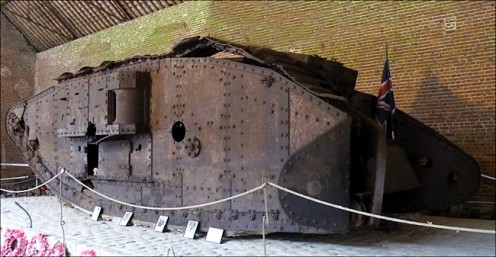
Deborah in the Barn Museum.


Finding Deborah - The Old Mark IV Tank.

There was a later German counter-offensive and much of the ground overrun by the British tanks was recaptured by the German forces. However, some sections of the advance were held. Including the village of Flequieres. The village was actually on the new front line for a time. The wrecked tank Deborah was found by a group of Scottish soldiers. The five corpses of the British armoured crew were taken from the vehicle. The wreckage was pushed into a trench and used as a gun position according to some. A young French girl living in the village observed this from a distance. Her scrutiny would become very useful in later decades when she was an old lady. For she witnessed the tank as it was being buried.
In 1918, the Great War ended after much horror and more killing on both sides. Twenty years later, there was a second war. The long periods of peace in this part of Europe that followed saw the tortured land return to its normal agricultural splendour. The meadows returned to the former ways of farming and French national prosperity settled upon this farming area. The children knew of the land’s dreadful history and sometimes the young boys would find things from the bygone war in the fields. One such youngster was called Philippe Gorczynski. He developed an interest in the history of the area and became an amateur historian. He acquired a hotel and become a hotelier by trade. One member of the village told him about a British tank buried out in the field. She had seen such an event when she was a child. The lady was the very person mentioned in the previous paragraph.
Philippe Gorczynski searched in vain for six years but could not pinpoint the location of the wrecked British tank named Deborah. He was certain it was there and never doubted the old lady who told the story. Eventually, he hired a private light aircraft to fly over the field. Philippe went up with the pilot and he was able to see things from above with an amateur archaeologists’ eye. With his new and improved aerial opinion, he hired a mechanical digger and got permission from a farmer who owned the field he wanted to dig. At his chosen location, the digger came upon something metal after digging for about two meters. He then called in an archaeology team to help dig out the discovery. In a short time, they were convinced of their find. It was a destroyed female mark IV British tank from the First World War. It was the tank known as Deborah. The very armoured vehicle that Second-Lieutenant Frank Gustav Heap and two of his crew had escaped from back in 1917.
The tank was brought up from its muddy preservation. It was then taken into the village of Flequieres and put on display in a barn come museum. There are photos of the crewman and a general description of how the tank came upon its fate. One of the people that came from Britain to pay homage was Frank Gustav’s Grandson Tim. He was able to elaborate on the story of what happened to Deborah. His Grandfather who escaped from the dreadful ordeal with his two surviving crewmen lived to be sixty-four and died in 1956. Lance Corporal Marsden, the tank driver, lived to be almost 82. The event with the tank happened five days before his thirtieth birthday. He died in 1969. The other survivor remains unknown.
The men that are buried from the tank Deborah are in a cemetery at Flequieres. Their names are as follows; Private W.G. Robinson, Gunner William Galway, Lance Corporal G.C. Foot, Gunner Joseph Cheverton and Gunner F.W. Tipping.
© 2017 colin powell

Tuesday, 18 November 2014

Red Baron (Manfred Von Richofen) Replica Fokker Dr1 Dreidecker

An aviation enthusiast named Paul Ford has spent £180,000 building an exact replica of Manfred Von Richtofen's Fokker Dr1 Dreidecker. This was the deadly German WWI fighter plane that Richtofen used among the 70 allied pilots he shot down. He was nicknamed; The Red Baron.

Now Paul Ford intends to take people up in his replica of the original WWI plane to indulge in mock dogfights.


Saturday, 30 August 2014

Covenant With Death - A story about a group of young men during the Great War!

A group of young men all from the same town are trained for combat in WWI. All their close friendship and training comes to a climatic moment when they must make their big charge. All the long training for this one big event that lasts no more then minuets charging across no-mans land.

We are presented with a group of young men from a small town or district. They all know one another and are caught up in the patriotic fever of the nation during the Great War. They enlist because it is the noble thing to do. All the old ladies of the village are thanking them for going to a far flung land to protect them and all are immersed in the propaganda of the time.

Among the young men are all the various people from brash young lads who think they are a hit with the ladies, others that are, some that are shy, others that are sheltered and still clutching their Mother's apron strings. All sorts of young men are among the recruits who train for the one great spectacle. The charge across No Mans Land. The story is daunting but compelling too. Well worth a read.