Showing posts with label european space exploration. Show all posts

Sunday, 27 July 2014

European Space Agency's Idea for a Quadcopter on Martian Surface

The most ludicrous way of getting a robot to the surface of Mars is maybe stuffing it inside a giant inflatable bouncy ball and dropping it from a parachute. And that is only slightly more ludicrous than attaching it to a rocket-powered hovercrane (a rocket-powered hovercrane!!!) and thenlowering it to the ground with some sort of ridiculous cable contraption.
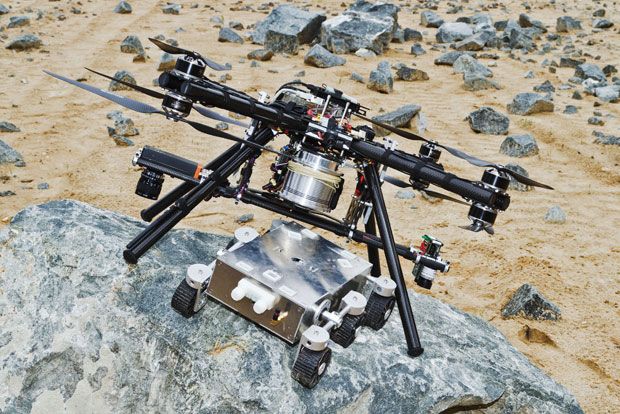
So, the bar is very high for finding ludicrous ways of getting robots to the surface of Mars, and the European Space Agency (ESA) has taken on the challenge with a quadcopter that can safely drop a rover down onto the Martian surface while hovering.

This is a combination of navigation software and hardware (GPS plus inertial systems, followed by vision-based navigation, a laser range finder, and a barometer), and visual hazard avoidance: the quadcopter is actively avoiding perceived obstacles (big pointy rocks and such) to find a nice, clear, flat, happy place to set down its rover cargo, using a 5-meter-long bridle.
You can think of this system as a combination of NASA's Morpheus lander, which has autonomous obstacle avoidance for landing site selection:

And this system from Japan, which is designed to deploy small rovers into (or next to) volcanoes:

Now, no matter what the ESA says in its press release, we don't want you to get the idea that this thing is now ready to fly off to Mars, rover in tow. There's a reason that NASA went with rockets and not rotors. I mean, there are probably lots of reasons, but one of them is that Mars doesn't have much atmosphere: the pressure at "sea level" on Mars (which is the average radius of the planet, Mars not currently being in possession of any seas) is about one-hundredth the atmospheric pressure at sea level on Earth.
And since things like helicopters depend on thrusting air downward to keep themselves up, you're going to need some ludicrously long blades (or a huge number of small ones) to physically move enough atmosphere to remain airborne. The reduced gravity (a little over a third of that on Earth) will help substantially, but it's still not a proven approach. This page from Georgia Techprovides more detail on how bad of an idea this is, and suggests flapping wings as a substitute (although I think it's research from 2001-ish).
What's most relevant here is the software that the team developed to navigate and detect hazards, because it can (presumably) be adapted to other flying platforms, like rocket cranes, or something more exotic, like maybe something based on a balloon. Or an anti-gravity hovership. The ESA has those, right?

Friday, 18 July 2014

U.K. wants commercial spaceport by 2018 | sen.com

Wow! Our own British Space Port by 2018. That's not small potatoes. Lets hope the government keeps on the ball with this one.


Click link below SEN (Space Exploration News)


U.K. wants commercial spaceport by 2018 | sen.com


 .


Monday, 30 June 2014

Europe plans to build world's biggest X-ray telescope

This is from: SPACEFLIGHT NOW - an online magazine of current space exploration news

A half-year after the European Space Agency formally prioritized high-energy astrophysics for its next flagship-class science mission, officials announced Friday the selection of a European-led X-ray observatory named Athena for launch in 2028.
Artist's concept of the Athena spacecraft. Credit: Athena project team
 
The huge telescope will replace ESA's XMM-Newton mission and NASA's Chandra X-ray Observatory, collecting data on the interplay between matter and black holes, halos of enigmatic hot gas enveloping faraway galaxies, distant gamma-ray bursts, and other phenomena.


Athena will see objects fainter than XMM-Newton or Chandra, and it is the only X-ray telescope in its class slated for launch in the 2020s, ensuring high demand for Athena's data haul, according to scientists.

The telescope will launch on a heavy-lifting rocket, possibly Europe's Ariane 5, and fly to the gravity-stable L2 Lagrange point a million miles from Earth for a five-year mission.

Athena will weigh about five metric tons, or about 11,000 pounds, at launch. Its telescope will measure about 12 meters, or 39 feet, long with ultra-lightweight silicon pore optics, a new technology comprising stacks of silicon wafers to reflect high-energy X-ray light to the mission's two instruments.

Missions like Athena must launch into space to see the universe in X-rays, which are absorbed by Earth's atmosphere, rendering observations from the ground impossible.

Athena will look back in time to observe how galaxies and galactic clusters assembled a few billion years after the Big Bang, according to the mission's backers.

The telescope will also resolve the flows of matter falling into black holes, contribute to exoplanet research, and survey the wider universe to map large-scale cosmic structures.

"Athena will be a state-of-the-art observatory that will provide a significant leap forward in scientific capabilities compared with previous X-ray missions, and will address fundamental open questions in astrophysics," said Alvaro Gimenez, ESA's director of science and robotic exploration. "Its selection ensures that Europe's success in the field of X-ray astronomy is maintained far beyond the lifetime of our flagship observatory XMM-Newton."

Officials announced in November that the next two large-class missions in Europe's Cosmic Vision program would be an X-ray telescope and a mission to confirm the existence of gravitational waves.
The Cosmic Vision program is a strategic architecture for the selection of Europe's space science missions through a judicious process involving proposals, reviews and recommendations by the European research community.

But the November decision in favor of X-ray and gravity wave missions did not come with a selection of specific mission concepts.

For the first large-class, or L1, Cosmic Vision mission, ESA is working on an orbiter to be launched to Jupiter in June 2022.

ESA's Science Program Committee last week signed off on the Athena mission for the L2 opportunity, and an endorsement of a concept for the L3 gravity wave research mission will come in 2020, with launch to follow in 2034.

Athena was the only proposal submitted for consideration by the committee, officials said.
Next comes detailed study and definition phases to mature technologies required for the Athena mission.
ESA will also begin negotiations with potential partners, such as the United States and Japan, to contribute to the Athena mission. NASA officials have already stated their interest to provide components for Athena's scientific sensors.

European Space Agency officials will meet again around 2019 for formal adoption of the Athena mission, setting a budget, plan and other details before industry begins construction of the spacecraft and its instruments.

Follow Stephen Clark on Twitter: @StephenClark1.