Boudicca and Cartimandua

Two Queens of Roman Britain.
There were two queens of Roman Britain. One was infamous and became a worldwide name. She was a glorious failure, but her terrible legacy was spectacular. Her name was Boudicca, queen of the Iceni. She is also known as The Warrior Queen.
Across the world, most people have heard of this late Chieftain’s wife. A woman from a wicker walled hut that was rendered with mud mixed with cow dung. A cone shape thatched roof would sit upon such abodes. Perhaps it was a big hut. Bigger than most humble Britons had. But it was basic by most civilized standards. This woman who led an army of many thousand warriors. Her reign was short and bloody and her testimonial was paid for with multiple thousands of lives. Her shrine came at a disgusting price of mass human slaughter. Yet still, she remains the persistent darling of the British Isles.
The other queen would have a long and successful reign. She remained living after being deposed. This more mysterious woman faded from memory. Her name was Cartimandua. She was Queen of the Brigantes from 43 AD to 69 AD
These queens were in Roman Britain and ruled at the same time. Cartimandua was the queen of her Brigante before, during and after Boudicca's short-lived reign of the Iceni. The two queens would have known of one another. I wonder if they ever crossed paths. Maybe when they were younger at some huge tribal gathering. Perhaps some Celtic festival.
I can't help wondering what these two queens would have said to one another If Boudicca had won and driven the Romans from the British Isles. Would the warrior queen have marched upon the Brigante queen for her lack of support? Would the warrior queen have wanted to bring Cartimandua to justice?
A large section of the 9th Legion was wiped out by Boudicca's forces.
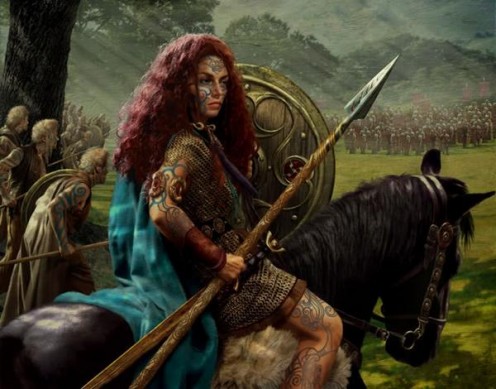
The Warrior Queen
Boudicca remains the most revered of the two women. The famous queen of the Iceni. The ancient British warrior queen who went to war with the Roman Empire. The time was 61 AD and the Emperor of Rome was Nero. The famous leader who fiddled while Rome burnt.
Roman historians loved their enigmatic enemies. They always told tales of such ferocious opponents. Especially if they had the good grace to fight and then die in defeat. The Romans got to write their history unchallenged as the illiterate Britons had no text. The Britons' records were told via their bards and their priests who were Druids.
Boudicca would become a monument of fear to the Roman historians. And this edifice of terror killed in excess of eighty thousand people. The warrior queen went on a killing rampage after she and her two daughters were violated by Roman militiamen. These rapists were the protective escort of a tax collector. The revenge of the Iceni would be swift and cruel. The murder and mayhem that followed would spread extreme terror among the Roman colonists. The occupying authorities almost abandoned the British Isles. Today's towns of Colchester, London and St Albans would all be burnt to the ground. The inhabitants put to the sword. A section of the Roman 9th Legion would be wiped out as they marched to the aid of the wretched colonists of Colchester.
Boudicca’s turbulent reign lasted for a little more than one year. The last few months would have been the rebellion. In the end, her uprising was disastrous for her people and Rome would exact a heavy price for such defiance. Queen Boudicca would be defeated at the Battle of Watling Street. Historians think it was somewhere in the midlands between Leicester and Coventry. No one knows for sure. Her corpse was not found on the battlefield after the Roman victory. The warrior queen left the field and went into hiding. She was never heard of again. Only the memory of her dreadful killing spree remained. It is most likely that she committed suicide in some wooded sanctuary. Perhaps Druids disposed of the corpse so that the Romans could not desecrate her body. They liked to parade their enemies before Rome and its mob of citizens. This had been done to Vercingetorix the Gaul. No such thing could be allowed to happen to the warrior queen.
Boudicca had an everlasting platform of fearful approval because her enemies recorded her rebellion. Today she echoes throughout history. Courtesy of the Roman Empire. And most Britons, are not displeased by such accolades.
Client Queen Cartimandua Allied with Rome.
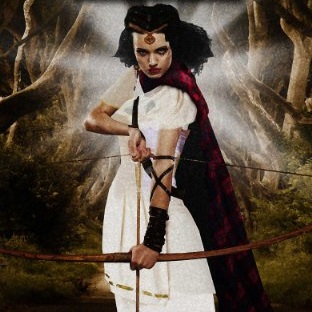
Cartimandua the less known queen of the Brigantes.
There was another queen living in Ancient Britain at the same time. She has no monument except that of a little-known collaborator. A Roman historian called Tacitus describes the Brigante queen as treacherous. Even though she was loyal to Rome. Cartimandua had been the queen of the Brigante in 43 AD when Emperor Claudius ordered his legions to invade the Isle. Rome held her in high regard. Therefore, Tacitus begrudgingly recognises the queen's rank in his written historical account. Cartimandua was caught up in immoral scandals and rejected her husband. Yet she ruled for more than twenty-five years and is believed to have continued her life after being usurped of power in 69 AD.
Among her many infamous deeds was the betrayal of Caractacus. He was a Catuvellauni Chieftain who tried to resist the advancing Romans. His kingdom was overrun. He retreated but kept fighting. The fugitive chieftain ran from one feudal kingdom to another. The Romans followed and overrun these areas of Ancient Britain too. Eventually, Caractacus went before Cartimandua of the Brigante. He wanted sanctuary and help against the Romans. The Brigante queen had him bound in chains and delivered to his enemy. The British chieftain was paraded through Rome and presented before Roman delegates. Caractacus made a bold and defiant speech which won admiration. He was sent to a comfortable sanctuary and spared execution. Cartimandua had made an important ally in Rome and secured her rule over the Brigante as a client queen.
Cartimandua’s reign seems to have been predominantly successful. Her Brigante kingdom was not overrun by the new invaders. While Cartimandua remained queen, the Romans left the Brigante alone. Roman historians do not revere her. So not much was recorded about her. She was uninteresting because she never rebelled. Although she remains the subject of scandalous gossip. When Boudicca the warrior queen rebelled against Rome, many British tribes started to flock to her cause. The Brigantes never. Cartimandua stayed true. She kept her alliance with Rome.
I’ve seen documentaries where historians have said that Rome never accepted female rulers and it was a reason why they would not recognise Boudicca as queen. Yet Rome accepted Cartimandua over her husband, a Brigante Chieftain they called Venutius (Latin name. Celtic name unknown.) Cleopatra of Egypt was preferred over her young brother. Rome preferred anyone who could aid them.
Cartimandua divorced her undesirable husband and with Roman aid, Venutius was driven north to the Caledonian tribes. The Brigante queen took her husband’s man at arms as her lover. The cuckold and displaced chieftain would wait patiently for many years in exile. He never forgot and never gave up his claim to the Brigante lands. Cartimandua's eventual fall would be sown during the reign of Emperor Claudius. It would take more than two decades to reap the ill harvest of fortune. In that twenty-five years, the Brigante queen would enjoy her power. Until the year of the four emperors.
The Roman Empire in the Year of the Four Emperors
In the year of 68 AD, the Roman Emperor Nero died. He committed suicide amid civil unrest. What followed was a period of time known as the year of the Four Emperors. Across the Roman Empire, powerful men tried to proclaim themselves as Emperors. There followed a succession of power grabs followed by murder. First came Emperor Galba, the man who conspired to displace Nero. He was removed and killed by the Praetorian Guard. New Emperor Otho was proclaimed. This did not last long as another man named Vitellius marched on Rome to proclaim himself Emperor. Emperor Otho lost a battle with Vitellius’ forces. Although Otho retreated from the battle uncaptured, he committed suicide soon after. Vitellius quickly got himself into trouble and began a killing spree. Anyone remotely suspected of challenging him was killed including citizens and money lenders. Vespasian in Judea went to Egypt and was accepted as Emperor in waiting where the huge grain supplies were.
In Rome forces loyal to Vespasian entered the city. They captured and murdered Vitellius as he tried to get back to his palace. He had been desperately trying to broker peace deals and win support beforehand. It was to no avail. Vespasian was proclaimed Emperor by the end of 69 AD
During this turbulent time in the Empire, Britain was under a Roman Governor called Marcus Vettius Bolanus who would be receiving all sorts of strange news. Various Emperors coming and going. Various allegiances. Cartimandua would almost become a victim too. Her banished ex-husband Venutius invaded the Brigante from the north. He had Caledonian and Brigante warriors to aid him. It was also the old cliche of, 'when the cat is away the mice will play.' There was no organised Roman authority because the empire was in political turmoil.
The Roman governor of Britain, Marcus Vettius Bolanus, managed to dispatch some help for Cartimandua. She was rescued and brought south as Venutius and his followers took the Brigante lands. Cartimandua went into exile. Some believe it was in mainland Europe. Here she faded from history.
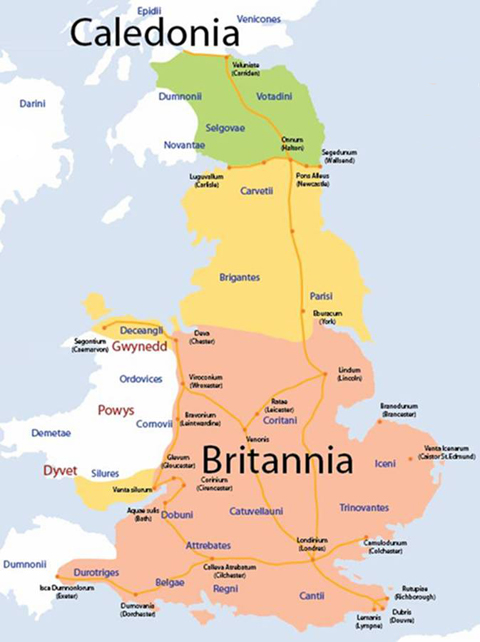
Cartimandua's Brigante in yellow.
Roman Britain Quiz
What if the two queens of Roman Britain met?

Perhaps they did meet?
Indulge the thought of these two different queens. Boudicca's army is destroyed by Roman forces and the defeated warrior queen flees northward. She is intent on suicide. The Brigante southern borders would not be far. What if there was a meeting. The two queens of Roman Britain. One a rebel, the other a collaborator. Cartimandua's enemies were to the north, in Caledonia. Boudicca's were the Romans to the south. It would not be in the interests of Cartimandua to join the rebellion. She may have been worried that the warrior queen would be successful.
But what if, just for a moment, the two might have met under a neutral circumstance. What would they have said to one another?


