I was looking at a a robotic company called DARPA. This group are making advancements in many fields concerning robotics or cybernetics. In this YouTube clip we see a man with a prosthetic limb. The technology is obviously in its infancy, but what encouragement. Funding can to make this a more beneficial thing for people who lose limbs. We've imagined such things in the past through t.v. science fiction, but now we are looking at reality. In the above clip we see a man using his prosthetic arm to pick up eggs from a carton and replace them in another. He manages to do this, but not with the confidence and ability of a normal organic limb. However, advancements in the future will surely come about.
Showing posts with label robotics. Show all posts
Showing posts with label robotics. Show all posts
Sunday, 27 July 2014


Could An Army Be Replaced with Robots Instead of Human Soldiers?

Sometimes the pace of advancement is so rapid, I can't keep up with it. It never fails to excite and dazzle me. These new innovations concerning robotic soldiers are just the tip of the ice berg. This is another article from EEEA Spectrum - a leading magazine/blog online where all sorts of grand ideas can be found. What if all these robots went rouge or some mad dictator got hold of them? It does have shades of Terminator about it all. I'm sure we'll develop ways of combating these robots too, or a new type of combating science will evolve for such a thing. Counter measures bring about counter, counter measures and so the ever expanding circle continues.
U.S. Army Considers Replacing Thousands of Soldiers With Robots
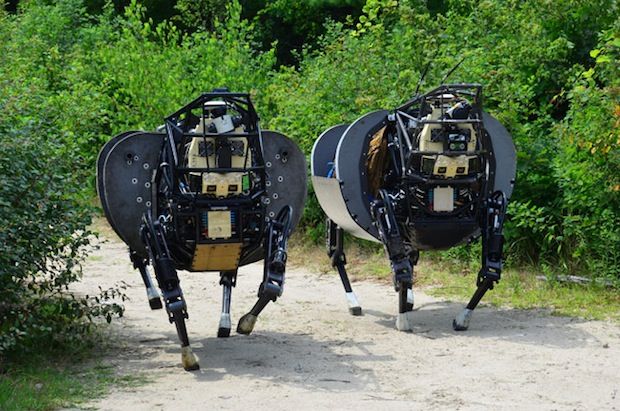
Photo: Boston Dynamics
Boston Dynamics designed the LS3 "robot mules" to help soldiers carry heavy loads.
Last week at the Army Aviation Symposium, in Arlington, Va., a U.S. Army officer announced that the Army is looking to slim down its personnel numbers and adopt more robots over the coming years. The biggest surprise, though, is the scale of the downsizing the Army might aim for.
At the current rate, the Army is expected to shrink from 540,000 people down to 420,000 by 2019. But at last week's event, Gen. Robert Cone, head of the Army's Training and Doctrine Command, offered some surprising details about the slim-down plans. As Defense News put it, he "quietly dropped a bomb," saying the Army is studying the possibility of reducing the size of a brigade from 4,000 soldiers to 3,000 in the coming years. To keep things just as effective while reducing manpower, the Army will bring in more unmanned power, in the form of robots. From the Defense News story:
“I’ve got clear guidance to think about what if you could robotically perform some of the tasks in terms of maneuverability, in terms of the future of the force,” he said, adding that he also has “clear guidance to rethink” the size of the nine-man infantry squad.“When you see the success, frankly, that the Navy has had in terms of lowering the numbers of people on ships, are there functions in the brigade that we could automate—robots or manned/unmanned teaming—and lower the number of people that are involved given the fact that people are our major cost,” he said.
The thing to keep in mind about initiatives like this is that the army personnel who are actually flying airplanes or shooting guns or disarming bombs don'tmake up the majority of the army. There's a concept called tooth-to-tail ratio, which is the ratio of soldiers directly involved in fighting missions (tooth) to those involved in supporting activities (tail). A typical ratio is about 1/3 tooth to 2/3 tail, which means that you're spending a lot of resources on logistics, supplies, and other efforts to support the actual combat operations. According to Gen. Cole, the Army sees that as an opportunity to become more efficient. "Maybe it’s one-half to one-half," he said. "The point is you get to keep more tooth, more folks that actually conduct operations on the ground and less supporting structure."
And one way of becoming more efficient is by using support robots—a trend we're seeing not only in the Army but other U.S. armed forces as well. Robots will likely include autonomous vehicles that can transport supplies,autonomous aircraft that can transport supplies, and other autonomous robots that can transport supplies (like the LS3 "robot mule," pictured above). As you may have noticed, there's a theme here, but most of those support robot programs are in the early stages and whether they'll prove effective, only time will tell.
Saturday, 7 June 2014
Doc Oc for Real

Real robotic arms are being made below is a link on the subject. How long before Doc Oc is a reality?
http://newstonight.co.za/content/mit-researchers-create-pair-robotic-arms-srls
Sunday, 7 July 2013
Robots Will Become House Hold Appliances
On
YouTube there are examples of advanced prototype humanoid robots that can walk
about and have perfect balance. One was an Asimo Honda model that had perfect
coordination and balance. Its movement was very fluid and it could side step as
well. Then another model appeared at a conference show. It was made by Kawanda
and was taller and leaner looking than the Asimo model. I could not believe how
advanced these Robots were and how well they moved. The Kawanda model began
posing upon the stage as though it was at a Mr Universe contest, showing
various arm movements then stretching out its arms, standing on one leg with
perfect balance. It was incredible.
Robotic engineering is increasing at mind boggling rates. How long before we have such
things as domestic appliances? How quickly will the new upgrades start coming
out as we quickly replace them the way we do mobile phones or computer tablets?
I
can imagine them with their own mobile phone systems. You'll ring home and it
will answer. You'll tell it what you want for dinner and it would have done all
the chores. We will become lazy. They might have agricultural ones ploughingfields and picking crops. Where will it stop and what will we do? Devote
ourselves to scientific or artistic past times? Yes everything sounds Hunky
Dory or will it be?
Even
out in Space they could be used. We were talking about mining asteroids and
using them as vehicles in space or extracting minerals from them. Rather than
use astronauts in such a hazardous enterprise, how about robots? We could
reduce the risk and it all seems very probable that this type of solution will
be used.
Again,
robotics makes the possibility of many tasks we perform even more remote. The
benefits of such machines could be tremendous. The amount of unemployed looks
even worse however. A vast amount of the population will need to be motivated
or we could all drift into a state of apathy.
When
I watched part of the Robotic display I found it exciting and also potentially
scary. I was not afraid of the actual machines, but more by what their integration
will do to mass population employment. All the science fiction notions of
machines doing the work become frighteningly more plausible. Multi millions of
these machines will become common domestic appliances like a hover or washing
machine. Every household will have one. I sincerely believe this will happen
and possibly in my lifetime. I think if we do not adjust ourselves to the
potential pit falls, we could ruin our society for some considerable time.
I
have an image of me driving along the motor way with these humanoid things
litter picking. They might be used by councils for waste disposal in town
centres or be traffic wardens. The potential is limitless and the mass of
people becoming unemployed is even more ominous. Sometimes technology advances
at a pace we can’t keep up with. I was truly shocked by how advanced these
humanoid robots could move.
Out
on the fringe of society these robots would be great; like mining or space
exploration in hazardous areas. This I see as positive, but that trend of
domestic reliability is the one that makes me wobble. The manufacturers need to
get them into domestic reliability to create a popular demand and enable them
to lower costs of mass purchasing these robots. However, if lots of people are
unemployed how will the economics for upgraded models come about?
We
are going to have to radically change our society to motivate large sections of
our population because we might struggle to adapt quick enough.
Tuesday, 18 June 2013
Robotic Engineering
Robotic engineering is increasing at mind boggling rates. How long before we have such things as domestic appliances. How quickly will the new upgrades start coming out as we quickly replace them the way we do mobile phones or computer tablets?
I can imagine them with their own mobile phone systems. You'll ring home and it will answer. You'll tell it what you want for dinner and it would have done all the chores. We will become even more lazy. They might have agricultural ones ploughing fields and picking crops. Where will it stop and what will we do? Devote ourselves to scientific or artistic past times? Yes everything sounds Hunky Dory or will it be?
Even out in Space they could be used. We were talking about mining asteroids and using them as vehicles in space or extracting minerals from them. Rather than use astronauts in such a hazardous enterprise, how about robots? We could reduce the risk and it all seems very probable that this type of solution will be used.
Again, robotics make the possibility of many tasks we perform even more remote. The benefits of such machines could be tremendous. The amount of unemployed looks even worse however. A vast amount of the population will need to be motivated or we could all drift into a state of apathy.
I find the above YouTube clip exciting and also potentially scary. Not the machines, but they way mass populations would become because of them being domestic appliances, which I sincerely believe will happen. I think if we do not adjust ourselves to the potential pit falls, we could ruin our society for some considerable time.
Out on the fringe would be great; like mining or space exploration in hazardous areas. This I see as positive, but that trend of domestic reliability is the one that makes me wobble.
I can imagine them with their own mobile phone systems. You'll ring home and it will answer. You'll tell it what you want for dinner and it would have done all the chores. We will become even more lazy. They might have agricultural ones ploughing fields and picking crops. Where will it stop and what will we do? Devote ourselves to scientific or artistic past times? Yes everything sounds Hunky Dory or will it be?
Even out in Space they could be used. We were talking about mining asteroids and using them as vehicles in space or extracting minerals from them. Rather than use astronauts in such a hazardous enterprise, how about robots? We could reduce the risk and it all seems very probable that this type of solution will be used.
Again, robotics make the possibility of many tasks we perform even more remote. The benefits of such machines could be tremendous. The amount of unemployed looks even worse however. A vast amount of the population will need to be motivated or we could all drift into a state of apathy.
I find the above YouTube clip exciting and also potentially scary. Not the machines, but they way mass populations would become because of them being domestic appliances, which I sincerely believe will happen. I think if we do not adjust ourselves to the potential pit falls, we could ruin our society for some considerable time.
Out on the fringe would be great; like mining or space exploration in hazardous areas. This I see as positive, but that trend of domestic reliability is the one that makes me wobble.
Subscribe to:
Posts (Atom)
-
The Shape of Snakes by Minette Walters My rating: 5 of 5 stars This is my favourite Minette Walters story. I could not put the book do...
-
 This British lady is famous for her collection of different earrings. For me, its the main thing that stands out in all her delightful...
 -
 Some Ladies want to copy Moyra Melons, but they don't have an inkling. There is no attempt at getting better ear rings and because...
