Showing posts with label #2015In5Words. Show all posts

Saturday, 30 December 2017

Splendid German War Movie.


When I saw this movie on Amazon Prime, I could not resist downloading it. I was not disappointed. It was an in-depth movie – a good German production. I liked Das Boat, Downfall and the original 1950s version of The Bridge. I suppose my choice of Rommel was upon the good merit of these previously watched German made war movies I had seen. I suppose I could add Stalingrad, but it was dubbed in English. I’m a Brit but dubbed English really does not work for me. Therefore, I was pleased when I realised this was still in German. I prefer to read subtitles and get a real feel for the nation speaking its native tongue.

The Rommel movie concentrates on the last seven months of Field Marshal’s life. We see him just prior to the Normandy invasion force and during the botched assassination attempt on Adolf Hitler’s life. The movie makes for a splendid historical drama and I would highly recommend watching this superb war film. If you are on Amazon Prime, you can rent it for 30 days at .99p. A bargain by any stretch of the imagination.

The Ominous Origin of an Austrian Folk Song - Ach du Lieber Augustin

Marx Augustin

Augustin's Casual Way of Life.

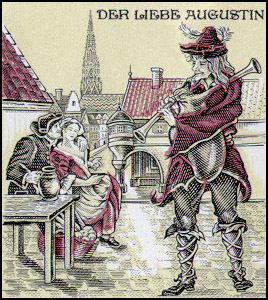
The above is the title of an old Austrian folk song that is often sung. One might imagine it in a beer Keller or something similar. It is usually played to one of the handheld accordion instruments. These are common among the German-speaking peoples of Europe. Sometimes a rum little tune can capture the imagination of the multitude. It might develop a fascination with viral quality. In the days of no computers, a song was a strong way of spreading across the land. Sometimes songs came about by strange and unexpected events.
Ach, du Lieber Augustin is such a song. The man it refers to was real. He lived in Austria between 1643 and 1685. He was a wandering minstrel who sang ballads. He was also a player of bagpipes. The taverns or alehouses of Vienna were the favourite haunts for the minstrel Marx Augustin. By all accounts, he was a jolly man who enjoyed a beer and was able to entertain with his bagpipe playing and Ballard singing. He may have been quick-witted and humorous. In such establishments frequented by inebriated and happy people, Marx Augustin may have accepted many a free stein of beer.
One might imagine a portly and jovial man who had found his vocation in life. Beer drinking and making people happy. In return, the appreciation was motivational for the happy go lucky minstrel. Perhaps a quick wit and warm camaraderie helped common folk escape the trials and tribulations of everyday life. Such ordeals and sufferings were extreme in 1679 Vienna. The city and nation were being ravaged by an epidemic. Some say it was bubonic plague.

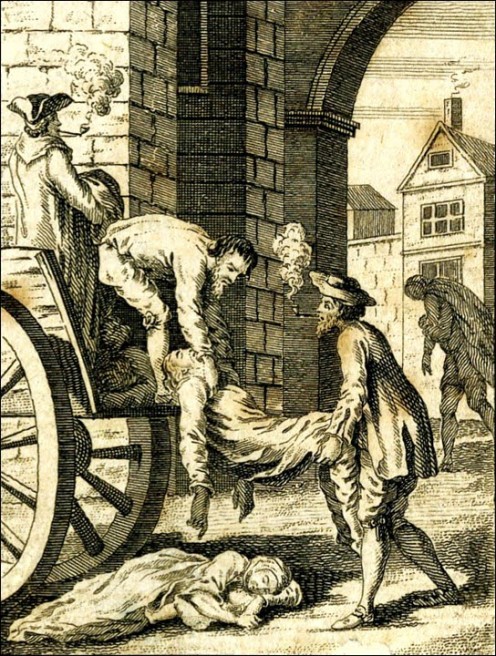
Collecting the Dead During the Plague.

Oh, Dear Augustin.

At the time, the Brotherhood of the Holy Trinity was trying to treat the many victims of the plague. They had opened a number of hospitals in Vienna. There were helpers leading carts around the city and gathering people that were ill. Some went to the makeshift hospitals. Others that died were taken to the outskirts of the city. There were open pits where the deceased were unceremoniously tipped. After so many days, when the hole became full of dead, it was filled in. Many thousands of people perished from 1679 to the early 1680s. During this time, the workers for the Brotherhood of the Trinity were a common sight around the city.
One night Augustin had been playing his bagpipes and singing his ballads in one of the many taverns. He had had an extreme amount to drink. Even by his standards. As the inebriated minstrel staggered home, he collapsed in a drunken stupor. He lay unconscious in the gutter. Around the block came the horse and cart. The workers for the Brotherhood of the Holy Trinity were on their rounds. They were gathering the dead. This had become normal. Each day people perished from the epidemic. They stopped by the prostrate figure of Augustine. With ill-deserved confidence, he was pronounced dead. His limp form was cast onto the cart with his bagpipes. Off went the gatherers following the trundling cart through the streets. Once full, the cart went to the outskirts of the city, where the large pits were dug.
When Marx Augustine woke, he must have been rather perplexed and then horrified. He was lying beneath the multitude of plague-ridden dead people. How long before the pit was filled in? He tried to get himself out but could not move the weight of the dead bodies. So folk legend says he began to play his bagpipes beneath the corpses. When the gathers heard the tune, they pulled the diseased bodies aside and were able to rescue Marx Augustine from the giant grave.

Ach du Lieber Augustin

Who Knows the Origin of the Melody for Sure?

The story spread and so the song came about. Ach, du Lieber Augustin. No one is sure if Marx Augustin wrote it himself or whether another minstrel did. This is because written documents of the song can only be proved back to 1800. Over one hundred years after the event.
There was a fiery German preacher named Abraham a Sancta Clara who told the story of Marx Augustin in the time of 1679 onwards. His religious platform attracted many people from far and wide. He also moved to Vienna. Perhaps having something to do with the Brotherhood of the Holy Trinity? Who can say for sure?
The song may have come about from an inspired listener of the monk. Perhaps encouraged by the elaborate tale. The holy man was as popular as the minstrel. It would have certainly been a yarn of great wonder. Abraham a Santa Clara was the religious name taken by Johann Ulrich Megerle before becoming a monk of his sacred order. He lived from 1644 to 1709.
No one knows for sure if Marx Augustine ever sang or wrote the Ballard about himself. As a wandering minstrel, it is feasible. He was a humorous man and he enjoyed the company of other comical people. One can imagine him singing such a song to amuse his audience. However, the truth is, that no one knows for sure because the written work of the song can only be traced back to 1800. One would need a copy of such a script from before 1685. We only know of a preacher who told the story at religious gatherings.
Ach, du Lieber Augustin translated into English reads; Oh, you dear Augustin. The Ballard keeps returning to how all is lost for Augustin. As the verses go on, each mentions something that is gone for poor Augustin. His girlfriend, his money, his coat and staff. One verse speaks of feasting being replaced by the plague. The tune sounds rather jovial and humorous. Yet the jolly words have a more ominous meaning. I think the melody sounds like something to present to a packed tavern of people. Happy soul’s intent upon life’s trials being twisted and presented in a more light-hearted fashion. In my mind’s eye, I can see the harmony touching intoxicated revellers with big cherub faces and glowing red noses. How the rudely drawn folk would relish the light-hearted escape of Ach, du Lieber Augustin.
Yet, I imagine today, it is sung in infant schools. It is, after all, a very jolly tune.

Oh, du Lieber Augustin-Remix (The Modern Day Bad Boy Version)

© 2017 colin powell

Friday, 18 December 2015

Mutts Fall In


Dogs are wonderful creatures. They are so full of emotion and are capable of learning too. I'm often amazed by our dog Dotty. I'm sure she picks up on what we say and they can understand much of our language.

She sits upon the top of the sofa back rest by the living room window, which overlooks the drive as I come home from work. She goes there about twenty minuets before I come home and waits. As soon as I come into the stony drive, she's off barking, running round to the side entrance through the kitchen to greet me home.


Giving You The Plague Doctor Steampunk Creation

Woow! What a wonderfully hideous looking monstrosity this is. But during the Black Death in the 1350s, Europe was awash with plague doctors who patrolled districts and provinces in various countries.

They were forerunners to witchfinder generals. A mixture of a religious zealot and herbal remedies. Some may have worked but if you were an old lady living in isolation and you possessed such knowledge; you could find yourself accused of being a witch.

What a horrific time the people must have lived in putting their faith in such diabolical zealots who believed in their placebo powers of healing and hunting out demonic evidence amid the infected and non-infected population.

It makes me grateful on how far we have come from such terrible times. Could they ever return? Could such human effigies ever come to haunt us again?

The compelling costume with its steampunk twist looks ghastly yet compelling. It's easy to see how people would be spooked into believing in such powers. It would be half the battle for a plague doctor worth his weight in gold.

I wonder how some of our professions will be viewed from the future. Could a tobacco seller smile from behind a counter, or a butcher amid joints of meat be looked at in the same forbidding fashion by some sort of futuristic liberalised humans?

It's all about how we change and adapt as we move through time in our carbon-based vehicles. Carbon vehicles that shut down one day to be viewed as history by new carbon life forms who would believe themselves better than us as we believe ourselves better than the abomination in the picture. Are we?

Wooow!