Showing posts with label #ships #RoyalNavy #shipwrecks #RIPTwitter. Show all posts

Wednesday, 26 September 2018

The Reverse of the Medal by Patrick O'Brian (My Goodreads Review)

The Reverse of the Medal (Aubrey & Maturin #11)

My rating: 5 of 5 stars

I started this yesterday and today I finished it. I could not put it down as a new development comes about. Another great yarn in the Aubrey/Maturin series. Once again Jack Aubrey proves he is a dab hand as a seaman. He chases an American commerce raider across the sea after leaving the West Indies. It is a nail-biting chase and the American ship is handled well by an experienced crew. Again, as much as Captain Aubrey is splendid at sea, he is a Buffon on land. It's as though his good sense deserts him when he steps off of the ship. In this story, he lasts a few hours before he gets himself into a diabolical mess. His naiveness of financial markets and stock exchange lands him in terrible trouble. His trusted friend Steve Maturin is splendid on land and a Buffoon at sea. These two friends complement each other. Maturin must do much to aid his friend in this part of the Aubrey/Maturin saga. I absolutely love these novels. They would make a dynamic TV show. The Movie was very good but the novels are something else. Splendid stuff. I can't wait to read the next one.


Monday, 17 September 2018

Treason's Harbour by Patrick O'Brian (My Goodreads)

Treason's Harbour (Aubrey/Maturin #9)

My rating: 4 of 5 stars

Espionage on the island of Malta plus conflict at sea. The whole saga is captivating. Steven Maturin really shines in this. On land that is. Where he excels.

Jack Aubrey is the same at sea, but rather like a fish out of water on land. These stories seem to switch between Maturin being the star in port or land with Jack Aubrey being a total master and commander aboard ship.

The espionage angle of this story is very gripping. Maturin is aware of all the deceit and complications too. A skilful enemy agent and his recruits want to infiltrate the Admiralty on the island of Malta. They are blackmailing a Sicilian Lady who is married to a captured British seaman. As Maturin uncovers things we are presented with more puzzles for future stories.

Jack Aubrey is ordered to come to terms with a titled middle eastern man who they suspect is allying with the French and who is demanding vast sums of money for neutrality or alliance etc. This leads to a great duel of ships at sea.

Another enjoyable part of the Aubrey/Maturin saga. I've already got the following story to this. The Far Side of the World. Truly splendid seafaring yarns.


Thursday, 6 September 2018

Another Great Douglas Reeman Story - In Danger's Hour. (My Goodreads Review)

In Danger's HourIn Danger's Hour by Douglas Reeman
My rating: 4 of 5 stars

Another very good WWII seafaring story from Douglas Reeman. This story takes place on board a minesweeper called HMS Rob Roy. It starts off in 1943 when the Rob Roy is doing coastal duties around Southern England. The ship has a young 28-year-old Captain Ransome. We are introduced to a number of the ship's crew. They are from diverse backgrounds. Some are likeable, some are loathsome and the young nieve to come of age etc. To be fair this is a usual WWII formate that Douglas Reeman often does. It works! We follow the crew members through their leave and love life. 

Then we go to Italy as the ship goes into action in the Mediterranean. The Axis powers have been driven from North Africa and the HMS Rob Roy is part of an enormous support group for the invasion of Sicily. Some of the action scenes are gripping. From this point on there is the prep work for D-Day 1944 when the Rob Roy returns for this new mission. All in all a good read for any fan of nautical war fiction.


View all my reviews

Saturday, 1 September 2018

The Greatest Enemy by Douglas Reeman (My Goodreads Review)

The Greatest Enemy

My rating: 5 of 5 stars

This was a fabulous and very gritty Royal Navy story. Most of Douglas Reeman’s stories are usually set in World War I or II. Especially II. This story is set in 1970. It concerns an old frigate named HMS Terrapin. The Terrapin is at the end of her service days. She is ready for the scrap yard or for sale to a developing nation. The ship is at Singapore when a new Captain is suddenly given charge of the languishing ship and over-relaxed crew. The Far East is a place that the United Kingdom is gradually withdrawing from. The Empire has gone and the Royal Navy is shrinking in size.

The new Captain is completely old school. Not suited for the modern day Navy. He is bubbling with aggressive patriotism and alive with no-nonsense enthusiasm. Lieutenant-Commander Standish is alarmed by the new Captain’s mad vigour. Yet through all of the bluster and tragic past of this no-nonsense man, there is a spark. The enthusiasm grips Standish and a loyalty begins to develop. The area of the sea they patrol is infested with pirate junks and smugglers. The Vietnam War is still going on and there are junks from the Mekong Delta.

HMS Terrapin is part of a wider naval mission or project with an American Admiral in overall command of the patrols up against the smuggling etc. There is also another British Captain attached to the American Admiral’s staff. A liaison officer. He is trying to ruin Terrapin’s new Commander.

The story becomes more gripping as the gun hoe Captain of the Terrapin gets it into his head that there is a bigger menace to deal with among the seafaring pirates and smugglers. Something connected with the Communist powers. The strange thing is… Lieutenant-Commander Standish thinks he might have a point.

I wished the British film industry would go back to making those old matinée pictures. This one would be an absolute sizzler. I could not put it down. I enjoyed every single page of this seafaring tale.


Monday, 13 August 2018

The Fortune of War by Patrick O'Brian (My Goodreads Review)

The Fortune of War (Aubrey/Maturin #6)


Once again, a spiffing read. I could not put this latest rendition of the Aubrey/Maturin seafarer’s sage down. This is the sixth story in the historical series. It is 1812 and the USA has declared war on the UK. This story is mainly focused on the ship’s physician, Steven Maturin. It is full of exciting intrigue and a real page-turner. Again the dialogue and narration bring the historical era alive. I can’t wait for the seventh story. This sixth tale all builds up to a thrilling climax.


Tuesday, 7 August 2018

Desolation Island by Patrick O'Brian (My Goodreads Review)

Desolation Island (Aubrey/Maturin #5)

My rating: 5 of 5 stars

Once again, a superb historical read. These Patrick O'Brian novels set on the high seas of the Napoleonic times are a marvel. The language and whole presentation of the stories are very special. I felt as though I was there among the fabulous characters. This tale is wonderfully interwoven with Maturin devising a cunning plan of espionage. Aubery must pit his wits against a pursuing Dutch Man-of-War battleship. His ship is old and undermanned and those who are aboard are riddled with disease. He also has a compliment of prisoners being transported to Botany Bay.

The ever pursuing and skilful Dutch ship is always chasing. It has the vastly superior firepower to the fleeing HMS Leopard. Captain Jack Aubrey must try and stay one step ahead of the awesome enemy ship. I can't praise these books high enough. I've just bought the next title to follow this adventure. If you enjoy seafaring tales then I would highly recommend these Aubrey/Maturin sagas. They are so compelling.


View all my reviews

Tuesday, 12 June 2018

The Mauritius Command by Patrick O'Brian (My Goodreads Review)

The Mauritius Command (Aubrey/Maturin Series, Book 4) (Aubrey & Maturin series)

My rating: 4 of 5 stars

Another fine Aubrey/Maturin story. Every bit as good as the others. This time Aubrey is a temporary Commodore and in charge of a small squadron of ships. He must confront a skilled French enemy operating out of Mauritius. The enemy is attacking and capturing British ships upon cargo routes from India to Britain. The islands of Mauritius are strategically placed to capture a wealth of British plunder. Bonaparte's Navy is making good use of the advantage. The Royal Navy is intent on eliminating this French ability. What follows is some strategic confrontations. Battles, where advantages are won, lost and then won again in an ever continuing cat and mouse adventure game upon the high seas. Splendid action scenes throughout and wonderfully atmospheric.


Friday, 2 March 2018

The Grand Replicated Spanish Galleon - El Galeón

The Grand Replicated Spanish Galleon - El Galeón


Serendipity

Carole and I got up one morning, expecting our ship, the Ventura, to dock in Ibiza. The day did not look too bad and we were rather excited. Carole and I had never been to the Spanish Island before. We went up onto the top deck towards the big canteen for breakfast. I could not help noticing how windy it was in the open. We were glad to enter the sliding doors of the self-service restaurant. As we sat down to eat, the Captain came over the speaker and said they were having trouble entering the harbour to dock. The wind was 32 knots and they needed it to be below 28 knots.
As time went on, the pilots attempted on three occasions but had to abandon the idea of Ventura docking at Ibiza. It was no good. The wind would not drop to within the safety limits. Eventually, the Captain came on the speaker again and said we were heading back to the Spanish mainland and towards Cartagena. We were a little disappointed. Cartagena was our next port of call and we were obviously going to get there a day beforehand.
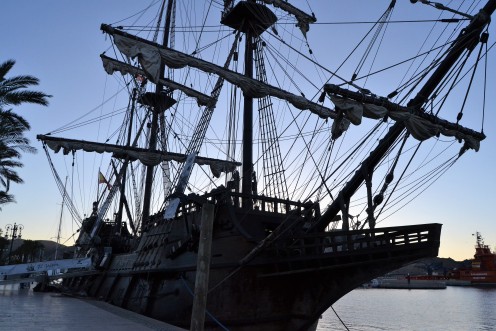
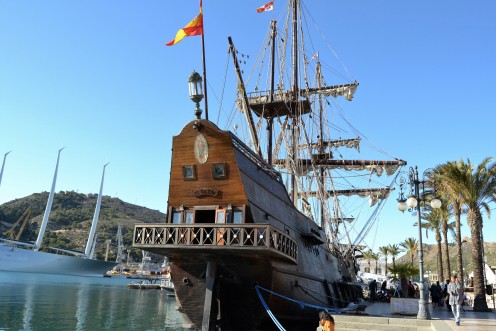
To our delight, Cartagena would prove to be a big bonus for us. The port was a lovely place and there was a special replica Spanish galleon in the arena. It is a museum ship that sails the world on a sort of moving celebration of the old Spanish exploration days. The ship is just referred to as, El Galeón. Of course, we had no idea that the ship would be in port. We caught the show by luck.

El Galeón in Cartagena

Cartagena at Night.

It was night time when the Ventura arrived at Cartagena and berthed. We were allowed to disembark and go for a walk because the town centre is very close to the dock. The high street was pretty with a very Christmas feel. All the shops were open and the Spanish were doing last moment shopping. It was a splendid sight and we enjoyed walking about the many shops. My imagination was already gripped because prior to crossing the road into the shopping centre, we had come across the Spanish Galleon in the dock.
I filmed my night time walk about the moored historical ship on the mobile phone. We had all the next day to explore. As I walked about the shopping centre at night, I was wondering and hoping that the grand Spanish Galleon would be open to the public. There was a bridge ramp for the vessel. Obviously, it was closed at night, but I felt sure it would open in the morning. I do enjoy looking at ships. Especially historical ones. I had seen a replica Portuguese ship of Christopher Columbus times and now this Spanish Galleon would be the cherry on the cake for me. I would learn that the ship is called El Galeón San Pelayo. The design was based upon a ship that was sent on a mission within a fleet back in 1565. Florida was part of Colonial Spain’s possession and the French had formed a settlement there in violation of international treaties. The Spanish sent a fleet in response that was led by Captain Pedro Menendez
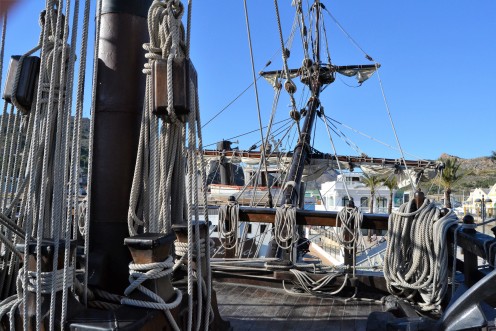
These ships of the day would return to Spain and come back to the Americas on many occasions. Maybe they were among the Spanish Armada some twenty odd years later. If not, ships of similar design were. I was awestruck by the gallon because it seemed so small. Our huge cruiser was moored a short distance away. It made El Galeon look like a rowing boat. However, once the observer got close to the historical vessel, I don’t think many would fail to be impressed by the craftsmanship and work that went into the ship. We had passed through a 100-knot wind and storm upon the Ventura. I had developed some idea as to the power of the sea. My mind boggled at the thought of the sailors from such times being aboard El Galeon in a storm. I even thought of this modern day replica. It sailed the world and the devoted historical staff that manned the museum ship would also have been through such weather. How did any of them cope? Especially if one had to climb the rigging in such dyer weather conditions.

From the Stern.

The Strange Looking Yacht was Huge.


We went to bed that night knowing the next morning would allow more time to explore Cartagena. I knew there was a huge Roman Amphitheatre with a museum upon entry. However, that was one thing we decided not to visit. I wanted to see El Galeon during the daylight and walk her deck and forecastle. I made a note to take my camera.
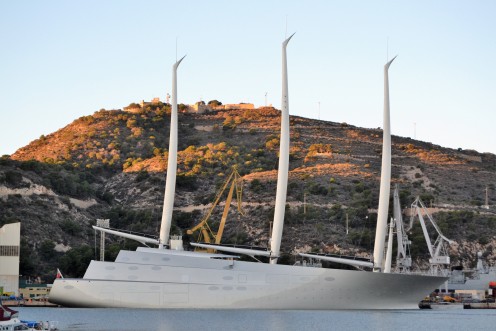
The next morning came. We skipped breakfast and went on to the dock. There was another strange sight across the water. A huge yacht. Or at least I think it was a yacht. It was not much smaller than our cruise liner, Ventura. It must have had multiple decks with three enormous thick masts. I had never seen a vessel like it. It was painted a battleship grey colour. I also noticed that it had a British red ensign at the stern. A merchant's vessel. I found it perplexing and do not know what the yacht/ship was for. I asked during the evening dinner, but everyone else was puzzled by the grand yacht-shaped ship too.
It was still too early for El Galeon to open so we went for a walk about the streets. The winter day was incredible for us. It was warm yet it was on the 16th of December. A wonderful clear blue sky made it seem as though it was still summer. When we returned to the dockside, there was a lot of activity around the Spanish Galleon. It was open.
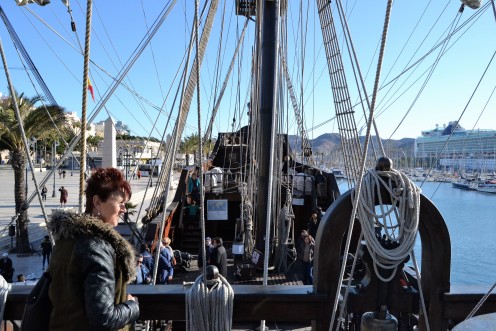
It was just five euros to go aboard. I also bought the booklet about the project of making the replica El Galeon. The ship had generated a great deal of interest from us British visitors from the Ventura. Also, the local Spanish people were visiting too. The ship had been around the globe, visiting far-off destinations. It had obviously attracted many people. The whole ship had a feeling of stepping back in the past. As much as I admired the workmanship of the vessel, I also appreciated how difficult it would be to sail the tempest seas. The craft looked so small in respect of severe storms. Yet men braved such elements and reached the Americas. I was like a child in a sweet shop. I tried to photograph as many different angles as possible.
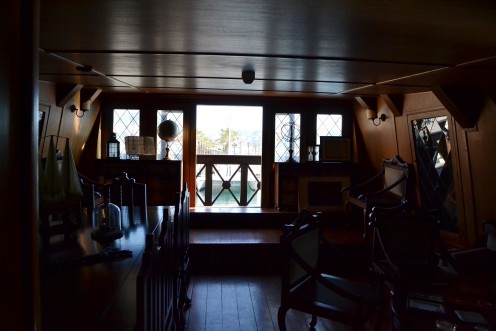
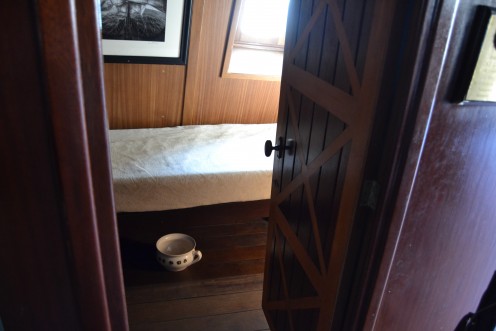
Even the Captain’s quarters looked cramped. There were side rooms before these quarters where other officers slept. This was at the stern of the ship. I liked the balcony area outside the Captain’s cabin. It offered something of relaxation in calm weather. It was also a railed walkway that went around slightly to the port and starboard sides. Down in the hold was where the rank and file of the crew quartered. It must have been very cramped for them. I think one would need to be made of a certain fibre to have sailed in such bygone days. Definitely not for the faint-hearted. At a lower level near the hull, there was a small screen which showed the visitor how the replica was made. The whole process was shown in stages. It was narrated in Spanish but was simple to follow the development via the visual presentation.
I stayed on board for some time. As for the Roman amphitheatre, I later regretted not paying a visit here. I heard from others, during evening dinner, that it was also a sight to behold. Still, I felt lucky from the maritime point of view. We had seen the Portuguese 700th anniversary with an old replica sailing ship of the Columbus era. Then in Cartagena, we were lucky enough to see this wonderful El Galeon. It all made for a great cruise holiday.

The Stern with Balcony from Captain's Cabin.


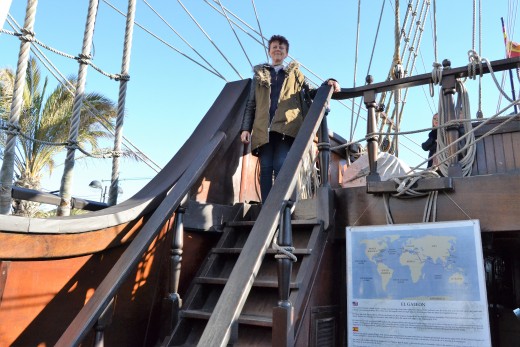
Aboard El Galeón


El Galeón The Open Deck.


El Galeón - Wandering Around the Ship.


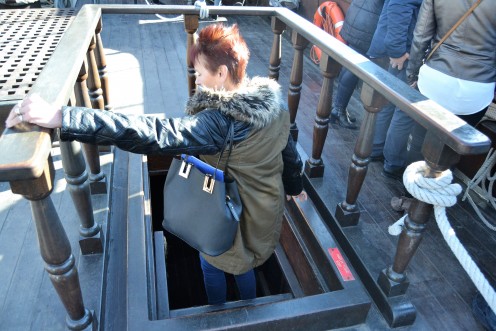
El Galeón - Going to the Lower Decks.


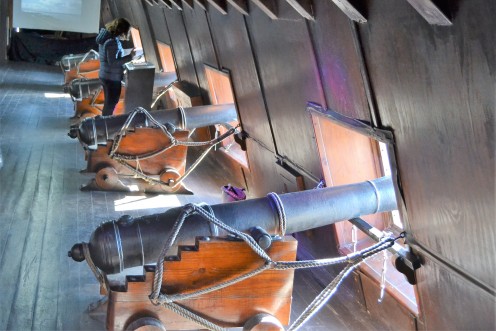
El Galeón - Cannons.


Captain's Cabin.


All Officer's Cabins Looked This Way.


© 2017 colin powell

Friday, 9 December 2016

Our Cruise Ship Docked Behind HMS Scott in Funchal, Madeira - An Island of Portugal.

We made our first port stop of the cruise holiday in the port of Funchal, Madeira - an island west of the Spanish Canary Islands that belongs to Portugal. It is a wonderfully green island and I have to say it is one of the most favourite overseas places that I long to visit. It is vibrant and green and the town of Funchal is a bustling happy place that enjoys a fabulous climate. It was December 1st and the afternoon temperature was in the early eighties. It was a glorious little place. 

To make my morning start off with a happy feel-good factor, our ship The Oceana moored right behind a British Royal Navy vessel called HMS Scott. I watched from the top aft deck of our cruise liner. I saw two officers and a navel hand hoist the naval ensign flag. It seemed to be a morning ceremony.   

It was great to see our lads flying the flag and we delighted in watching the flag being hoisted dead on 0800 hours. Great stuff and a good start to the wonderful day that was to come.

The early cloud cleared and the day turned bright blue. Carole and I know Funchal rather well now and we enjoyed the walk from the port into the town centre.

Tuesday, 25 October 2016

Mary Roberts Survived The Titanic and Two Years Later - The Rohilla.

Mary Kezia Roberts was born in Liverpool in the year of 1870. Her parents were Welsh from the Isle of Anglesey. When she grew to an adult, she spent her working life on board various ships as a stewardess. In 1896 she married a Scotsman who was an electrical engineer. He was five years younger than she. Mary was 26 and David Roberts, her husband from Dundee, was 21.

They were married in Derbyshire and had five children. Mary must have been away from home a lot in the early part of the 20th century because she worked for the White Star Shipping line.

In 1912, Mary was the stewardess on the exciting new passenger liner called The Titanic. She was 42 years of age at this time. As most people know, the Titanic hit an iceberg and sank with a tremendous loss of life. A disaster that echoes throughout eternity. Mary Roberts managed to survive aboard a lifeboat.
She resumed her career at sea and became a First Class Stewardess. At the outbreak of World War I, Mary was a stewardess aboard the hospital ship HMHS Rohilla. The ship was originally a passenger ship travelling from the UK to India but had been seconded by the navy at the outbreak of the war for hospital duties. The Rohilla was making her way from Scotland to Dunkirk, where it would bring aboard wounded soldiers from the trenches.

However, the ship was caught in a violent storm off of Whitby in Yorkshire. The lighthouse was not working due to wartime restrictions at night. The Rohilla cruised too close to the rocks off of Whitby and struck them. Her back was broken and the stricken ship was wedged among the rocks while the horrendous storm smashed into the broken vessel. The entire crew were in a most desperate situation and for Mary Roberts, a survivor of the Titanic but two years earlier, this was another traumatic event.

The lifeboats were rowed by hand out of the protective harbour, but the rescuers had too much difficulty in keeping the boats close enough to the stricken ship. The off-loading of crew members onto the rescue boats became exhausting as the relentless storm smashed the ship and tossed the rescue boats about. The rescue operation took 50 hours and many of the Rohilla’s crew became so desperate as the clung to the breaking and disintegrating ship, that some chanced the stormy waves.
Many perished in the attempt to reach shore or get to the lifeboats. Of 223 people aboard the Rohilla, only 140 survived the tragedy. The other 83 perished in the sea. Mary Roberts was among the 140 survivors. She went on to say that the Rohilla was a much more perilous affair for her than the Titanic. Perhaps because aboard the Titanic she was put in a lifeboat with others before the ship went down. The water was cold but not stormy.


The last person to leave the Rohilla was the Captain. He was reported to be clinging to a mast when the lifeboat got to him. He was said to be clutching a black cat that lived on board the ship and the pet seemed undisturbed by the commotion of what had gone on.

The Rohilla, for Mary, would be a more tempest and desperate affair clinging to the breaking ship with land only a few hundred yards away, but unable to reach it. The lady certainly had stories to tell of her time at sea. She remained working on liners into the late 1920s.


Mary Roberts passed away in 1932 in Ewell, Epsom, Surrey, England, where she is buried next to her husband David Roberts. He passed away a year later. One of their daughters, Daisy Bell lived to be 97 and died of old age in 2003. 


Saturday, 9 April 2011

H.M.S. Victoria's Dreadful Mistake.

HMS Victoria's Last Moments
In the year of 1893, naval command of the British Mediterranean fleet belonged to Vice Admiral Sir George Tryon - a strict and very disciplined man. In the June month of this year he was leading a squadron of ships in two columns off of Tripoli along the coast of Lebanon.

His fleet travelled in two columns cruising parallel to one another. Tryon was aboard his flagship H.M.S. Victoria and led the first column of six ships and his deputy, leading the second column of five ships, was Rear Admiral Albert Hastings Markham aboard H.M.S. Camperdown.


Tryon ordered a manoeuvre where upon both columns turned inwards and around at 180 degrees. A move that other officers thought brought the two columns dangerously close together. A couple of them carefully tried to point out the fact, but Tryon brusquely insisted upon his order being carried out.

In the second division of five ships, Markham held back flagging confirmation because he was unsure if he had received the correct order. However, he soon received, by semaphore, a rebuke 'What are you waiting for?' This was public and other members of his crew would have witnessed this.

Markham executed the order and H.M.S. Camperdown began the turn as H.M.S. Victoria also turned. Both the ironclads were heading towards each other on a collision course - each vessel needed more manoeuvrability to fall at way with each other on a parallel course in the opposite direction.

As each ship drew closer, other crewmen aboard Victoria and Camperdown expected Tryon to issue a last moment order but none came.

Markham's ship, HMS Camperdown had a ram that smashed into Victoria's hull - twelve feet below the waterline. The shear catastrophe of what had happened was still lost on many of HMS Victoria's crew. They began to assemble on the deck to await orders as the doomed ship began to take in water and list.

Tryon realised his dreadful mistake and finally gave the order for his crew to abandon ship. Those on deck went into the sea, but others trapped below were unable to get out of the sinking ship in time. Among the survivors that got off of the HMS Victoria was second in command John Jellicoe who would later be Commander in Chief at the battle of Jutland.

Vice Admiral Sir George Tryon realised that the entire disaster was his fault and could not leave his post knowing that many of his crew could not get off of HMS Victoria in time. He went down with his ship and was among the 358 crew that lost their lives in the tragedy at sea.