Showing posts with label historical ships. Show all posts

Saturday, 17 November 2018

Heartstone by C. J. Sansom (My Goodreads Review)

Heartstone (Matthew Shardlake, #5)

My rating: 5 of 5 stars

I was so looking forward to this Matthew Shardlake story. C. J. Sansom always finds a way of entwining the hunchback lawyer into the historical events of King Henry VIII's time. 

In the last story, the clever and modest lawman earnt great favour by his help to Catherine Parr. In this new story, Catherine Parr is now queen. She once again calls upon Matthew's help. 

This time the trusted lawyer and his companion Barak go on a crime adventure that takes them to Portsmouth and the surrounding area. It is 1545 and the French are about to invade England. Amid the clamour and preparation for war, the steadfast lawyer and Barak seek to find answers to a young man's wardship. 

Also answers to a young ladies confinement in Bedlam. She was in the previous story.

I knew that the events of the Mary Rose and the Battle of the Solent were going to be the decisive backdrop for this 5th novel. I have always had a fascination for the ship and went to see the raised hull in Portsmouth navel museum a few years back. 

Therefore, the whole story came to a fabulous climax as Matthew pursues his quest against all odds with familiar dastardly scoundrels of court and new ones to boot. A rip-roaring tale of Tudor England.


Saturday, 8 September 2018

The Ionian Mission by Patrick O'Brian (My Goodreads Review)

The Ionian Mission (Aubrey/Maturin Series, Book 8) (Aubrey & Maturin series)

My rating: 5 of 5 stars

Splendid Historical Read.

This was book eight in the Aubrey/Maturin saga. It was most enjoyable throughout. A bloody and gripping sea action too. All set in 1812. Much of the first half of the story is on blockade duty aboard HMS Worcester, but then the HMS Surprise comes back into the story. This is much to the delight of Jack Aubrey and the reader. We then go on an adventure to the Greek Islands and Adriatic where Greek and Turkish pirates are the danger. Aubrey is on a diplomatic mission of sorts, but when the action comes, it is fast and furious.

Steven Maturin is married to Diane Villiers and is establishing his grounds with his wife before we set off for the Mediterranean Sea. This saga is wonderful andI've been reading it in the proper order. There always seems to be something else for the reader to get into. If you enjoy seafaring sagas, then I could not recommend anything more highly than the Aubrey/Maturin series. They are truly tales to behold.


Tuesday, 28 August 2018

The Surgeon's Mate by Patrick O'Brian (My Goodreads Review)

The Surgeon's Mate (Aubrey/Maturin, #7)

My rating: 4 of 5 stars

The Surgeon’s Mate is the 7th Aubrey/Maturin Royal Navy story set during the time of the Napoleonic Wars. It is 1812 and there is a new war with the USA. Aubrey and Maturin have escaped on board the HMS Shannon and been present during the battle with USS Chesapeake. From Canada, Aubrey and Maturin make their way back to Britain where more dilemmas await each man’s careful consideration. As a Captain at sea, Jack Aubrey is tremendous. On land, he seems to become a bit of a buffoon. Quite by accident. These land capers get him into all sorts of trouble and often his devoted wife Sophie and his good friend Maturin are the ones who seem to get him out of such vexations. Usually, a ship’s command turns up on time and he can get away from it all with a high sea adventure.

This story moves along the same lines as Aubrey and Maturin go on a mission in the Baltic. In this sea is a fortified island manned by Catalans. Maturin is half Catalan and half Irish. To persuade the garrison to surrender and ally with Britain against Napoleon is the aim of the British government. Maturin is selected to do this and he wishes Aubrey to command the sloop, HMS Ariel, upon the mission. Once again, Maturin is up to his neck at sea where Aubrey can always pull something out of the bag for him. Also, the elegant and tantalising Diane Villiers is still in the story. She becomes more dashing with her gloriously refined roguish elegance and sincere support for her country. The whole saga takes another fabulous step forward. A peach of a read. I can’t wait for the next story in this wonderful chronicle of seafarers.


View all my reviews

Thursday, 10 May 2018

Post Captain by Patrick O'Brian (My Goodreads Review)

Post Captain (Aubrey/Maturin, #2)

My rating: 4 of 5 stars

This is the second Aubrey/Maturin story. They are set during the Napoleonic wars at sea. In this story, we see our heroes up against it with debt collectors threatening. Jack Aubrey needs a ship because while at sea, he can keep the creditors away. The dialogue is splendid and some of the narration has that old fashion feel too. It all makes for a great atmospheric feel. The battles at sea are particularly gripping. Even if, like me, you know nothing about sailing at sea; you'll get sucked up into these dazzling adventures. I'll definitely go for the third story after being thrilled by the first two adventures. I can't express how good the dialogue is. I know I've mentioned it before, but this is what makes the story so fine. The speech is how one might well imagine how people of such times would talk. I felt as though I was there. Walking about the old port towns and visiting well to do people. Some of these parts of the story had an almost Pride and Prejudice - Jane Austin feel about it. Then there are the descriptions of men at sea and the workings of such magnificent vessels.


Wednesday, 2 May 2018

Master and Commander by Patrick O'Brian (My Goodreads Review)

Master and Commander

My rating: 4 of 5 stars

I almost skipped this first story and would have started on Post Captain, which is the second of these acclaimed stories of the Royal Navy during the time of Nelson etc. However, I was informed that the movie of the same name is nothing like the first Patrick O'Brien novel of the same name. All the characters are there, but I think the movie is more like another Aubrey–Maturin story called the Far Side of the World. The movie was most enjoyable, so I'm not trying to knock it. I just thought I might already know the story.

Alas, I did not. The whole Aubrey–Maturin saga starts off splendidly in the Mediterranean. Our two heroes are on the island of Majorca. This is where they first meet at a concert hosted by musicians and wives of the British gentry. I was absolutely enthralled by the dialogue of these many seamen and the author presents the times wonderfully well. The characters are splendid and the action sequences are gripping. I would highly recommend this novel. Especially if you enjoy historical fiction of a nautical flavour. I will eventually read other stories of the Aubrey–Maturin series. I am now a fan.


Friday, 2 March 2018

The Grand Replicated Spanish Galleon - El Galeón

The Grand Replicated Spanish Galleon - El Galeón


Serendipity

Carole and I got up one morning, expecting our ship, the Ventura, to dock in Ibiza. The day did not look too bad and we were rather excited. Carole and I had never been to the Spanish Island before. We went up onto the top deck towards the big canteen for breakfast. I could not help noticing how windy it was in the open. We were glad to enter the sliding doors of the self-service restaurant. As we sat down to eat, the Captain came over the speaker and said they were having trouble entering the harbour to dock. The wind was 32 knots and they needed it to be below 28 knots.
As time went on, the pilots attempted on three occasions but had to abandon the idea of Ventura docking at Ibiza. It was no good. The wind would not drop to within the safety limits. Eventually, the Captain came on the speaker again and said we were heading back to the Spanish mainland and towards Cartagena. We were a little disappointed. Cartagena was our next port of call and we were obviously going to get there a day beforehand.
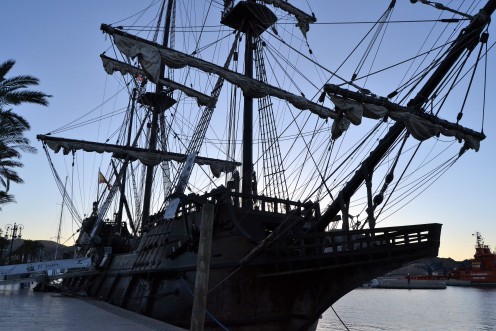
To our delight, Cartagena would prove to be a big bonus for us. The port was a lovely place and there was a special replica Spanish galleon in the arena. It is a museum ship that sails the world on a sort of moving celebration of the old Spanish exploration days. The ship is just referred to as, El Galeón. Of course, we had no idea that the ship would be in port. We caught the show by luck.

El Galeón in Cartagena

Cartagena at Night.

It was night time when the Ventura arrived at Cartagena and berthed. We were allowed to disembark and go for a walk because the town centre is very close to the dock. The high street was pretty with a very Christmas feel. All the shops were open and the Spanish were doing last moment shopping. It was a splendid sight and we enjoyed walking about the many shops. My imagination was already gripped because prior to crossing the road into the shopping centre, we had come across the Spanish Galleon in the dock.
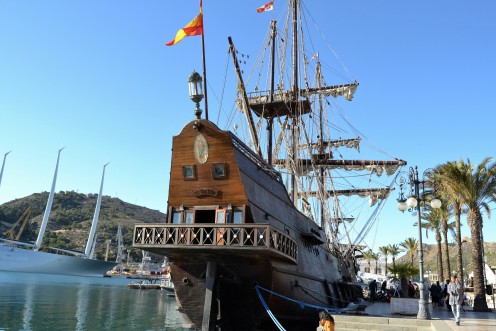
I filmed my night time walk about the moored historical ship on the mobile phone. We had all the next day to explore. As I walked about the shopping centre at night, I was wondering and hoping that the grand Spanish Galleon would be open to the public. There was a bridge ramp for the vessel. Obviously, it was closed at night, but I felt sure it would open in the morning. I do enjoy looking at ships. Especially historical ones. I had seen a replica Portuguese ship of Christopher Columbus times and now this Spanish Galleon would be the cherry on the cake for me. I would learn that the ship is called El Galeón San Pelayo. The design was based upon a ship that was sent on a mission within a fleet back in 1565. Florida was part of Colonial Spain’s possession and the French had formed a settlement there in violation of international treaties. The Spanish sent a fleet in response that was led by Captain Pedro Menendez
These ships of the day would return to Spain and come back to the Americas on many occasions. Maybe they were among the Spanish Armada some twenty odd years later. If not, ships of similar design were. I was awestruck by the gallon because it seemed so small. Our huge cruiser was moored a short distance away. It made El Galeon look like a rowing boat. However, once the observer got close to the historical vessel, I don’t think many would fail to be impressed by the craftsmanship and work that went into the ship. We had passed through a 100-knot wind and storm upon the Ventura. I had developed some idea as to the power of the sea. My mind boggled at the thought of the sailors from such times being aboard El Galeon in a storm. I even thought of this modern day replica. It sailed the world and the devoted historical staff that manned the museum ship would also have been through such weather. How did any of them cope? Especially if one had to climb the rigging in such dyer weather conditions.

From the Stern.

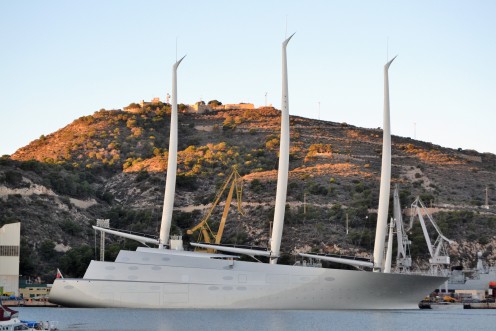
The Strange Looking Yacht was Huge.


We went to bed that night knowing the next morning would allow more time to explore Cartagena. I knew there was a huge Roman Amphitheatre with a museum upon entry. However, that was one thing we decided not to visit. I wanted to see El Galeon during the daylight and walk her deck and forecastle. I made a note to take my camera.
The next morning came. We skipped breakfast and went on to the dock. There was another strange sight across the water. A huge yacht. Or at least I think it was a yacht. It was not much smaller than our cruise liner, Ventura. It must have had multiple decks with three enormous thick masts. I had never seen a vessel like it. It was painted a battleship grey colour. I also noticed that it had a British red ensign at the stern. A merchant's vessel. I found it perplexing and do not know what the yacht/ship was for. I asked during the evening dinner, but everyone else was puzzled by the grand yacht-shaped ship too.
It was still too early for El Galeon to open so we went for a walk about the streets. The winter day was incredible for us. It was warm yet it was on the 16th of December. A wonderful clear blue sky made it seem as though it was still summer. When we returned to the dockside, there was a lot of activity around the Spanish Galleon. It was open.
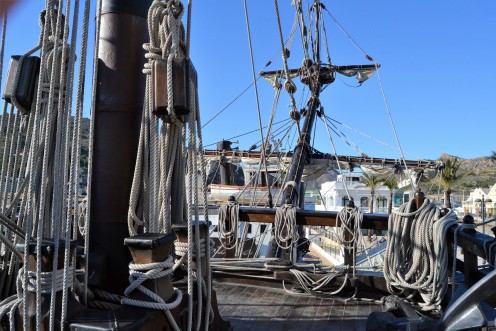
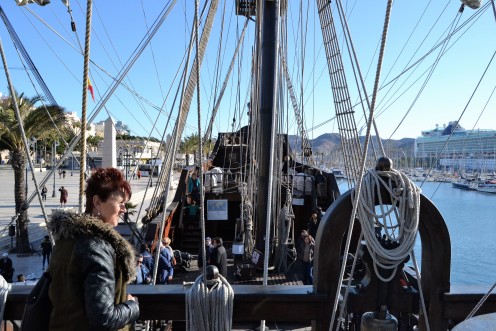
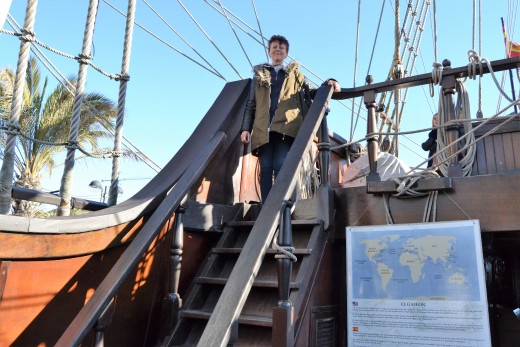
It was just five euros to go aboard. I also bought the booklet about the project of making the replica El Galeon. The ship had generated a great deal of interest from us British visitors from the Ventura. Also, the local Spanish people were visiting too. The ship had been around the globe, visiting far-off destinations. It had obviously attracted many people. The whole ship had a feeling of stepping back in the past. As much as I admired the workmanship of the vessel, I also appreciated how difficult it would be to sail the tempest seas. The craft looked so small in respect of severe storms. Yet men braved such elements and reached the Americas. I was like a child in a sweet shop. I tried to photograph as many different angles as possible.
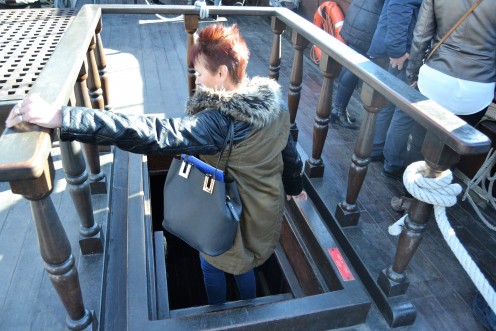
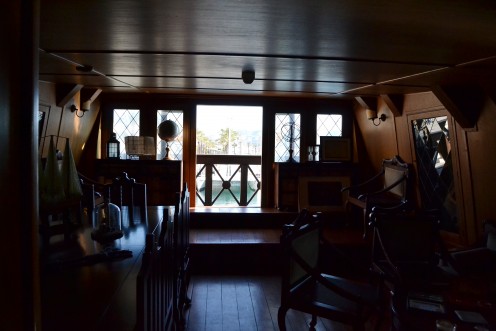
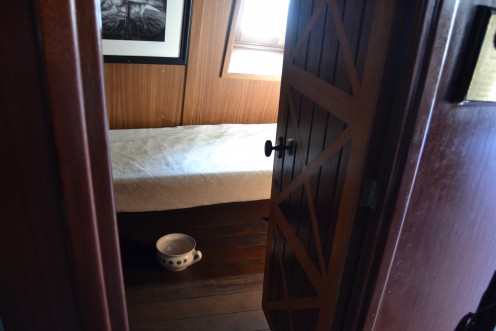
Even the Captain’s quarters looked cramped. There were side rooms before these quarters where other officers slept. This was at the stern of the ship. I liked the balcony area outside the Captain’s cabin. It offered something of relaxation in calm weather. It was also a railed walkway that went around slightly to the port and starboard sides. Down in the hold was where the rank and file of the crew quartered. It must have been very cramped for them. I think one would need to be made of a certain fibre to have sailed in such bygone days. Definitely not for the faint-hearted. At a lower level near the hull, there was a small screen which showed the visitor how the replica was made. The whole process was shown in stages. It was narrated in Spanish but was simple to follow the development via the visual presentation.
I stayed on board for some time. As for the Roman amphitheatre, I later regretted not paying a visit here. I heard from others, during evening dinner, that it was also a sight to behold. Still, I felt lucky from the maritime point of view. We had seen the Portuguese 700th anniversary with an old replica sailing ship of the Columbus era. Then in Cartagena, we were lucky enough to see this wonderful El Galeon. It all made for a great cruise holiday.

The Stern with Balcony from Captain's Cabin.


Aboard El Galeón


El Galeón The Open Deck.


El Galeón - Wandering Around the Ship.


El Galeón - Going to the Lower Decks.


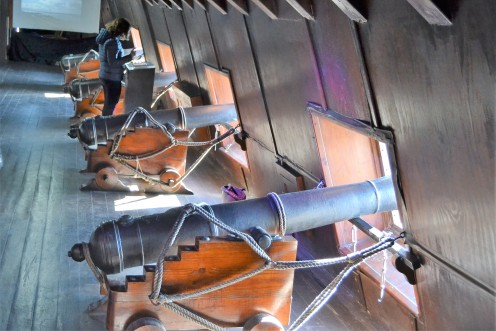
El Galeón - Cannons.


Captain's Cabin.


All Officer's Cabins Looked This Way.


© 2017 colin powell

Tuesday, 25 October 2016

Mary Roberts Survived The Titanic and Two Years Later - The Rohilla.

Mary Kezia Roberts was born in Liverpool in the year of 1870. Her parents were Welsh from the Isle of Anglesey. When she grew to an adult, she spent her working life on board various ships as a stewardess. In 1896 she married a Scotsman who was an electrical engineer. He was five years younger than she. Mary was 26 and David Roberts, her husband from Dundee, was 21.

They were married in Derbyshire and had five children. Mary must have been away from home a lot in the early part of the 20th century because she worked for the White Star Shipping line.

In 1912, Mary was the stewardess on the exciting new passenger liner called The Titanic. She was 42 years of age at this time. As most people know, the Titanic hit an iceberg and sank with a tremendous loss of life. A disaster that echoes throughout eternity. Mary Roberts managed to survive aboard a lifeboat.
She resumed her career at sea and became a First Class Stewardess. At the outbreak of World War I, Mary was a stewardess aboard the hospital ship HMHS Rohilla. The ship was originally a passenger ship travelling from the UK to India but had been seconded by the navy at the outbreak of the war for hospital duties. The Rohilla was making her way from Scotland to Dunkirk, where it would bring aboard wounded soldiers from the trenches.

However, the ship was caught in a violent storm off of Whitby in Yorkshire. The lighthouse was not working due to wartime restrictions at night. The Rohilla cruised too close to the rocks off of Whitby and struck them. Her back was broken and the stricken ship was wedged among the rocks while the horrendous storm smashed into the broken vessel. The entire crew were in a most desperate situation and for Mary Roberts, a survivor of the Titanic but two years earlier, this was another traumatic event.

The lifeboats were rowed by hand out of the protective harbour, but the rescuers had too much difficulty in keeping the boats close enough to the stricken ship. The off-loading of crew members onto the rescue boats became exhausting as the relentless storm smashed the ship and tossed the rescue boats about. The rescue operation took 50 hours and many of the Rohilla’s crew became so desperate as the clung to the breaking and disintegrating ship, that some chanced the stormy waves.
Many perished in the attempt to reach shore or get to the lifeboats. Of 223 people aboard the Rohilla, only 140 survived the tragedy. The other 83 perished in the sea. Mary Roberts was among the 140 survivors. She went on to say that the Rohilla was a much more perilous affair for her than the Titanic. Perhaps because aboard the Titanic she was put in a lifeboat with others before the ship went down. The water was cold but not stormy.


The last person to leave the Rohilla was the Captain. He was reported to be clinging to a mast when the lifeboat got to him. He was said to be clutching a black cat that lived on board the ship and the pet seemed undisturbed by the commotion of what had gone on.

The Rohilla, for Mary, would be a more tempest and desperate affair clinging to the breaking ship with land only a few hundred yards away, but unable to reach it. The lady certainly had stories to tell of her time at sea. She remained working on liners into the late 1920s.


Mary Roberts passed away in 1932 in Ewell, Epsom, Surrey, England, where she is buried next to her husband David Roberts. He passed away a year later. One of their daughters, Daisy Bell lived to be 97 and died of old age in 2003. 


Monday, 25 July 2016

Enjoy fiction historical reading or a retro science fiction story


Enjoy fiction historical reading or a retro science fiction story - an adaptation of HMS Thunder Child from War of the Worlds. In USA NOW! In UK from 2017.

Wednesday, 2 March 2016

Nelson's Flagship at the Naval Dockyard - Portsmouth

The Naval Dockyard - Portsmouth


Today, 29th February 2016, Carole and I decided to go to Portsmouth. We were in the New Forest and decided a trip to the historical dockyard where HMS Victory is docked as a museum would make a great start to our week holiday. Also, I was dying to get a look at the Mary Rose; King Henry VIII’s flagship built in 1511. She sank in 1545 during the Battle of the Solent when she mysteriously capsized after firing a volley from her guns. As the ship came about she leant too far over and sea water entered her open gun ports making her keel over with five hundred men on board. The Mary Rose was in service for 34 years before this accident and took part in three wars. Two with France and one with Scotland.

Of all the souls aboard the MaryRose only between 25 and 35 men survived the disaster out of the 500 men aboard. Many were soldiers and archers. Boarding crew for close quarter fighting. The shipwreck was raised in 1982 after almost 450 years under water. Before being raised, there were years of underwater archaeological work. The painstaking effort brought the remaining half of the ship into a Museum close to where HMS Victory is docked. For many years the half section of hull has been sprayed with water and wax to create a preservative condition. Thus enabling tourists, like me, to visit.

Unfortunately, when I got to the museum, The Mary Rose display was closed for refurbishment until summer of 2016. Therefore my ticket can be re-used when summer comes. I was so disappointed, but did go inside the Mary Rose shop part of the museum and took some photos of the model display. I will return in June to see the ship’s inner hull.

Instead, we contented ourselves with a tour around the HMS Victory. The grand galleon of Nelson. His flagship at the Battle of Trafalgar back in 1805. This was fun and I managed to get some fine photos. The guide that showed us around was an ex-Royal Navy man retired. He told us a few shocking stories of the battle and showed us many of the things used in day to day life. While on board and inside the Victory, most of the photos were taken on my mobile. These I can’t put on the blog yet. However, I’ll add the inner section photos when I return home to the Fenland. The Wi-Fi in the hotel is pants.

One of the stories our guide told was rather grisly. It was of Nelson’s secretary. His name was John Scott. Nelson had two secretaries. One at sea and one on land, back at base; so to speak. Both had the same name ‘John Scott.’ In one of the photos on the top deck, you can see the office of John Scott’s room below quarterdeck. The John Scott on land was the luckier of the two secretaries, for the John Scott secretary at sea was the first man to be killed on board the Victory. It was as the first opening shot was fired. John Scott came out on the open deck and was standing on the very spot where Nelson would be shot hours later, during the height of the battle. A cannon or round shot from a French ship hit John Scott in the stomach and spine decapitating him instantly. His upwards section of body or torso was lifted by some marines and his abdomen and legs by others. Both sections of his body were unceremoniously thrown overboard into the sea as the fusillade of galleons began to rip into each other. The Victory had some 821 men on board. Of this crew, 59 lost their lives according to the guide, but there were also injuries and amputees who survived the battle too. Of course, Admiral Lord Nelson was one of the 59 who perished. He was standing close to where John Scott was killed some hours later when a French sniper, in the rigging of an enemy ship, shot him through the shoulder. The musket ball travelled down through his lungs and broke his ribs to become lodged in the small of his back by his spine. He was carried below and took over three hours to die. Before he passed away, he learnt of his victory over the French fleet.

I saw a lot of things of interest in the dockyard museum as well. There was a multitude of models and I bought a couple of small wooden replica display ships for my living room at home. One was the Sovereign of the Seas from around the 1640s. The other was a replica of the Mary Rose. (My little fad and passion at the moment)

I also got some snaps of HMS Warrior. A huge ironclad built in 1860. This ship’s decaying hull was being used as a jetty/pontoon in south Wales. When someone discovered the makeshift jetty was once the Warrior, the national trust bodies decided to renovate the ship to its former glory. The hull was towed to Hartlepool and restored. This was in the 1980s so I’m told.


I never went aboard the Warrior. I only took shots outside the docks. Unfortunately, my wife Carole came over very ill. In the end, we had to go back to the hotel in Ringwood so she could rest. Still, we can go back another day in the week, because our ticket lasts the year and we can come and go as much as we like in that time. It was a very interesting place and one could easily wonder about the historical dockyard for hours. Across the Solent is Gosport and our tickets are valid at the Submarine museum over here too. Therefore at least two more ventures are due. One more this week and another in June to see the Mary Rose.


The last time I went aboard the HMS Victory was in 1974. I was thirteen and on a day trip with the Army Cadets. I remember thinking the ship was massive, but when I saw her again on this leap year day on 29th Feb 2016, she did not seem so huge. I have been on cruise liners since the first time and perhaps my horizons have broadened since that time. Still, the ship was impressive.


I walked around the ship clicking away trying to get the old sailing man o war from as many angles as possible.


As one can see. Some sort of renovation work was being done to the bow of the ship. There were scaffolding and sheeting around one side.


She looked a sight to behold with her gun ports open. By the time she came to fame at the battle of Trafalgar in 1805, she was already forty-five years of age.


There are several decks on board Victory as the lines of cannon would suggest. However, my wife is five foot three inches in height and she had to duck her head to get past some of the beams on the lower deck.


As I was about to board I took another shot of the ships line of guns along the port side going towards the bow.


As I followed the other tourists towards the entrance we all had to duck to get inside. If you were five foot, you would still have to duck or bang your head.


Once inside, the guide allowed us to view the stern of the ship where Nelson's living quarters were. There was also the Captain's table in front of us. This could be packed away when going into battle.


This was the secretaries quarters. John Scott came out of these rooms and stood roughly where I'm taking this photo. Right next to the spot where Nelson would also die during the battle. John Scott died from the first salvo as the battle commenced. He was standing at the very spot where I'm taking this picture. His top half and bottom half were thrown into the sea with a double splash as the rest of the crew got on with the Battle of Trafalgar.


Our tour guide was a retired Royal Navy man. He told many stories as we went about the ship. Above are the two toilets used by the rank and file of the crew. One can see two holes on the top of the seat at the stern of the ship. One had to go in full view of everyone, while sailors defecated into the sea. There was a rope hanging down with a rag tied to the end. This was dangling in the sea constantly. Therefore it was being washed as the ship ploughed through the waves. It was known as a tow rag. Hence the swear word 'you old tow rag' as a derogatory term that came from sailors and spread among the local population as a form of swearing insults. This was told to us by the guide.


The rear of the ship displayed the man-o-war's famous name. I had to get a shot of that and the more luxurious quarters at the stern of the ship.


The great stove was where all the meals were prepared. The guide also told us why the plates were square. It was to stop them rolling about when stacked as the ship tossed and turned at high seas. Hence the saying; 'Three square meals a day.' There were also huge wooden buckets containing slabs of meat. These were lying close by ready to cook. They were dowsed in salt which ran down the meat and collected at the bottom of the barrel. This was scrapped up, hence; 'scrapping the bottom of the barrel.' A saying we also use today. The salt at the bottom of the barrel was gathered and sold at port. The money acquired went into the ship's slush fund.


Each of the lower decks had lines of guns along the port and starboard side. There was usually twelve men to a gun if firing from one side. However if both sides (port and starboard were maned) it became six men to a gun. The British crews could fire, reload and fire again within ninety seconds. They practised constantly and were the quickest among all nations when it came to sea warfare in this day and age. 


The thick ropes were upon all guns because of the kickback when each gun was fired. There was a very disciplined drill to keep all of this in check.


When the thick ropes started to ware, many of the sailors would start to unravel them to get at the inner bindings that were still of use and less worn. They could sell the inner old rope once ashore and get more money for the ship's slush fund, hence; 'money for old rope.' another of our sayings we still use to this day.


There were also punishment apparatus like the cat o nine tails and other canning devices that our guide delighted in showing us. He said everyone due punishment by the cat o nine tails was tied to a rake and given up to twenty-five lashes. It could not be done below deck because there was no room, hence the saying, 'no room to swing a car.' This, of course, is the cat o nine tails. The flogged men were taken to sickbay afterwards and wrapped in brown vinegar paper. Afterwards, salt was rubbed into the scars. Hence; 'rubbing salt into the wound,' another saying we still use today.