Another riveting episode of the hunchback lawyer, tackling a diabolical conspiracy against Queen Katherine Parr - the sixth and final wife of King Henry VIII. It is 1546 and the final months of the grand and volatile old king's life are playing out. Matthew Shardlake is asked to attend the royal court and brought before a small council. Katherine Parr is in a desperate situation. Religious fundamentalism is at its height. The radical left has Protestants competing for ultimate power while the conservative and traditional Catholics are trying to restore the old ways of religion. The old king is flirting with Rome and a new found peace. Is he going to compromise?
Queen Katherine Parr has written a confession of a sinner lamentation work. A written piece that could cause tremendous political ramifications for England and the old king. This private work has been stolen. But which fraction has it? Matthew Shardlake is given the task of recovering it. He comes up against diabolical conspiracies along the way. It all leads to a dreadful and unbelievable consequence. A great tour through Tudor England and a highly recommended read.
I was so looking forward to this Matthew Shardlake story. C. J. Sansom always finds a way of entwining the hunchback lawyer into the historical events of King Henry VIII's time. In the last story, the clever and modest lawman earnt great favour by his help to Catherine Parr. In this new story, Catherine Parr is now queen. She once again calls upon Matthew's help. This time the trusted lawyer and his companion Barak go on a crime adventure that takes them to Portsmouth and the surrounding area. It is 1545 and the French are about to invade England. Amid the clamour and preparation for war, the steadfast lawyer and Barak seek to find answers to a young man's wardship. Also answers to a young ladies confinement in Bedlam. She was in the previous story. I knew that the events of the Mary Rose and the Battle of the Solent were going to be the decisive backdrop for this 5th novel. I have always had a fascination for the ship and went to see the raised hull in Portsmouth navel museum a few years back. Therefore, the whole story came to a fabulous climax as Matthew pursues his quest against all odds with familiar dastardly scoundrels of court and new ones to boot. A rip-roaring tale of Tudor England.
Yet another splendid 'who done it' read from C. J. Sansom's number four story in the Matthew Shardlake series. It is 1543 and the ill and decrepit King Henry VIII is trying to woo Catherine Parr. The lady who will become his sixth and final wife.
This time Matthew Shardlake is recalled for a mission by Thomas Cramer. London is plagued by a serial killer who is devising deaths along the line of the Bible's book of Revelation. Victims are selected and given horrific deaths in accordance with these Biblical teachings. In a race against time, Matthew and his trusted accomplice Jack Barak are on the trail of the killer. However, the killer always seems to be one step ahead of them and knows a great deal about Matthew and Jack too.
The story takes the reader on a lot of twists and turns with dead ends etc. You, the reader, will be kept guessing all the way. As it draws closer to the dynamic climax the tension is nail-biting and compelling. You will not be able to put this down.
Another splendid adventure for Matthew Shardlake. This time it is 1541 and he is on a mission for Thomas Cramer, the Arch Bishop of Canterbury. Sharlake the lawyer from London's Lincoln's Inn must travel to York with his trusted accomplice and minder Jack Barak. Their recent employer Thomas Cromwell is dead. Beheaded by King Henry VIII because of his mistake concerning the marriage match to Anne of Cleeves.
The North of England is more Catholic in its leaning and does not take easily to Protestant Reformation. There has been an uprising and this was viciously put down by King Henry VIII.
It is into this festering atmosphere of hate and resentment, that Shardlake must go. He is to oversee the safety of a conspirator. An enemy of the King and Reformation. This Catholic prisoner must be transported back to London and the Tower were the more skilled interrogators (Torturers) can work upon extracting information.
The King is also making a stately visit to York with his new wife, Katherine Howard. Before long Matthew Shardlake is in over his head where high society murder, intrigue and corruption is concerned. Plus a person intent on murder is stalking him.
I'm fast becoming hooked on these Shardlake novels by C.J. Sansom. Each one has the ability to take the reader to old-world England during the reign of the tyrant King Henry VIII. Splendid stuff, all the way.
There could have been as many as 700 men aboard the Mary Rose as the renovated ship sailed forth to battle against the French in 1545 during the reign of King Henry VIII. This was the Battle of the Solent and the French were attempting to invade England.
The much-loved ship was over 30 years of age. She had been built at the beginning of Henry VIII's reign. She was the pride of the English navy and had seen much service during her 30 plus years.
A renovation programme to modernize her was embarked upon. Many believe the work contributed to the disaster that would make Mary Rose famous. Also for every ten fighting men aboard the ship, one could add an extra tonne in weight. With the upper decks crammed with soldiers, many below the boarding repellent netting, one can imagine the possible ways the disaster would unfold.
By 1545 England was nearing the end of the king's almost 38-year reign. (1509 - 1547) The famous and infamous old king was present during the terrible event. He and his entourage were watching from land as the ships sailed out of the Solent to engage the French navy in battle. The Mary Rose was at the head of the fleet, bristling with new guns and a formidable force of soldiers ready to board the French ships.
As the freshly renovated Mary Rose came about, she keeled over as a strong gust of wind caught her sails. Her new and lower gun ports were open and ready for action. No doubt cannons ready to fire upon the French enemy. As the ship listed further than expected, experts in history and marine engineering believe the ships lower gunports allowed the sea to come through into the vessel that was already overweight with soldiers.
The centre of gravity shifted and the Mary Rose listed more. In moments the grand ship slid lower as more seawater cascaded into the vessel. All aboard would have struggled against the extreme listing but in vain. It all happened so quickly as the many hundreds of men went down with the ship. Around 25 sailors in the upper rigging were all that survived the sinking. One moment the ship was sailing into action and the next she was sliding under the sea with a mass of panicking men contained in the hold and unable to get off the doomed vessel.
The French invasion was not successful, but the loss of the Mary Rose was a bitter manifestation for the English and their king. The last moments of this ship's life would immortalise her in history. Had she survived the battle, the ship would have faded and been virtually unknown.
The wreck of the Mary Rose was raised and is now in a museum at Portsmouth.
Excellent historical read. Set in King Henry VIII's England of 1540. Matthew Shardlake must help Thomas Cromwell. The king's main man is in serious trouble concerning the Anne of Cleeves marriage. In an attempt to win back favour with the king, Cromwell enlists the help of the hunchback lawyer Matthew Shardlake to find the secret of Greek Fire. In this day and age, Greek fire is akin to an atomic weapon and would allow Henry VIII's navy to have tremendous power. The problems start for Matthew as he comes across a collection of dead bodies along his investigative way. Soon his own life is in peril too.
This is a gritty fast-paced historical thriller set against the backdrop of protestant reformist England etc. It has a splendid feel and is the second Shardlake story I have read. It was very compelling and I'll certainly be reading the third instalment after this exciting historical thriller brought 1540's London to life.
Scotland's Super League Battleship - The Great Michael
For a short time in history, Scotland was a superpower with a state of the art battleship. It did not last long. The nation was allied with a powerful country that won the war against the Papal States and allies. Scotland was victorious, but she lost everything. The historic alliance was to be a tale of monumental bad luck. The nation had been on the winning side of its war but lost the one battle it fought. If ever there was an agony to victory, Scotland paid such a price during the War of the League of Cambrai. The part of the conflict that lasted from 1513 to 1516.
Why Are Some Great Ships Hidden in History?
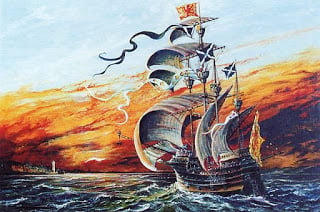
The Great Michael. A wonderful battleship. The most formidable for its day. Why is it that hardly anyone knows of this galleon? This splendid wooden giant of the sea is obscure. It was state of the art technology back in 1507 when plans were first laid and construction began. This was ordered by Scotland’s successful King James IV. Through honour of a treaty with France, Scotland would go to war. This campaign would see all of the upcoming nation's achievements taken. So many rapid gains lost in a devastating miscalculation. The wonderful ship would be among such losses.
This period of time is often overlooked by many casual history buffs. However, stumbling upon such snippets of information is what makes the offhand reading of such shadowy history a delight. Especially where this great ship is concerned. The construction of the Great Michael was an achievement of envious recognition. Especially from England. In this nation, the twenty-year-old King Henry VIII had come to power a couple of years prior. The young English king wanted a ship of equal worth or better. For he knew the Great Michael was a super league ship of the time. The ship was revolutionary and caused an arms race. All European Monarchs were jealous of the ship. It was no superpower that had built such a vessel. It was Scotland.
All of a sudden, the Great King of Scotland, James IV was a rising star who had been a steadfast and strong leader of his nation. Finally, after previous decades and constant effectiveness of rule, James IV's nation was beginning to show promise. The National influence was the notable development. The improvement and successful economic growth were pursued with shipbuilding to compliment the King's prospering Scotland.
The Scottish king had set a precedent in naval supremacy. The up and coming Stewarts of Scotland had invested wisely in their future. Under King James IV’s rule, the Scots had climbed to the pinnacle. For a brief moment in history, they touched the stars. Scotland would become a naval powerhouse. Their jewel in the crown would be the Great Michael. A ship to behold when launched in 1511. This magnificent galleon had twice the displacement of England’s The Mary Rose. The young and grand English King Henry VIII’s pride and joy. Suddenly, the ship was not good enough. Henry VIII wanted a ship to equal The Great Michael.
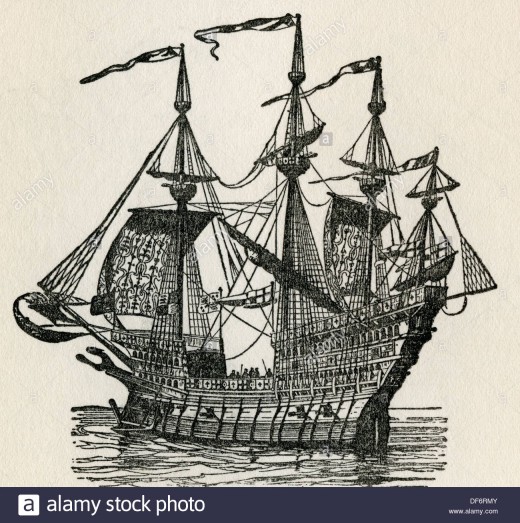
For the young English monarch, this was a circumstance that would not do. He brought in all of his shipbuilders and put them to the task of building a battleship to match. This would take three years from the date when the Great Michael was launched. Much would happen between the times of building the Henry Grace à Dieu nicknamed the Great Harry.
The Great Harry of England.
In this time England and Scotland were firm and old enemies. England’s inferior ship The Mary Rose was launched at the same time of 1511. In many ways, it might have been an arms race. The Great Harry was still a few years away from construction.
It is sad and strange how TheGreat Michael faded into obscurity in such a short space of time. She would be about longer than England's The Mary Rose. The English ship had over thirty-three years of service. The Mary Rose would fight in conflicts with France and Scotland. She may have faded into obscurity too, like The Great Michael.
However, a catastrophic accident made The Mary Rose iconic. The galleon capsized during the Battle of the Solent in 1545. Those last few dreadful moments of the ship’s life would immortalise her. By this point in time, the English king was old. King Henry VIII was watching from the shore when this event happened. It was a moment of dreadful disaster coupled with sensationalism. The King was watching with his entourage. The whole shocking event before their eyes. The disaster that would win huge merit in historical memory. Especially when it was salvaged from the seabed hundreds of years later and put into a museum. So much would be known of the Mary Rose and her life as a galleon in the Royal English Navy. This ship's life and service were magnified to history because of the disaster that befell her.
Perhaps such dreadful things are right to be remembered. However, I can’t help feeling that this great Scottish galleon The Great Michael does not get the recognition she rightly deserves. I think it is simply that her service and fate were not sensational enough. Only a few historians and ship enthusiasts know of her. Yet within the French Navy as The Great Nave of Scotland, thisgalleon must have seen service.
The Great Michael was sent by King James IV to ally with the French Navy in 1513. The War of the League of Cambrai was in full swing. France was at war with the Papal States and other European powers began to join sides to honour alliances and treaties. Scotland joined with France, Venice and the Duchy of Ferrara.
England joined with the Papal States, Spain, the Holy Roman Empire, the Duchy of Milan and the Swiss Mercenaries. Young King Henry VIII of England went to France and fought with the Holy Roman Empire. Scotland, in support of France, led an ill-fated invasion of England. With the English King absent, the country was under the regency control of Queen Catherine of Aragon.
The Great Michael had been hired by French King Louis XII along with two other Scottish galleons. The Margaret and the James. The battleships were very expensive to run and the loan to an old ally was a sure way of the bankrolling ships from another nation’s purse. The huge ship would never return to Scotland because King James IV was killed at the Battle of Flodden in England. Also, the cream of Scotland’s nobility fell at the furious confrontation. Though Scotland was on the winning side of the war, she was left bankrupt with many of her nobles and king dead.
Scotland’s financial situation had become desperate overnight. The late James IV left his kingdom in the hands of his baby son and wife, Queen Mary Tudor (Elder sister of English King Henry VIII.) She had to be regent with help of the remaining Scottish nobility while the infant king grew up. TheGreat Michael was sold to the French Navy in the following year of 1514 for a pittance of what the galleon was worth.
The Great Michael was renamed The Great Nave of Scotland and some say she was left in ports and hardly ever put to sea. I doubt this is true and would assume the ship would see service over the decades that would pass. There were rumours that TheGreat Nave of Scotland took part in the Battle of the Solent. This was thirty-one years after being sold to France. This is feasible, but there is no concrete proof that the ship was with the French fleet. She would still have been a formidable vessel thirty years later. I can’t see why such a galleon would not have been used in the French fleet. No one knows what became of her in later years. There are no records to date about TheGreat Michael's or The Great Nave of Scotland's fate.Scotland’s great galleon of the seas faded from history.
Royal Scots Navy
How could such a thing be?
The War of the League of Cambrai was a bittersweet victory for Scotland.The disastrous battle of Flodden took everything from them. They were on the winning side but lost everything. The King and much of the nation's gentry were gone. A victory that left a winning nation bankrupt.
Scotland's Huge Battleship.
The Galleon that Faded from History
The Great Michael. A ship worthy of any superpower's navy. This colossal battleship of the day belonged to King James IV of Scotland. His navy could boast the finest ship in the world during the year was 1511.
During the early period of Norman occupation, England was a very harsh place for the Anglo-Saxon peasantry to live. French speaking Norman society began to forcefully transform England. Ordinary laymen were always looking for ways to improve their circumstance under the new overlords.
Among the religious orders of Christianity, there came the Cistercian monks who wanted to move away from mainstream society and be self-sufficient alongside their devotion to God. This body of monks devoted themselves to the Worship of God and the prayer for other people outside the Cistercian order too. It was innovative and profitable for them. It would lead to other more widespread ways of a financial enterprise with a force of devoted helpers. Their trade was a place in heaven for all helpers who could work and follow the rules of devotion and worship. With this, there was also offered sanctuary, food, and order.
Rich men would leave lands to the Cistercians in order that the monks would pray to God for their well-being. In reality, one could say, these nobles were buying their way to Heaven through the monks - using the priests as spiritual solicitors. In the Middle Ages, this culture was real and adamantly believed.
In order to keep these inherited lands, the monks had to work them for profit, but as they spent so much time devoted to the worship of God; it was difficult to keep livestock in the fields, cultivate land, build and maintain their monasteries.
Therefore, the Cistercians came up with an idea to recruit laymen into the monastic order. They could not be ordained or accepted as true monks or priests because most were illiterate. They would just be a sub-culture of working monks who followed the Cistercian order's code of chastity and religious conduct.
These lay monks could never be ordained as true priests but would gain rights to Heaven and serve a devoted life of worship maintaining the monastery they were assigned to. As said before, the volunteers would be clothed, housed and well fed.
If a married man went into the order, his wife and children would be abandoned. There was no place in the Cistercian order for the family. These monasteries were able to produce food, clothes, and other valuable commodities on a vast scale. At markets all over England, they could undercut a lot of farmers trying to sell their produce because they could produce and transport it without the overhead costs.
Un-ordained lay priests
Eventually, the Cistercians had a vast army of unordained lay priests, who farmed, built and served the upper echelons of the Christian order - supplementary priests who worked without pay. They were given shelter (that they built,) Clothes(that they made,) and food (that they farmed,)
The Cistercians owned vast lands, built roads and used rivers to spread their trade. All this done by their army of lay priests. The Cistercian monasteries became like supermarkets of our day and age. Certain monasteries would become renowned for a particular type of wine or fabric. Maybe, becoming a brand name among some districts.
Their impact throughout England and all over Europe was colossal, but such influence was to be shattered by the great plague in 1347. In England alone; half the countries population was wiped out and those that were left became more valuable. Lay priests to work the land for nothing were suddenly harder to come by.
After a time they did reform but not as strong. All these monasteries, in England, would loose their grip outright. Two hundred years later Henry VIII brought in his reformation act and dismantled the monasteries and stripped them of power.