1,000 Harley Davidson enthusiasts gathered in Qian Dao Lake, Zhejiang, China to celebrate the 5th Harley Davidson National Rally, as part of the company’s 110-year anniversary. Harley Davidson motorbikes are considered by Chinese tax authorities to be luxury items, so they are taxed at extremely high rates – sometimes the tax alone is equivalent to the bike’s US price tag. Traffic and transportation authorities have also placed Harley's in the same category as electric bikes, horses and bicycles – they cannot be on highways and major avenues. So, in China, the chance for like-minded Harley enthusiasts to meet and celebrate their love of biking is never missed.
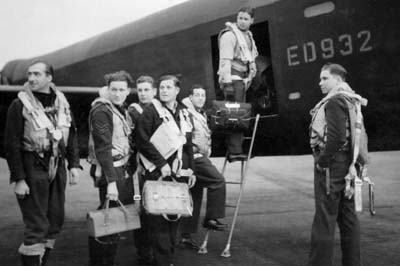
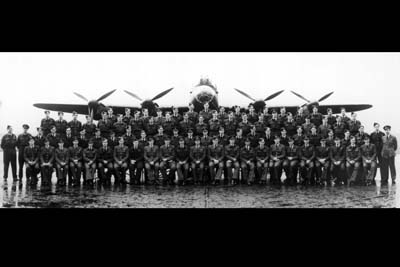
In May 1943 19 aircraft, crewed by 133 young men, took off on the daring and innovative Dambusters raid.
What is less well known is that the bouncing bombs dropped from those legendary Dambuster raids were tested in a series of secret operations on a Scottish loch.
The tests were carried out on Loch Striven, which is on the Glenstriven estate in Argyll, with locals being evacuated from the area so they would not know what was going on.
Loch Striven was also home to two dormant gas carrying ships, the Nestor and the Gastor, for 14 years. Two Harland and Wolff oil tankers were also laid up in the loch for almost 20 years, while an X-class submarine was lost in the water due to an engine leak in November 1942.
As the nation prepares to mark the 70th anniversary of the raid, a retired fighter pilot has revealed the true extent of the damage the mission caused to Nazi Germany.
Clive Rowley, a former commanding officer of the RAF's prestigious Battle of Britain Memorial Flight (BBMF) turned aviation historian and author, said the military and strategic significance of destroying three dams in the industrial heartland of Germany in 1943 has only just been realised.
The 133 men who went on the mission in 19 aircraft, 56 of whom did not return, were also incredibly courageous and skilful in carrying out the daring low flights, he said.
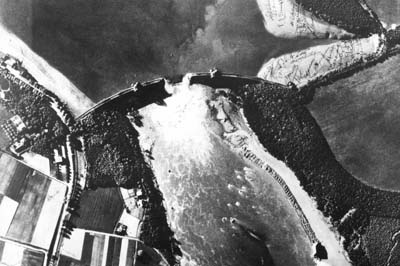
Operation Chastise, the attack on German dams immortalised by the 1955 film starring Michael Redgrave and Richard Todd, took place 70 years ago on May 16, 1943, during the Second World War.
The mission was launched from RAF Scampton, near Lincoln by 617 Squadron.
At the time it was hailed as an incredible success even with the loss of life, but for decades afterwards its effects were downplayed or even condemned as a waste of resources by a succession of historians.
Now, extensive research carried out by retired Squadron Leader Mr Rowley suggests that the loss of water caused by the dams' destruction had a far greater effect than many realised even at the time - from making firefighters powerless to put out the flames of British incendiary bombs to cutting vital German steel production due to a lack of water for cooling.
The cost of repairing the damage caused by 617 Squadron's raid ran to the equivalent of £5.9 billion in today's money and 7,000 workers who would otherwise have been building the Atlantic Wall to prevent the D-Day landings had to be called away to fix the ruined dams.
It was an economic disaster for the Third Reich that diverted significant resources away from Germany's war effect at a critical point during the conflict.
Four power stations were destroyed, 12 war production factories, about 100 other factories damaged, railway bridges were incapacitated, bridges knocked down, and 3,000 acres of farmland destroyed.
Coal production also dropped by some 20,000 tonnes in the month that followed and steel production by about 180,000 tonnes in the month that followed.
Mr Rowley said: "In that sense it was truly militarily important, strategically important, and I think that more modern research has uncovered that and hasn't been widely recognised until now."
Mr Rowley, who in addition to flying one of the Coningsby-based BBMF's Spitfires and commanding the unit also flew BAC Lightning jets, has published his findings in a new bookazine called Dambusters.
It combines his detailed research with previously unpublished pictures and original artwork to provide a full and unvarnished account of the raid - arguably the most daring mission in the RAF's history.
The timescale in which the raid came about - the Lancaster had only been in squadron service for 17 months, and there was only 56 days from the formation of the squadron to the bombings - was nothing short of amazing, Mr Rowley said.
He went on: "Then you were asking these men, 133 men went on the raid in 19 aircraft, to fly these enormous bombers with 102 foot wingspan at 100 ft, 60 feet on the attack run, in the dark.
"I've spent a lot of my life as a fighter pilot flying around at low level normally at 250 feet in fast jets, sometimes lower, often quite a bit faster than the Dambusters flew, but generally in daylight.
"I can state categorically that the courage, the skill, the tenacity to carry on doing what they were doing - and actually it would appear that they were enjoying the thrill of it -is nothing short of amazing.
"It was a combination of bravery, skill, ingenuity, science, technology, all came together in this one precision raid."
The Dambusters crew would have been fearful, he said, but appeared fearless in order to boost morale among their fellow airmen.
They are also sure to have enjoyed the thrill of low level flying, Mr Rowley added. "To them it was just a job and they just got on and did what they were asked to do and paid an enormous price for it.
"42% of the men that went on the raid did not come home, and they knew that was highly likely, and yet they volunteered for the new squadron, they volunteered for the mission. They wanted to make a difference.
"When it came to the actual getting in the aeroplane and doing it they tended to have a fatalistic attitude. From now on what will be will be.”
Remembering and commemorating the mission, especially with such heavy losses was vital Mr Rowley said, and even more so now to acknowledge the full extent of the effect on Nazi Germany.
He said: "It is important to recognise that it was worthwhile and that the results were worth their death, if anything ever is worth a man's death."
Here is an overview of how the mission came about and how it was executed.
The idea
The plan for the Dambusters raid originated early in the Second World War - some sources cite as early as 1940 - when aeronautical engineer Dr Barnes Wallis, proposing the use of a 10 ton bomb from an altitude of about 40,000 ft on German dams, was forced to re-think as no bomber aircraft was capable at the time of flying at that altitude with such a heavy payload.
He realised a much smaller explosive charge would suffice, if it could be exploded directly against the dam wall below the surface of the water, but the major German reservoir dams were protected by heavy torpedo nets to prevent such an attack.
With a team at Vickers, Wallis designed the 'bouncing bomb', a missile that would skip across the water, hit the dam and roll to the bottom.
It needed to be dropped at the right height, the right speed and the right distance so it would skim for a significant distance over the surface of the water in a series of bounces before reaching the dam wall.
Its residual spin would run the bomb down the side of the dam to its underwater base. Using a hydrostatic fuse, an accurate drop could bypass the dam's defences and enable the bomb to explode against the dam.
March, 1941
Wallis researches, writes and circulates a paper entitled "A Note on the Methods of Attacking the Axis Powers" among military and political circles. The outcome is the formation of the 'Aerial Attacks on Dams Committee' to take his suggestions further.
February 26, 1943
Wallis' idea was put forward to Bomber Command and after several conferences was accepted. While Wallis' team worked to perfect the 'Upkeep' bomb design, Bomber Command assigned the mission to 5 Group.
March, 1943
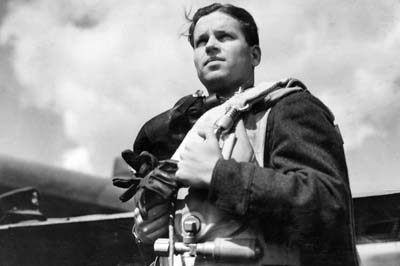
For the mission, named Operation Chastise, a new unit, 617 Squadron, was formed with 24-year-old Wing Commander Guy Gibson in command and based at RAF Scampton, just north-west of Lincoln.
Even Gibson, a veteran of over 170 bombing and night-fighter missions, did not know the reason behind the formation of this squadron. His task was to mould and train the crew members, volunteers all into a squadron capable of carrying out a difficult single raid.
He was soon to find out what his targets were to be, to divert attention away from the truth. A rumour was started that the aircraft were about to attack the Tirpitz battleship.
The new 617 squadron began training, which was to consist of flying and navigating at zero feet. They then switched to flying over water. This created its own problems for the pilots, who complained they could not judge height over water.
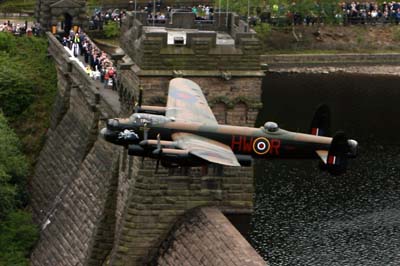
Gibson's men began test runs over reservoirs around England, including the Derwent Valley.
Many problems were encountered, and practice runs at Reculver Bay continued using the test Upkeep bombs. Finally everything came together and a date was set for the full moon on May 16/17.
Only on the eleventh hour did any of the crews find out what the real targets were. They were charged with flying across the English channel, to cross the Netherlands and Germany at zero feet and to drop a bomb on the Ruhr dams.
May 13, 1943
Following their final testing, the Upkeep bombs were delivered, with the goal of Gibson's men conducting the mission four days later.
May 16, 1943
A total of 19 aircraft set out at dark; nine were to attack the Mohne dam, then proceed to the Eder; five were to attack the Sorpe; and five constituted a 'flying reserve'.
Gibson's crews flew at around 100 feet to evade German radar. On the outbound flight Gibson's Formation 1, consisting of nine Lancasters, lost an aircraft en route to the Mohne when it was downed by high tension wires.
Gibson led the attack on the Mohne dam and successfully released his bomb. He was followed by Flight Lieutenant John Hopgood whose bomber was caught in the blast from its bomb and crashed.
To support his pilots, Gibson circled back to draw German flak while the others attacked. Following a successful run by Flight Lieutenant Harold Martin, Squadron Leader Henry Young was able to breach the dam.
With the Mohne Dam broken, Gibson led the flight to Eder where his three remaining aircraft negotiated tricky terrain to score hits on the dam. The dam was finally opened by Pilot Officer Leslie Knight.
While Formation 1 was achieving success, Formation 2 and its reinforcements continued to struggle.
Unlike Mohne and Eder, the Sorpe Dam was earthen rather than masonry. Due to increasing fog and as the dam was undefended, Flight Lieutenant Joseph McCarthy from Formation 2, was able to make 10 runs before releasing his bomb. Scoring a hit, the bomb only damaged the crest of the dam.
Two aircraft from Formation 3 attacked as well, but were unable to inflict substantial damage. The remaining two reserve aircraft were directed to secondary targets at Ennepe and Lister. While Ennepe was unsuccessfully attacked, Lister escaped unharmed as Pilot Officer Warner Ottley was downed en route. Two additional aircraft were lost during the return flight.
Aftermath
Operation Chastise cost 617 Squadron eight aircraft. A total of 53 airmen, who only had 11 weeks from go-ahead for the project to execution, were killed during the raid and three were made prisoners of war.
The successful attacks on the Mohne and Eder dams released 330 million tons of water into the western Ruhr, reducing water production by 75% and flooding large amounts of farmland.
In addition, over 1,600 were killed though many of these were forced labourers from occupied countries and Soviet prisoners of war.
While British planners were pleased with the results, they were not long lasting. By late June, German engineers had fully restored water production and hydroelectric power.
Though the military benefit was fleeting, the success of the raids provided a boost to British morale and aided Prime Minister Winston Churchill in negotiations with the United States and Soviet Union.
For his role in the mission, Gibson was awarded the Victoria Cross while the men of 617 Squadron received a combined five Distinguished Service Orders, ten Distinguished Flying Crosses and four bars, twelve Distinguished Flying Medals, and two Conspicuous Gallantry Medals.
The young men flying the daring Dambusters raid have gone down in history as some of the bravest and most elite airmen.
Their mission took place at a vital time in the war and not only caused a great deal of damage in Germany's industrial heartland, but also lifted morale at home.
The task at hand was almost inconceivable - to fly Lancaster bombers at just 60ft above the ground - incredibly low when compared to the 250ft aircraft must fly at nowadays - in the dark across northern Europe, and successfully deploy bombs on German dams.
Tragically, almost half of the crew members who went on the raid did not return.
Guy Gibson
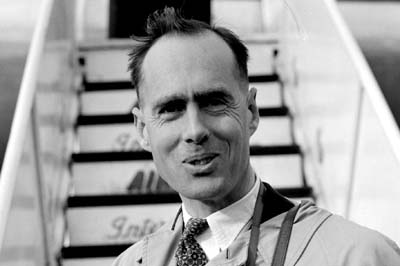
The name Guy Gibson, the 24-year-old Wing Commander who was placed in command of the crews who were taking part in the mission, has become synonymous with the Dambusters raid.
He was a veteran of over 170 bombing and night-fighter missions and immortalised by Richard Todd in the 1955 film The Dam Busters.
Following the Dams raid Gibson left the squadron but remained in the RAF.
After returning from a trip to America with Winston Churchill he found time to write a book entitled Enemy Coast Ahead, but this was no replacement for flying, and he is said to have continually harassed the Ministry to get back in the air, and eventually succeeded.
On the September 19, 1944 he flew out of Woodhall Spa on a bombing mission flying a Mosquito from 627 squadron.
Having completed the bombing raid Gibson went on to check anti-aircraft positions, but the mosquito tragically crashed and killed both Gibson and his navigator Squadron Leader JB Warwick. Gibson was just 26 when he died.
Leonard Cheshire
Group Captain Leonard Cheshire led RAF No 617 Squadron (or Dambusters) for eight months during the Second World War.
He became one of the youngest commanding officers and the most decorated bomber pilot of the war with the award of the Victoria Cross in 1944.
Cheshire had pioneered a new method of marking enemy targets, flying in at a very low level in the face of strong defences.
In four years of fighting against the bitterest opposition he maintained a standard of outstanding personal achievement, his successful operations being the result of careful planning, brilliant execution and supreme contempt for danger.
For example, on one occasion he flew his P-51 Mustang in slow figures of eight above a target obscured by low cloud, to act as a bomb-aiming mark for his squadron.
Cheshire was, in his day, both the youngest Group Captain in the service and, following his VC, the most decorated.
On his 101st mission, he was official British observer of the nuclear bombing of Nagasaki from The Great Artiste, an event which profoundly changed him.
On his return from the mission he left the RAF and went home to his house, Le Court in Hampshire.
He founded a hospice which grew into the charity Leonard Cheshire Disability and he became known for his work in conflict resolution. He was created Baron Cheshire in 1991 in recognition of his charitable work.
He died in 1992, at the age of 74.
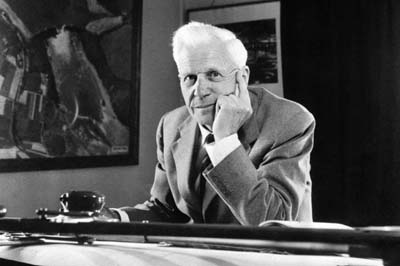
Described by his family as a man of peace and not war, the brilliant and often eccentric engineer Barnes Wallis became synonymous with designing the bomb that almost brought Germany to its knees during the Second World War.
His efforts brought extensive flooding and devastation to dams in the Ruhr but also aided then Prime Minister Winston Churchill in negotiations with the United States and Soviet Union.
His much-celebrated genius, for which he was later knighted, also came with some particular quirks; it is said he used to eat three spoonfuls of porridge and eight prunes for breakfast and always ate cold rice pudding when he got home.
He lived until the grand age of 92, having been born in Ripley, Derbyshire on September 26, 1887.
He was two years old when his parents, Charles Wallis, a doctor, and Edith Ashby, moved him and his three siblings to London.
Wallis was educated at Christ's Hospital in Horsham. He was a natural at maths, English and science, but was said to have been lacking in Latin studies.
By the end of his successful education he had decided that he wanted to be an engineer. Unable to afford university once he had finished school, he started an indentured apprenticeship at the Thames Engineering Works at Blackheath.
He worked on many projects but in 1908 transferred to JS Whites shipyard at Cowes working on Naval destroyers.
While there Wallis blossomed and was promoted to the design office.
In 1912 the young Hartley Blyth Pratt joined the firm from armament firm Vickers and he and Wallis quickly became great friends.
Wallis's work with boats had given him a sound grasp of fluid dynamics and when airship design again became fashionable Pratt was called back to Vickers.
It was only a few months before he called Wallis and arranged for him to join the massive organisation of Vickers as his assistant.
When the Second World War broke out, Wallis was Assistant Chief Designer at Vickers Armstrong Aviation section at Weybridge.
Here, independently of any Air Ministry requirement he spent time investigating how the energy sources of the axis powers (Germany and Italy) might be reduced or eliminated.
Specialist publications provided him with all the necessary background information on the German dams and he formed the opinion that knocking out the water reserves of the Ruhr would curtail steel production severely.
Wallis proceeded to experiment and explore the possibilities and limitations that might surround attacking German dams. What emerged was the 'bouncing bomb' and Dambusters raid.
After the war, he never stopped designing and inventing.
He carried on until he was forced to retire, at the age of 83, and even then did not cease. He is reported to have had ideas for swing-wing planes, such as the Swallow, hypersonic aircraft and other modifications and improvements for the air industry.
He also invented the non-misting, glassless mirror which is made out of unbreakable and non-flammable polyester.
Wallis received a knighthood for his work and service to his country in 1968.
He was also presented with a £10,000 government award which he gave to his old school and made an Honorary Fellow of the Royal Aeronautical Society.
Wallis married Molly Bloxam on St George's Day in 1925. He was 16 years older than her and they were step cousins.
They had four children, Elizabeth, Christopher, Mary and Barnes and also adopted Molly's sister's children when their parents died.
They spent most of their life living in Effingham. Wallis's children soon grew up and had 20 children of their own to create an extensive family.
Wallis died on October 30, 1979, aged 92.
Dambusters - published by Lincolnshire publisher Mortons Media Group, is available online and though WH Smith.
These all remind me of those little times when I could raid the radiogram and go through the records. It was great playing all the old 45s that my Mother and Father were always accumulating.
This one was in my Mum and Dad's forty five collection and when they were out, my sister and I would always play these. I used to think this was a smashing song and it gives me a nostalgic little buzz when ever I hear it.
I remember this one as a kid. It was in my Mum and Dad's record collection. I used to have a girlfriend who always used that title sentence as well. She often started by saying: "I'm telling you now..." and then it was followed by nagging or scolding about something.
It used to make me laugh, because I would think of Freddie and the Dreamers and start singing this song in response. She used to get more wound up.
During the final days of Boudicca, after her defeat by Suetonius
and his Roman Army, what could the Iceni warrior queen have possibly done? She
was not too far from the southern boarders of the Brigante where another Queen
ruled. This was the Queen known as Cartimandua and it is very probable that she
would not entertain helping Boudicca in anyway. Cartimandua had given another
rebel chieftain named Caractacus to the Romans when he sought sanctuary in the
Brigante.
It is believed that Boudicca escaped the battlefield after
the defeat of her rebellion and this theory must carry some weight because Rome
would have written of such a thing if her body was found among the slain.
If she went into hiding and poisoned herself she remains a
myth and for a writer of historical fiction one can milk such a grey area of ‘ifs’
and ‘maybes.’ How long did she remain before taking her poison?
Cartimandua’s dilemma
Surely Queen Cartimandua of Brigantes would have been very
concerned by the dreaded warrior queen’s success. As a Roman ally she must have
been praying to any Gods that they might hear her pleas. What of her divorced
and spurned husband Venutius? He had been driven from the Brigante because of
his intolerance towards her friendship with Rome. Surely he did not remain
inactive while Boudicca and her Iceni went on the rampage.
The Brigante are a bit of a grey area during Boudicca’s
rebellion. Queen Cartimandua was long established as Brigante sovereign by this
time and ruled for a further eight years after Boudicca’s demise.
If I could go back in time I would dearly love to interview
Cartimandua – more so than Boudicca. She must have had, or had access to; a strong
degree of political expertise for she seems to have kept a huge temperamental
power at bay to the south and a mischief making ex-husband away to the north. For well over twenty five years, she was able
to keep Rome at ease by collaborating and being a buffer between her divorced ex-husband,
in exile in Caledonia among the Picts. Did she really play one off against the
other - stroking and pleasing the wolf of Rome while scolding and beating the weasel
in Caledonia? If she did, all this must have broken down briefly during
Boudicca’s rebellion. For a short space of time in 61 AD, Cartimandua must have
been faced with a terrible dilemma. Boudicca looked as though she might win.
With Boudicca to the south and Venutius to the north,
Cartimandua must have become anxious because of her Roman friendship – a circumstance
that would have no merit among any Britons of the rebellion once Rome was
driven off of the Isle.
It is therefore feasible that she may have gone to her
southern boarders to stop her people from rallying to Boudicca’s cause. When
Boudicca did lose her final battle, Cartimandua may have enjoyed a brief time
of adulation from the Brigante commoners. Rome was not going to take revenge on
them.
Maybe Cartimandua was more substantial then history portrays
her. I can’t help feeling that this Brigante queen may have been more cunning
then Boudicca. She may have used Rome as much as Rome used her. Even under
civil strife – eight years latter – during the Year of the Four Emperors in 69
AD, Rome thought enough of Cartimandua to send help and bring her south when
the empire was consumed in civil war.
All we know is that Cartimandua was allowed to go into exile
in mainland Europe while Rome sorted out its civil strife, leaving the Brigante
under Venutius to simmer and await Rome’s more special attention in 71 AD. None
know what became of Cartimandua as she went into exile. She fades from history
and becomes virtually unknown.
I often wondered if Boudicca and Cartimandua may have met
between the days of the warrior queen’s defeat and her taking the poison elixir
that took her to the afterlife, from where she screams out at us with her story
of monumental failure.
But what of Cartimandua – the durable sovereign that reigned
for more than twenty five years and even escaped to tell the tale after her
eventual demise. I would really love to have had a chat with Queen Cartimandua
of the Brigantes.
I was stunned by the news that Margaret Thatcher had died this morning on 8th April 2013. She was 87 years of age, but I still find it hard to believe. I thought she would live forever - then again, perhaps she will. There are people in the UK that passionately disagreed with her and those who are devoted to the icon that she often seems to be.
All I would like to say is this: Margaret Thatcher was a tough leader who had to make some hard decisions. She didn't get things wrong all the time despite what many might think. I often found fault with her as a youngster in my twenties. Perhaps I was a trendy lefty at times, but as I've got older and now own my own house (courtesy of Thatcherism) I find myself reflecting on more realistic issues. Real issues that she had the strength to confront on more then one occasion.
Well Prime Minister Thatcher - I'll always respect you and admit - you were right on many things that I thought were wrong at the time. Especially with trade unions, but today I humbly admit you may have been right on certain issues concerning ballots and holding the nation to ransom. In the long run you got it right on that issue. You were a very determined and fine Prime Minister and a very great Briton.
I will not say Rest in Peace, because I can't think of such a determined person resting. I will say 'Echo in Eternity' for good and positive things that Margerat Thatcher is and will always be. For champions of trying and believing; she will live forever.
Just when Moyra Melons' husband thought his wife could not pull anything else out of the bag, concerning the Wow! factor on great ear rings; his darling wife did it again.
As one can see, when the poor fellow came home to be asked what he thought of this tantalising pair. They, of course, are rather fetching - don't you think?
He was speechless for a moment. He then came over in a hot flush and began to groan and gurgle incoherently.
"Is that all you can say?" asked Moyra raising an enquiring eye-brow.
Suddenly, he could contain himself no more and let out a 'Devil may care' caveman roar and slammed the door - denying our imagination's what he thought of such a lovely pair of ear rings. Only a fly on the wall would get to know really. So you'll all have to make do with British understatement on what he thought of such superb ear rings. He seems to have decided they were rather nice.
If ever you get the chance and want to brighten up your day and blow away all those cobwebs; please read any of these little gems by P.G. Wodehouse. Eggs, Beans and Crumpets or Young Men in Spats. They are all short stories of high society young fellows in Britain during the 1920s and 1930s. The characters are wonderful and each little story is a joy of male stupidity portrayed in the most humorous of ways. You'll hold your sides to stop them splitting with laughter. They are absolutely marvellous.
There are a pair of things in this world that Moyra Melons likes to know capture a chaps attention. She finds all sorts of ways to show them off and we readers have enjoyed a fine range of different methods in which Moyra displays her lovely attributes. She is often unsure if fellows will notice them, but to her joy; we always do.
I'm sure that right now they are the first pair of divine things that you, the reader of this blog, perceive. Yes I know your dazzled, so let us cast aside my British understatement and celebrate Moyra Melons divine ways of displaying many a perfect pair of delightful ear rings.
Sometimes, I was work in a cemetery in Essex, England, UK. It is a strange place at times and one comes across all sorts of things. You learn about the robins who are extremely territorial and quite vicious little things. The graves are lined headstones with privet hedge borders running around the entire perimeter and each robin has its own section of shrub and area of ground beyond which it defends against intruders. When we dig graves; the robins like to come close and search the dirt mound for worms. It is all part of nature and we become quite accustomed to the robins, as they do us grave diggers.
The graves tell all sorts of stories and some are rather tragic, while others talk of long life, asking questions of what the deceased might have seen during their lives. Sometimes, I come across a grave that causes one to wonder. The headstone above is of an American person called Ronald Black. I could not help but take a photo because I wondered, how he came to be buried in this quite little graveyard in Hockley, Essex, England. Perhaps he was a Brit who was in the US Air Force?
Ronald Black was born on 1st of April 1947 and died on his 54th birthday - 1st April 2001. He was in the US Air Force and fought in the Vietnam War. This would not be unusual for an American born in the late 1940s of course, but where he lived after, and died at such a young age afterwards, in England does seem strange to me. He might have old Vietnam Vet friends in the USA who remember him from the late sixties while serving in his nation's air force during the Vietnam War. So, in a way, this blog is here for any Vietnam veteran American who might have known Ronald Black while in the US Air Force. He rests in peace in Hockley, Essex, England, UK
I am sure that long term, Britain within the EU can work. However, pro-Euro people can't say it will be alright in the long run, even though it will. British people will not buy this at the moment. Perhaps David Cameron's attempt to kick the can down the road until 2017 might be such an attempt. I can understand this. In the meantime pro-EU needs better teeth then to start fear mongering about the UK being in a disastrous situation if it left the EU. It would not. The UK would probably be better off staying in the EU if it changed. It must change and pro-Euro Brits must emphasis this more. If the EU will not tolerate this, then I would reluctantly agree that the UK must leave.
David Cameron has bought some time, perhaps, but among pro-EU people, there is no one of substance who can offer plausible arguments against mass migration and to change laws we are powerless to impose as a sovereign nation because there is an EU directive prohibiting us. No matter how much the EU, rants that we can't have powers back; they must yield to this. If they refuse, we leave. We cannot possibly stay in under such restricting circumstances. I am in total agreement with David Cameron on this, we need to see what we can change and if we can do this first. We must also be careful that little mince morsels of consent from the EU are not bigged up to appear like we have got power back. There must be clear honesty from our own politicians.
It is very encouraging for fellow Brits to voice sensible arguments for the UK to try and help reform the EU from within. Richard Branson's blog was very well worded and simple in its good reasons for staying in the heart of the EU and fighting to change the present way Brussels and Strasbourg work. We (Brits) should not run away from this. All euro sceptics correctly point out a great many things wrong with the EU, but using a UK exit policy of the EU is very wrong indeed.
Everything that Richard Branson states in his blog are sound reasons why. Mainly the future - the EU will sort this mess out and the coming years will look very promising if we stick together. I hope and pray that more substantial people of influence will make their voices heard for the United Kingdom to become more deeply involved with the EU.
I believe that other fellow Europeans in all other states would want to change and restructure some of the EU's bureaucracy, but the other states don't use running away from the problem as a solution. It is no good voicing correct points about a faulty apparatus and then running away from it. Get in there (all the people of substance from across Europe) and change it - make it more effective and seen to be so. We need more high profile Brits like Richard Branson delivering short, sweet sharp to the point messages like the blog he wrote below.
Branson warns against British EU exit
A British exit from the European Union would be 'very bad' for British business and for the economy, said Virgin boss Sir Richard Branson.
Writing in his New Year blog, the founder of the Virgin Group said global business relies on large trading agreements created by regions, not by countries.
"The EU is the UK's biggest trading partner. Its combined market dwarfs the US and China. For that reason alone, the UK must stay in to help rebuild the EU," he wrote.
"Obviously Europe has had difficulties, but so has America and most other countries in the world. The tough medicine that countries like Ireland, Spain and Portugal have given themselves will result in Europe being in far better shape than America in a few years' time."
Looking ahead, he said Britain must be at the centre to help the EU forge new partnerships with the emerging markets of Latin America and Asia - and to renew and extend our relationships with the US and Canada.
"Those powerful economies want to trade with a market of 500 million people and not the UK's 60 million," said Branson.
"The UK must not become a peripheral country on the edge of Europe. This will be damaging to long-term prospects of British business and also in the country's ability to attract new international companies to set up and employ people in the country."
He urged the British government to get together with Germany to restructure Europe. "We are in a position where if we take a positive approach, Germany and ourselves could be the key two countries to the restructure of Europe.
"Unless we do all this, Britain could be an island completely adrift in 20 years."